Should my kid go to Saturday Thai school? An honest look
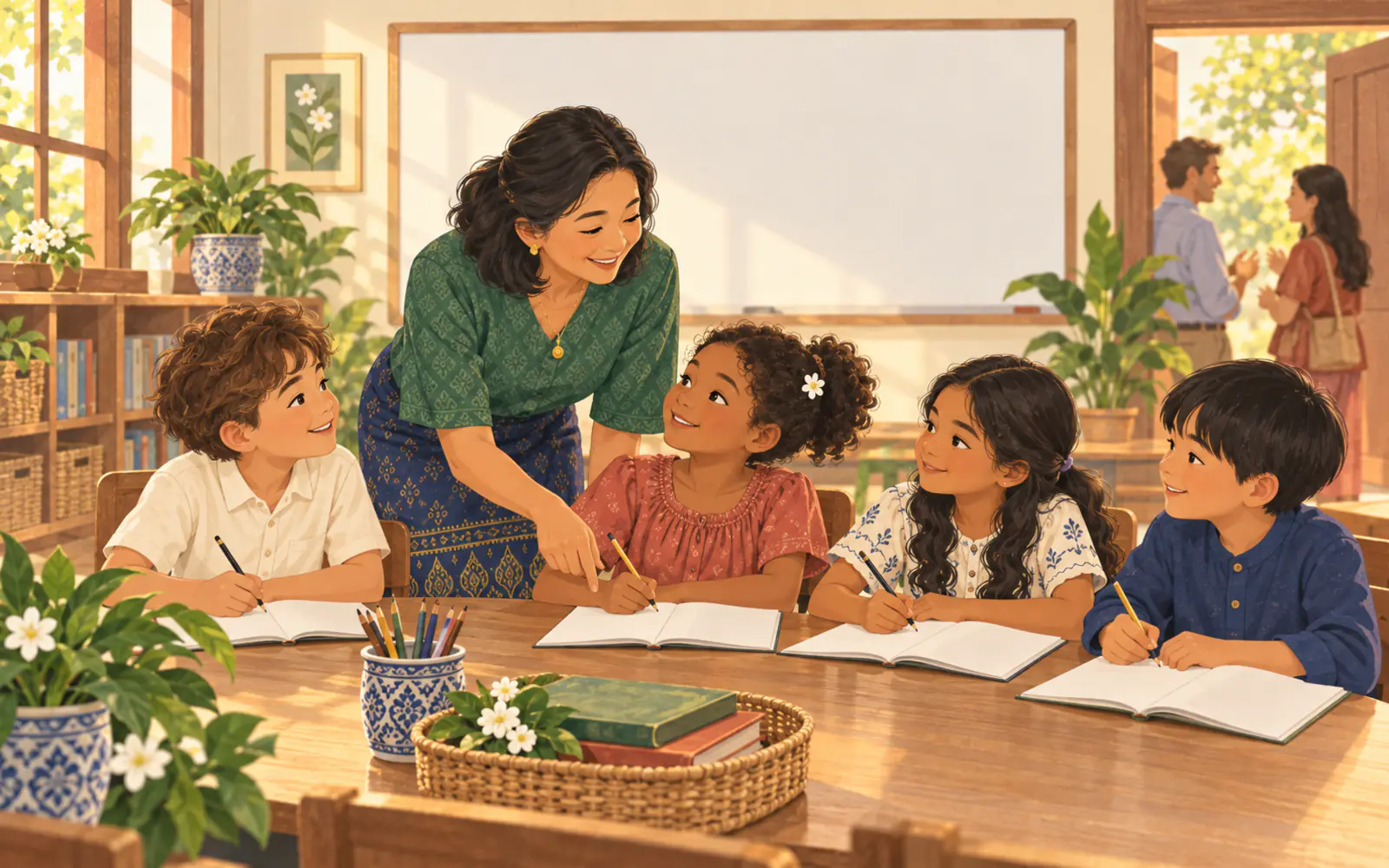
Your kid has a Thai parent, a Thai grandmother on a screen every Sunday, and a calendar full of football, birthday parties and the right to sleep in. Someone mentions the Thai class at the temple on weekend mornings. Is it worth it?
There’s no single right answer. Here is what Thai school actually gives, what it costs, and what to do if it isn’t for your family. Nothing here is a judgement: families with a full-time Thai school habit and families with none both raise kids who feel Thai.
What does Saturday Thai school actually give kids?
“Saturday school” is the common name, but many classes run on Sundays or weekday evenings. Many are held at Thai temples and taught by volunteers. What they offer usually comes down to four things:
- Reading and writing. Spoken Thai can come from home. Reading and writing Thai script usually need teaching.
- Structure. A fixed time each week when Thai is the point, not an afterthought.
- Other kids like them. For many children this is the real gift: a room full of kids who also have a yai in Thailand and a Thai nickname nobody at school can say.
- Culture with the language. Songs, festivals, the wai, Songkran and Loy Krathong, often in the same building where the community celebrates them.
What it can’t do on its own is make a child fluent. A study of teachers at Lithuanian Saturday schools abroad (a similar setting, not Thai data) notes that some parents speak little or none of the language at home and still expect a half-day weekly school to make their child fluent. A weekly class can’t carry that alone.
What does it cost the family?
Be honest with yourselves about the real price, because a plan you can keep beats a plan you abandon in March.
| Cost | What it looks like |
|---|---|
| Time | A weekend morning every week, plus travel. For families far from a temple or city, that can be most of the day |
| Money | Usually modest. For example, Wat Buddhanusorn in Fremont, California, lists youth classes at $100 for September to June |
| Goodwill | Kids miss sports, parties and lie-ins. Some will resent it, at least for a while |
| Volunteers | Many classes depend on volunteer teachers and parents. Wat Mongkoltepmunee’s Sunday school in Pennsylvania, for example, is supported by volunteer teachers and Thai parents |
The Lithuanian study above also describes teachers giving up their free time and Saturdays, and sometimes having to find their own materials and rooms. If your local Thai class runs on goodwill, offering a hand is often the best way to keep it alive.
My kid understands Thai but answers in English. Is that normal?
Yes, and it’s one of the most common patterns in bilingual families. Researchers call it the receptive–expressive gap: understanding runs ahead of speaking. A study that followed 52 Spanish–English bilingual children from age 4.5 to 10 found that by 10, their speaking was almost always English-dominant while their understanding was most often balanced between the two languages. The authors link this to the “understands but doesn’t speak” pattern many adults with a heritage language know well.
So a child who answers in English isn’t rejecting Thai. They’re replying in the language that’s easiest to reach for. What tends to help:
- Keep speaking Thai to them. Understanding is the foundation everything else is built on.
- Make replying small. One short, real phrase they can say back beats a long correction.
- Create moments where Thai is the only shared language, like a video call with a grandparent who doesn’t speak English.
- Praise the reply, not the grammar. Being corrected mid-sentence can make anyone go quiet, children included.
What else keeps Thai alive at home?
Thai school works best on top of Thai at home, not instead of it. A large questionnaire study of 1,899 bilingual families with a child aged 6 to 10 (De Houwer, 2007) found that whether children spoke the minority language depended a lot on how it was used at home. Children had a high chance of speaking it when both parents used the minority language at home and at most one parent also spoke the majority language. The well-known “one parent, one language” approach was neither necessary nor enough on its own.
In a family where only one parent speaks Thai, that’s not a verdict. It’s a reason to add Thai moments wherever you can:
- Video calls with yai (ยาย, yaai) or other family in Thailand, with a few set phrases the kids can always say.
- Thai at the edges of the day: mealtimes, bath, bedtime, praise.
- Thai songs, cartoons and shows, ideally ones a parent watched as a kid.
- Trips to Thailand, where Thai is suddenly useful and the cousins are real.
Here’s a line a parent can start using tonight:
เก่งมากลูก
geng maak luuk
Well done, sweetie.
Literally: “clever very child”
เก่ง is the praise word for kids: good at it, clever. Stretch it out, เก่งมากกก, and it gets warmer.
Draft: waiting for a native speaker’s review.
Short replies you can use with your kids tonight, in Reply Thai, coming soon to iPhone.
Reply Thai, our iPhone app, has a “Thai with my kids” moment built around lines like this one, for mealtime, bath, bedtime and songs. For more phrases from family life, see Say it in Thai.
How do I find a Thai school near me?
| Where to look | What to know |
|---|---|
| Thai temples | Many run weekend Thai classes for children. Ask at the temple office or look at its website and community board. If you’re new to temple visits, our temple etiquette guide covers what to wear and do |
| Your Thai embassy or consulate | Embassies often know the local Thai schools and teachers. In 2022 the Royal Thai Embassy in Stockholm reported more than 70 teachers from across Europe at the annual meeting of the Federation of Thai Language and Culture Teachers in Europe (FTTE) |
| School in Sweden (modersmål) | A pupil with a guardian whose mother tongue is Thai is offered mother-tongue tuition if Thai is the child’s daily language at home and they have basic knowledge of it. The provider only has to arrange it if at least five eligible pupils want it and a suitable teacher is available. An Association of Thai Teachers in Sweden had about 38 teachers at its August 2026 meeting |
| Thai associations and parents’ groups | Often the quickest way to hear which classes are actually running this term |
While you’re sorting Thai things for your child: if they don’t have a Thai birth certificate yet, our Thai passport guide walks through the paper trail.
Is it too late, and what if they quit?
It isn’t too late. A child who understands Thai at 10, 14 or 17 has a head start that many adult learners would love, and understanding is the part that’s hardest to build from scratch. Starting later is still starting.
And if your kid quits Thai school, it isn’t wasted. The letters they learned, the songs, the friends and the hours of listening all stay somewhere. Nobody failed: not the child, and not you. The door stays open, and the most important Thai lessons still happen at the dinner table and on that Sunday call with yai.
More stories about growing up between two homes are in Belong. For the word your kid will hear for themselves in Thailand, read what “luk khrueng” means.
Thai words on this page are a draft until a native speaker has reviewed them.
Questions people ask
Is Saturday Thai school worth it?
For many families, yes, if it fits your life. It gives structure, reading and writing, and friends who are also Thai by family. It isn't a substitute for Thai at home: research on bilingual families finds that how much the minority language is used at home matters a lot. If the weekly trip makes everyone miserable, home habits and video calls with family may do more.
My kid understands Thai but answers in English. What do I do?
It's very common. A study that followed 52 bilingual children from 4.5 to 10 years found their speaking became mostly English-dominant while their understanding stayed balanced. Keep speaking Thai, make replying easy with short everyday phrases, and create moments where Thai is the only shared language, like calls with grandparents.
Is it too late for my child to learn Thai?
No. A child who understands Thai already has a big head start, even if they rarely speak it, because understanding is the part that's hardest to build from scratch. Starting at 8, 12 or 16 is still a start, and short everyday replies are a good place to begin.
Can my child get Thai lessons at school in Sweden?
Possibly. Under the Swedish Education Act, a pupil with a guardian whose mother tongue is Thai is offered mother-tongue tuition if Thai is the child's daily language at home and the child has basic knowledge of it. The school provider only has to arrange it if at least five eligible pupils want it and a suitable teacher is available. Ask your municipality.
How do I find a Thai school near me?
Start with the Thai temples near you, which often run weekend classes, then ask your Thai embassy or consulate and local Thai associations. In Sweden, also ask your child's school about modersmål tuition in Thai. Parents' groups on social media are a good way to hear what's running this term.
Sources
All links read on .
- Giguere and Hoff (2022), Bilingual development in the receptive and expressive domains: they differ. International Journal of Bilingual Education and Bilingualism (PubMed Central)
- De Houwer (2007), Parental language input patterns and children's bilingual use. Applied Psycholinguistics 28(3)
- Jakaitė-Bulbukienė and Matulionytė (2024), Motivation of Lithuanian Saturday school heritage language teachers. Journal of Eurasian Studies 15(2)
- Skollag (2010:800), 10 kap. 7 § on mother-tongue tuition (Swedish; consolidated to SFS 2026:1636)
- Skolförordning (2011:185), 5 kap. 10 § on the five-pupil threshold (Swedish; consolidated to SFS 2026:1721)
- Royal Thai Embassy, Stockholm: 11th annual meeting of the Federation of Thai Language and Culture Teachers in Europe (FTTE), 28 May 2022
- ScandAsia: Thai teachers in Sweden strengthen community network (24 August 2026)
- Thai Ministry of Foreign Affairs: mobile consular services at Wat Mongkoltepmunee, Pennsylvania (7–8 June 2025)
- Wat Buddhanusorn, Fremont, California: Thai language class
In the glossary: ยาย (yai)
How we write and check our guidesReport a mistake
Letters from the in-between
One email when there’s something worth reading: new guides, stories from other luk khrueng, and a phrase for your next family call. No spam, ever.