Thai temple etiquette with family: what to wear, how to krab
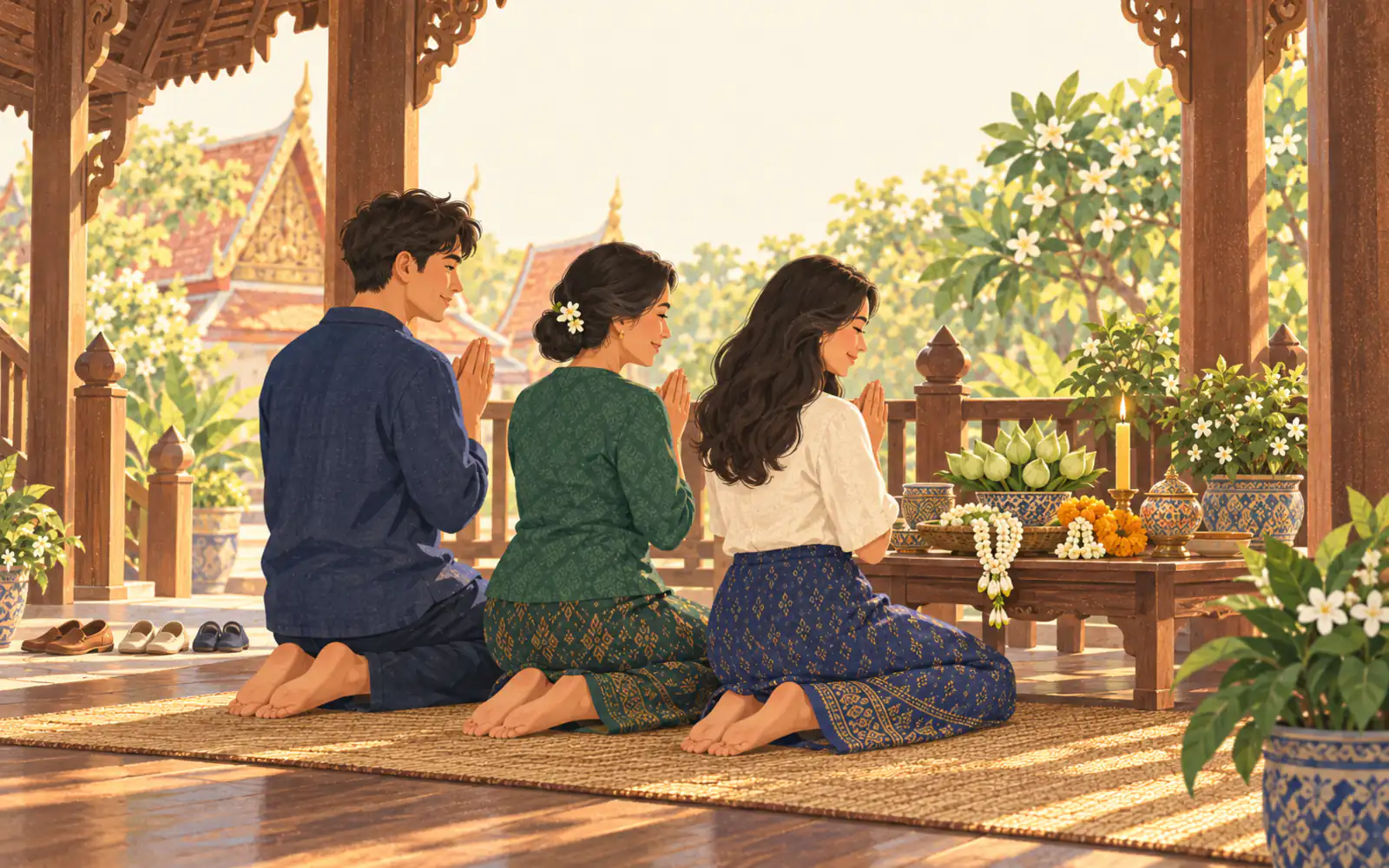
Maybe it’s a merit-making morning, a family birthday or a funeral. Yai hands you a lotus, everyone kneels, and nobody explains. That’s how most Thai kids learn it too: by copying. This guide gives you the how and the why, so the next visit feels a little more like yours.
Why does every temple and family do it a bit differently?
Thai Buddhist customs differ between temples, regions and families. Travel guides disagree on details too, like how high to hold your hands. So read everything here as “commonly”, not as law.
The one rule that always works: if your family or the temple does something differently, follow them. Watching quietly and doing what the others do is always respectful.
What should I wear to a Thai temple?
Modest clothes say you came to show respect, like everyone else there.
- Cover your shoulders and knees. A top with sleeves, and long trousers or a long skirt.
- Skip see-through, very tight or very short clothes. Wat Pho in Bangkok asks visitors to dress neatly and modestly, and says women may not wear shorts above the knee.
- Shoes you can slip off. You’ll take them off a lot.
- A light scarf in your bag, in case you need to cover your shoulders.
On วันพระ (wan phra), the Buddhist holy days that follow the moon, people keeping extra precepts often dress simply in white. That’s not a rule for visitors, just good to know when you see it. The “big” holy days fall on the full and new moon, the “small” ones on the half-moon days. The biggest temple days of the year, Makha Bucha, Visakha Bucha and Asahna Bucha, are public holidays: the dates are in our Thai public holidays 2027 table.
What do I need to know about shoes, feet and heads?
In Thai culture the feet are the lowest part of the body and the head is the highest. Most temple manners follow from that.
| Do | Don’t |
|---|---|
| Take your shoes off before any hall with a Buddha image, and leave them by the steps | Wear shoes inside, even “just for a second” |
| Step over the raised threshold of the doorway; many families teach kids this | Stand on the threshold |
| Sit with your feet tucked away, pointing behind you | Point your feet, especially the soles, at a Buddha image, a monk or an elder |
| Lower your body a little when you pass a seated monk or elder | Climb on or sit on a Buddha image, even for a photo |
| Ask before you photograph a monk up close, and look for “no photos” signs | Touch anyone’s head, or reach over people’s heads |
Out in the temple grounds you can usually keep your shoes on. On the floor, people sit in พับเพียบ (phap phiap): legs folded to one side, feet pointing back. If your legs go numb, quietly switch sides. Everyone does. If your knees or back won’t do it, sit at the back or on a chair if there is one. Feet tucked away matters more than a perfect pose.
How do you krab (กราบ) three times, and why three?
To krab (กราบ, graap in our spelling; you’ll also see krap or kraap) is the full bow: you kneel and touch your forehead to the floor between your hands. Five points touch the floor: two knees, two hands and the forehead.
Why three? The bows are for the Three Gems: the Buddha, the Dhamma (his teaching) and the Sangha (the monks who practise it). Bhikkhu Khantipalo’s Lay Buddhist Practice gives the same order: first to the Buddha, then the Dhamma, then the Sangha.
You’ll see it when people arrive and leave, when they greet monks, and at merit-making at home. Bow to the Buddha image first, then to the monks. Men and women do it slightly differently: men usually kneel with toes tucked under, women with the tops of their feet flat on the floor. Elders get a different, smaller bow: once, sitting in พับเพียบ.
The steps are in How to krab, step by step at the end of this guide. If you can’t kneel, a respectful wai with your head bowed is fine.
How do you wai a monk?
The wai (ไหว้, wai) is palms together and a small bow. The higher the hands, the more respect. For the Buddha and monks, Thairath’s guide puts the hands highest: thumbs between your eyebrows, fingertips at your forehead, head bowed. The levels for parents, elders and people your own age are in our guide to the Thai wai.
Talking to monks. Speak calmly and politely. Thai has special words for talking to and about monks, but you don’t need them to be respectful. Your family will usually do the talking, and a wai says the rest.
Offering things. Use both hands. If the monk sits on the floor, kneel to offer; if he’s on a chair, stand. The raised platform where monks sit is for them, so don’t sit on it.
What’s the rule for women and monks, and why?
A monk’s discipline says he must not touch a woman. In Thailand, things aren’t handed straight from a woman’s hand to a monk’s. It’s about his practice, not a judgement about women.
- Don’t touch a monk or his robe, or hand him things directly.
- To offer something, the monk lays down a cloth (ผ้ารับประเคน, phaa rap pra-khen). Wait until he holds its edge, then place the item on the cloth.
- At the morning alms round, women place food in the bowl without touching the monk or his robe.
- Some temples, Wat Pho among them, ask women not to step up onto the monks’ platform at all.
- A few temples, especially in the north, have areas women don’t enter. The silver ordination hall at Wat Sri Suphan in Chiang Mai is one, from an old Lanna custom. There will be a sign. Follow it, and ask if you’re unsure.
What happens when your family makes merit (ทำบุญ)?
ทำบุญ (tham bun) means making merit: food for the monks, a donation, a good deed. Families often do it on birthdays, holy days and for relatives who have died, so a temple visit with family often includes it.
What to bring. Nothing is needed to walk in. Many temples sell small sets of incense, a candle and flowers near the hall, so arriving empty-handed is fine. If you want to give money, it usually goes in the donation box rather than into a monk’s hand.
What the offerings mean, the morning alms round, pouring water for a relative and what to say: our guide to tak bat and merit making with your Thai family covers all of it. (At a funeral, our guide to Thai funeral etiquette covers the rest of that day.)
If a brother or cousin is ordaining, our guide to ordination in a Thai family covers the day, the nak and what guests do.
What if I get it wrong?
You’ll be fine. Wrong leg, late bow, forgot a step: everyone around you has seen it a hundred times, often from their own kids. What people notice is that you came, that you were calm, and that you tried. Sitting at the back and just watching is also respectful.
If you want one Thai line for the temple, this is the one you’ll use most:
ต้องถอดรองเท้าไหม
torng thort rorng thao mai
ต้องถอดรองเท้าไหมครับ
torng thort rorng thao mai khrap
ต้องถอดรองเท้าไหมคะ
torng thort rorng thao mai kha
Do I need to take my shoes off?
Literally: “must take-off shoes (question)”
Ask before any building at the wat. The answer is almost always yes.
Draft: waiting for a native speaker’s review.
Practise the temple moments in Reply Thai, coming soon to iPhone.
Reply Thai, our iPhone app, has an “At the temple” guide with these cards and the opening chant นะโม ตัสสะ (na-moh tat-sa) to listen to, plus short lessons for the big family days around it. For more words like วันพระ and ทำบุญ, see the glossary, or browse more phrases in Say it in Thai. More family life, explained from the inside, is in Understand.
Thai words on this page are a draft until a native speaker has reviewed them.
How to krab (กราบ), step by step
- Kneel. Kneel and sit back on your heels, back straight, hands resting on your thighs.
- Palms together at your chest. Bring your palms together in front of your chest, fingertips pointing up.
- Hands to your forehead. Raise your joined hands and bow your head a little, so your thumbs rest between your eyebrows.
- Bow to the floor. Lower your hands to the floor, palms flat and a little apart, and bow until your forehead touches the floor between them.
- Three times in all. Come back up with your hands at your forehead and bow down again, three times in all: for the Buddha, the Dhamma and the Sangha.
- Finish. After the third bow, sit up, bring your joined hands to your forehead once more, then rest them. If you can't kneel, a respectful wai with your head bowed is fine.
Questions people ask
What should I wear to a Thai temple?
Clothes that cover your shoulders and knees: a top with sleeves and long trousers or a long skirt. Skip see-through, very tight or very short clothes. Wat Pho in Bangkok asks visitors to dress modestly and says women may not wear shorts above the knee. A light scarf in your bag helps.
Why do Thais bow three times?
The three bows are for the Three Gems: the Buddha, the Dhamma (his teaching) and the Sangha (the community of monks who practise it). Bhikkhu Khantipalo's Lay Buddhist Practice describes the same order: first to the Buddha, then the Dhamma, then the Sangha.
Can women touch monks?
No. A monk's discipline says he must not touch a woman, so women don't touch a monk or his robe or hand things straight to him. To offer something, a woman places it on a cloth the monk holds out (ผ้ารับประเคน). It is about the monk's practice, not a judgement about women.
What do you bring when making merit?
Nothing is required to walk in. Families often bring flowers, incense and a candle for the Buddha, food for the monks if they are offering a morning meal, and a little money for the donation box or an envelope on a tray. Many temples sell small flower and incense sets near the hall.
Do I have to take my shoes off everywhere in a temple?
No. Take them off before you go into a hall or building with a Buddha image, and leave them by the steps. Out in the temple grounds you can usually keep them on. Socks are fine.
Is it okay to just watch if I don't know what to do?
Yes. Sitting quietly at the back with your hands together, or copying what your family does a beat later, is respectful. Customs differ between temples, regions and families, and nobody expects a first-timer to know every step.
Sources
All links read on .
- Wat Pho (Wat Phra Chetuphon), Bangkok: planning your visit (Thai)
- Thailand Foundation: Feet low, head high, a guide to Thai etiquette (16 February 2024)
- Thairath: the meaning of the wai and the krap, level by level (Thai)
- TruePlookpanya: Buddhist etiquette (Thai)
- Royal Thai Army Chaplain Division: preparing a merit-making ceremony (Thai)
- Bhikkhu Khantipalo, Lay Buddhist Practice (Buddhist Publication Society)
- Suan Sunandha Rajabhat University Library: big and small wan phra (Thai)
- Bangkok Biz News: Wat Sri Suphan, Chiang Mai, and the Lanna custom (Thai)
- ThaiPod101: visiting a temple in Thailand (31 July 2026)
- ScandAsia: Thai temple etiquette (7 April 2021)
In the glossary: ทำบุญ (tham bun), ตักบาตร (tak baat), วันพระ (wan phra)
How we write and check our guidesReport a mistake
Letters from the in-between
One email when there’s something worth reading: new guides, stories from other luk khrueng, and a phrase for your next family call. No spam, ever.