Chinese New Year Thailand 2027: Thai-Chinese family guide
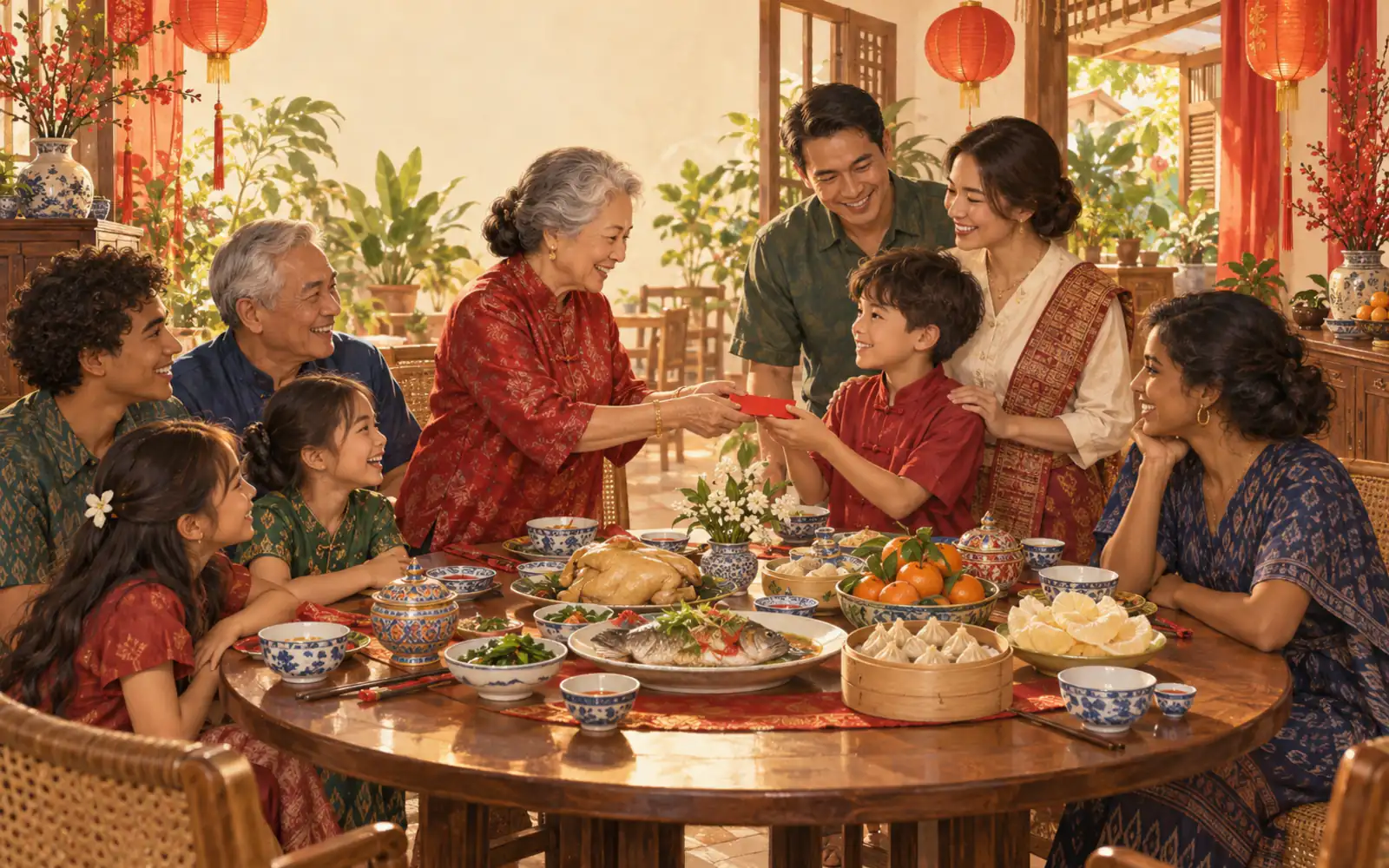
You married into a family, or were born into one, and every February the house suddenly fills with oranges, roast duck and relatives you only see once a year. Welcome to Chinese New Year. If nobody ever explained it to you, this is the explainer you were too polite to ask for.
When is Chinese New Year 2027?
Saturday 6 February 2027. ตรุษจีน (trut jiin), Chinese New Year, follows the lunar calendar, so it moves every year (RTHK).
The new year is the year of the goat, sometimes translated sheep: a Fire Goat year running from 6 February 2027 to 25 January 2028 (Wikipedia). Thailand’s own calendar calls 2027 a goat year too, but traditionally changes animals at Songkran in April. Our Thai public holidays 2027 page explains the Thai year animal and has every 2027 date in one table.
Is Chinese New Year a public holiday in Thailand?
Not nationwide. It isn’t on the Bank of Thailand’s list of 18 holidays for 2027. Banks in five southern provinces (Narathiwat, Pattani, Yala, Satun and Songkhla) get Chinese New Year off, but only when it doesn’t land on a weekend or another holiday (Bank of Thailand). In 2027 it’s a Saturday, so nobody gets an extra day.
That doesn’t make it small. For families who keep it, it’s one of the biggest gatherings of the year, holiday or not.
Why do so many Thai families celebrate it?
Because so many Thai families have Chinese roots. Wikipedia puts the Thai Chinese at roughly 9.3 to 10 million people, about 13 per cent of the country, and notes that most of them simply identify as Thai (Wikipedia). Most families that arrived before the 1950s took Thai surnames, which is why a Thai name on a passport tells you nothing about a Chinese great-grandmother.
The Teochew connection. The biggest group by far is Teochew, from the Chaoshan area of southern China, with Hakka, Hainanese, Cantonese and Hokkien families too (Wikipedia). You can hear it in the family words. In many Thai-Chinese homes, especially Teochew ones, grandma may be อาม่า (aa-maa) and grandpa อากง (aa-gong), not the Thai yaai/yaa and taa/puu (Wiktionary). If you’re unsure what to call whom on the day, our guide to Thai family words covers the Thai side. Copying what your cousins say is always safe.
So if you’re luk khrueng and your Thai side never mentioned China, it’s still worth asking. The answer might be “of course we’re Chinese”, said as if everybody knew.
What do Thai-Chinese families do over the three days?
Thai media describe the festival as three days, and families do them in their own way, so take this as the common shape (Thairath):
- Shopping day. Two days before New Year. Families buy and cook for the offerings: meats such as pork, duck and chicken, the dishes the ancestors liked, and fruit in sets of three, five, seven or nine kinds. Incense, candles and gold paper and paper money get ready too.
- Offering day. The day before New Year, and the big family gathering. In the daytime the family makes offerings to the ancestors, a way of showing gratitude and remembering them. At night comes an offering to the god of wealth, for luck and prosperity in the year ahead.
- New Year’s Day. You visit the elders to ask for their blessings, then go out and enjoy yourself. Bright clothes are popular, especially red, for luck.
On New Year’s Day itself, some families avoid things that might “sweep away” the luck or start the year badly: no cleaning the house, no washing clothes, no arguing, no crying, no swearing, and no lending or borrowing money (Thairath). If you’re a guest, the easy rule is: don’t offer to clean or tidy until someone says it’s fine.
Some families also visit relatives with oranges. Thairath describes bringing four oranges to the most senior elder, who gives oranges back in return (Thairath). Families vary, so watch what the others do first.
How do red envelopes (ang pao) work?
Elders give, younger people receive. อั่งเปา (ang-pao) are red envelopes of money that the older generation gives to the younger ones for good luck (Thairath). As the receiver, your job is easy: wish the giver well, take the envelope politely and say thank you.
ขอบคุณ
khorp khun
ขอบคุณครับ
khorp khun khrap
ขอบคุณค่ะ
khorp khun kha
Thank you.
Add the kin word and it’s personal: ขอบคุณค่ะย่า, ขอบคุณครับย่า. With elders, keep ครับ/ค่ะ.
Draft: waiting for a native speaker’s review.
Once you’re a working adult, your family may expect you to start giving to the younger ones. There’s no single rule, and no official amount. Ask a parent or a cousin quietly before the day; it’s a very normal question. If you want the wider etiquette of giving money in an envelope, our page on money envelopes at Thai weddings covers the Thai side of it.
What should I say to the elders?
Families with Chinese roots often use a Chinese-dialect New Year greeting before taking an ang pao, wishing the elders luck and prosperity (Thairath). Ask your family to teach you their version. Every family says it a little differently, and being taught it is half the fun.
In Thai, a warm wish for good health always lands well with a grandparent:
ขอให้ยายสุขภาพแข็งแรงนะ
khor hai yaai suk-kha-phaap khaeng raeng na
ขอให้ยายสุขภาพแข็งแรงนะครับ
khor hai yaai suk-kha-phaap khaeng raeng na khrap
ขอให้ยายสุขภาพแข็งแรงนะคะ
khor hai yaai suk-kha-phaap khaeng raeng na kha
I wish you good health, Yai.
Literally: “ask that grandma health strong na”
Swap ยาย for ตา, ย่า or ปู่. Good health is the wish elders love most.
Draft: waiting for a native speaker’s review.
Swap yaai for the name your family uses. For more ways to bless the elders, and how to receive a blessing back, see our Thai New Year wishes for family.
Can I join if my family visits a shrine?
Yes, quietly. If your family visits a Chinese shrine or temple over the holiday, follow the family, dress modestly, and don’t touch offerings that aren’t yours. Most of our Thai temple etiquette guide applies, and when in doubt, ask the person next to you what to do next.
What happens in Yaowarat, Bangkok’s Chinatown?
Yaowarat Road becomes the city’s party. In 2026 the road was lit with lanterns and arches from Odeon Circle to Chaloem Buri Intersection every evening from 6 pm to 11 pm, through 1 March (National News Bureau of Thailand). In 2025 Princess Maha Chakri Sirindhorn opened the Yaowarat Chinese New Year Festival at the Commemorative Archway (Chaipattana Foundation). The 2027 programme hasn’t been announced yet, so check closer to February.
Expect crowds, food stalls and red everywhere. It’s a good outing on New Year’s Day, once the elders are visited and the envelopes are safely in your bag.
Practise before the big day
You don’t need to know every custom. Turning up, wishing the elders well and saying thank you for the envelope is already doing it right.
In Reply Thai, Chinese New Year sits in the Big family days moment, with a short culture card on ตรุษจีน and the red envelopes, so the thank-you is ready before you walk in.
Reply Thai for iPhoneComing soonThai words on this page are a draft until a native speaker has reviewed them.
Questions people ask
When is Chinese New Year 2027?
Saturday 6 February 2027. It follows the lunar calendar, so the date moves from year to year.
Is Chinese New Year a public holiday in Thailand?
Not nationwide. The Bank of Thailand gives it as an extra bank holiday only for branches in Narathiwat, Pattani, Yala, Satun and Songkhla, and only when it doesn't fall on a weekend or another holiday. In 2027 it falls on a Saturday, so there's no extra day.
Do Thai people celebrate Lunar New Year?
Many do. It isn’t a national public holiday, but many Thai families have Chinese roots and keep Chinese New Year, which is Lunar New Year: offerings to the gods and ancestors the day before, then visiting elders in red. In 2027 it falls on Saturday 6 February.
What do Thai-Chinese families do at Chinese New Year?
Families commonly shop and prepare the food first, then gather on the day before New Year to make offerings to the ancestors in the daytime and to the god of wealth at night. On New Year's Day they visit elders to ask for blessings, often dressed in bright colours, especially red.
Who gives red envelopes (ang pao) in Thailand?
Elders give red envelopes, อั่งเปา (ang-pao), to younger family members for good luck. If you receive one, wish the giver well and thank them. If you're an adult who earns, ask your family whether they expect you to start giving to the younger ones too.
What is the 2027 Chinese zodiac animal?
The year that starts on 6 February 2027 is the year of the goat (also translated sheep), a Fire Goat year. Thailand's own calendar also calls 2027 a goat year, but traditionally switches animals at Songkran in April.
Sources
All links read on .
- RTHK: Hong Kong's 2027 general holidays (Lunar New Year on Saturday 6 February 2027; 15 May 2026)
- Bank of Thailand notification 37/2569: financial institution holidays for 2027 (English translation, announced 17 August 2026)
- Thairath: Chinese New Year 2567, what the offering day means and what to do (Thai, 8 January 2024)
- Wikipedia: Thai Chinese (background, dialect groups)
- Wikipedia: Goat (zodiac) (the Fire Goat year from 6 February 2027)
- Wiktionary: อาม่า, grandmother, used among people of Teochew descent
- National News Bureau of Thailand: Yaowarat lights up for the Thailand–China New Year celebration (13 February 2026)
- Chaipattana Foundation: Princess Maha Chakri Sirindhorn opens the Yaowarat Chinese New Year Festival 2025 (29 January 2025)
How we write and check our guidesReport a mistake
Letters from the in-between
One email when there’s something worth reading: new guides, stories from other luk khrueng, and a phrase for your next family call. No spam, ever.