Why does my Thai sound like my mum? Polite vs casual Thai
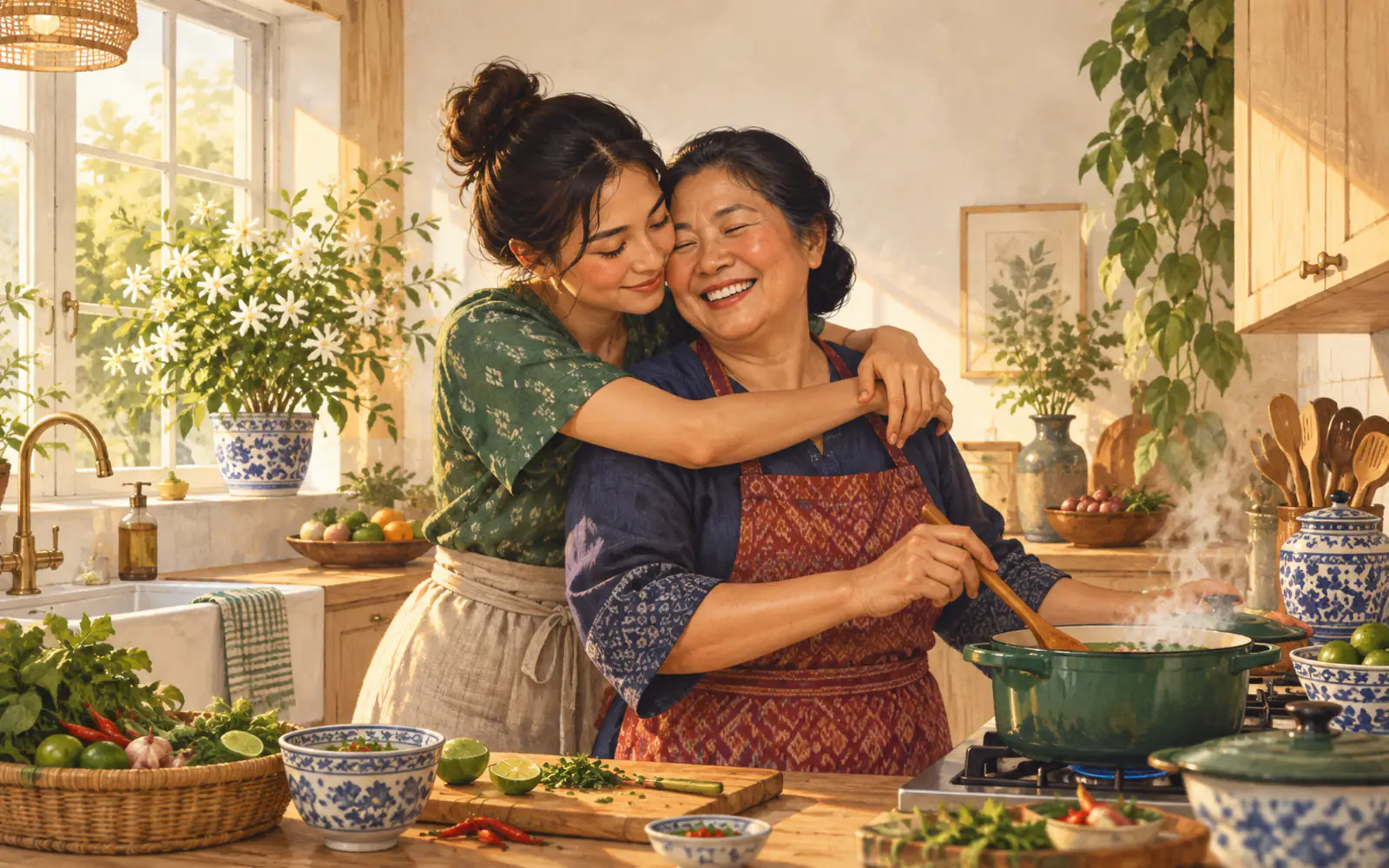
Someone at a party says your Thai is so polite. Your cousin’s friends laugh, kindly, when you add ครับ to “see you later”. A Thai friend your age answers you like you’re their teacher. If any of that sounds familiar, nothing is wrong with your Thai. It just has your mum’s manners.
Why does heritage Thai sound like the person who taught it?
Thai chooses words for “I” and “you” by who is speaking to whom. Wikipedia’s summary of Thai grammar puts it simply: pronouns “are selected according to the gender and relative status of speaker and audience”. A 2022 survey of 100 Thai university students found that the listener’s age was the strongest factor in which pronoun people chose, ahead of how close they were, and the listener’s gender. The authors tie that to how much Thai culture values seniority.
Now think about who you spoke Thai to growing up. Your mum, aunties, Yai, the monk at the temple, a family friend you called ป้า. Nearly all of them were older than you. So you learned the Thai for talking up: ครับ/ค่ะ at the end of every sentence, ผม or หนู for “I”, family words for “you”. Thai people have a nice name for that kind of Thai: พูดเพราะ (phuut phrao), “speaking beautifully”. (It’s also how our founder ended up calling a boss “auntie”.) If you want the endings themselves explained, here’s what ka and khrap mean.
This isn’t only a Thai thing. A 2007 UCLA piece on heritage speakers describes their language as “home-based” and notes they often need to learn other registers later. In many heritage languages, home is where the casual register lives. In Thai families it’s often the polite one, because home is where the elders are.
Is it a problem that my Thai is polite?
No. Polite Thai is never wrong, and with anyone older it’s exactly right. It’s the Thai that makes Yai’s friends smile and gets you an extra helping.
The only catch is distance. Between friends of the same age, a ครับ or ค่ะ on every single line can sound like you’re keeping them at arm’s length, or it just sounds cute. That’s why your Thai can feel great at a family lunch and stiff at a bar with people your age. You don’t need to lose the polite version. You add a second one.
Polite vs casual Thai: what actually changes?
Four small switches do most of the work. This table shows the common Bangkok-style pattern. Regions and families differ, so treat it as a map, not rules.
| With elders (talking up) | With friends your age (talking sideways) | Watch out | |
|---|---|---|---|
| Endings | ครับ khrap (men), ค่ะ kha (women), on most sentences | Fewer of them. Softer endings instead: นะ na, จ้า jaa, อ่ะ a | A bare sentence with no ending at all can sound curt. นะ works with everyone. |
| “I” | ผม phom (men), หนู nuu (girls and young women to elders) | เรา rao, or your own nickname | หนู to a friend sounds like a little girl talking to her aunt. |
| “You” | Family words (พี่, ป้า, ยาย) | Their nickname. Once you’re close: แก gae, นาย naai | แก never goes up the ladder, even though Yai may call you that. |
| Questions | ไหม mai | ป่ะ pa (“going?”, “want some?”) | ป่ะ to an elder sounds cheeky. |
The safest single change is in the second row. Using เรา or your nickname for “I” with people your age is friendly, gender-neutral and never rude. Endings work the same way. Here’s the everyday thank-you between friends, softer than the polite ขอบคุณครับ/ค่ะ:
ขอบใจนะ
khorp jai na
Thanks.
Literally: “thank-heart (softener)”
ขอบใจ is thanks for friends and anyone younger. Up the family ladder it’s always ขอบคุณ. ขอบคุณนะ is a warm in-between that fits anyone.
Draft: waiting for a native speaker’s review.
Do Thai friends say khrap and kha?
Sometimes, but not on every line. Once people are friends, ครับ/ค่ะ tend to drop away or turn into playful chat spellings like คับ, ค้าบ or ค่า, which read as cute, not formal.
Keep them:
- with anyone older, even by a year or two (they’re your พี่)
- with strangers, staff, a friend’s parents, and your boss
- in the first few minutes with people your age you’ve just met
- for a real apology or a big thank-you, even with friends
Drop them when the other person drops theirs with you. Mirroring is the whole trick. And if you slip and add a ครับ anyway, laughing it off with เอ้ย ติดครับอีกแล้ว (oei, tit khrap iik laew, “oops, slipped in a khrap again”) turns it into a shared joke.
What about กู and มึง?
You’ll hear them from cousins, in films and in group chats. กู (guu, “I”) and มึง (mueng, “you”) are very old words. A famous Sukhothai inscription opens with พ่อกู, “my father”. Today Wikipedia’s pronoun table lists them as “impolite/vulgar”, and that’s how they land with almost everyone.
Between very close friends, though, they can mean “we’re tight”. So if a friend uses them with you, they’re telling you you’re close. You never have to say them back. เรา keeps you right beside them, with no risk of saying the wrong thing to the wrong person. Understanding them is enough. For the rest of what your cousins say, from 555 onwards, see our Thai slang dictionary.
Is it normal to understand Thai but not speak it?
Completely. Researchers describe heritage speakers on a range: some mainly understand, some speak fluently, most are somewhere in between. Being able to follow a whole family argument and then freeze when it’s your turn is one of the most common versions there is.
It also doesn’t make you less connected. A 2022 study of heritage bilinguals found that cultural identification with the heritage language was predicted by how well people understood it. Your listening is real Thai, and it’s what speaking gets built on. We wrote more about that in what “luk khrueng” means.
How do you practise sounding your age without faking it?
You don’t need slang to sound natural. You need to say something, then adjust.
- Say something, even if it’s polite. A polite reply beats a silent one every time.
- Mirror. Use the “I”, the “you” and the endings they use with you. เรา back to เรา, นะ back to นะ.
- Ask. พูดกันเองได้ป่ะ (phuut gan eng dai pa), “Can we just talk casually?” Asking is polite in itself, and most people say yes with a laugh.
- React like a friend. Small reactions carry a lot of warmth:
จริงดิ
jing di
No way! / Seriously?!
Literally: “true (go on)”
Said with rising surprise, จริงดิ means “no way!”. Said flat, it means “of course it’s true”. จริงป่ะ (jing pa) is the same surprise as a question.
Draft: waiting for a native speaker’s review.
This is exactly what the Thai with friends your age moment in Reply Thai is for: the casual Thai your cousins use with each other, practised as replies, so the switch is ready before the next family trip. If you want to go further, an opt-in “Real talk” section explains กู/มึง with clear rules on who, when, and when never.
Reply Thai for iPhoneComing soonWant more phrases to start with? Try Say it in Thai, or read why everyone you just met is called Bank or Ploy: Thai nicknames, explained.
Thai words on this page are a draft until a native speaker has reviewed them. How people talk casually varies by region, age and friend group.
Questions people ask
Why does my Thai sound so formal?
Because of who you learned it from. Thai picks words like “I” and “you” by who you’re talking to, and a 2022 study of Thai university students found the listener’s age matters most. If you mostly spoke Thai to parents, aunties and Yai, you learned the polite, talking-up version. That’s a real skill, not a mistake.
Do Thai friends say khrap and kha to each other?
Sometimes, but not on every line. Between friends of the same age, ครับ and ค่ะ often drop away or get swapped for softer endings like นะ (na). They stay with anyone older, with strangers, in the first minutes with someone new, and in a serious apology or thank-you. When in doubt, mirror the other person.
What’s the difference between phom, chan and rao?
ผม (phom) is the common male “I”, polite and a little formal among friends. ฉัน (chan) is a common “I” mostly used by women. เรา (rao) means “we”, and casually “I”, and it works for anyone with friends. If you’re unsure, เรา or your own nickname is a safe way to say “I” to people your age.
I understand Thai but can’t speak it. Is that normal?
Very. Researchers describe heritage speakers on a range, from people who mainly understand to people who are fully fluent, and understanding more than you can say is a common pattern. Listening is the foundation speaking is built on, so you’re not starting from zero.
Is กู/มึง rude?
Usually, yes. กู (guu, “I”) and มึง (mueng, “you”) are listed as impolite or vulgar. Between very close friends they can signal “we’re tight”, and you’ll hear them in films and among cousins. You never have to use them. เรา keeps you right beside your friends without the risk.
Sources
All links read on .
- Wikipedia: Thai language (polite particles, pronouns and registers)
- Serdar, L. and Bussabakkaew, T. (2022). First- and second-person pronoun use: a case study of Mae Fah Luang University students (in Thai). Journal of Humanities and Social Sciences, Thonburi Rajabhat University 5(3), 8–21
- UCLA International Institute: “Unforeign Language” (4 September 2007), on heritage speakers and registers
- Wikipedia: Heritage language (receptive and productive skills, with cited research)
- Hayakawa, Chung-Fat-Yim and Marian (2022). Predictors of language proficiency and cultural identification in heritage bilinguals. Frontiers in Communication 7
In the glossary: พี่ (phii), ป้า (paa)
How we write and check our guidesReport a mistake
Letters from the in-between
One email when there’s something worth reading: new guides, stories from other luk khrueng, and a phrase for your next family call. No spam, ever.