Ka and khrap in Thai: what they mean and who says which
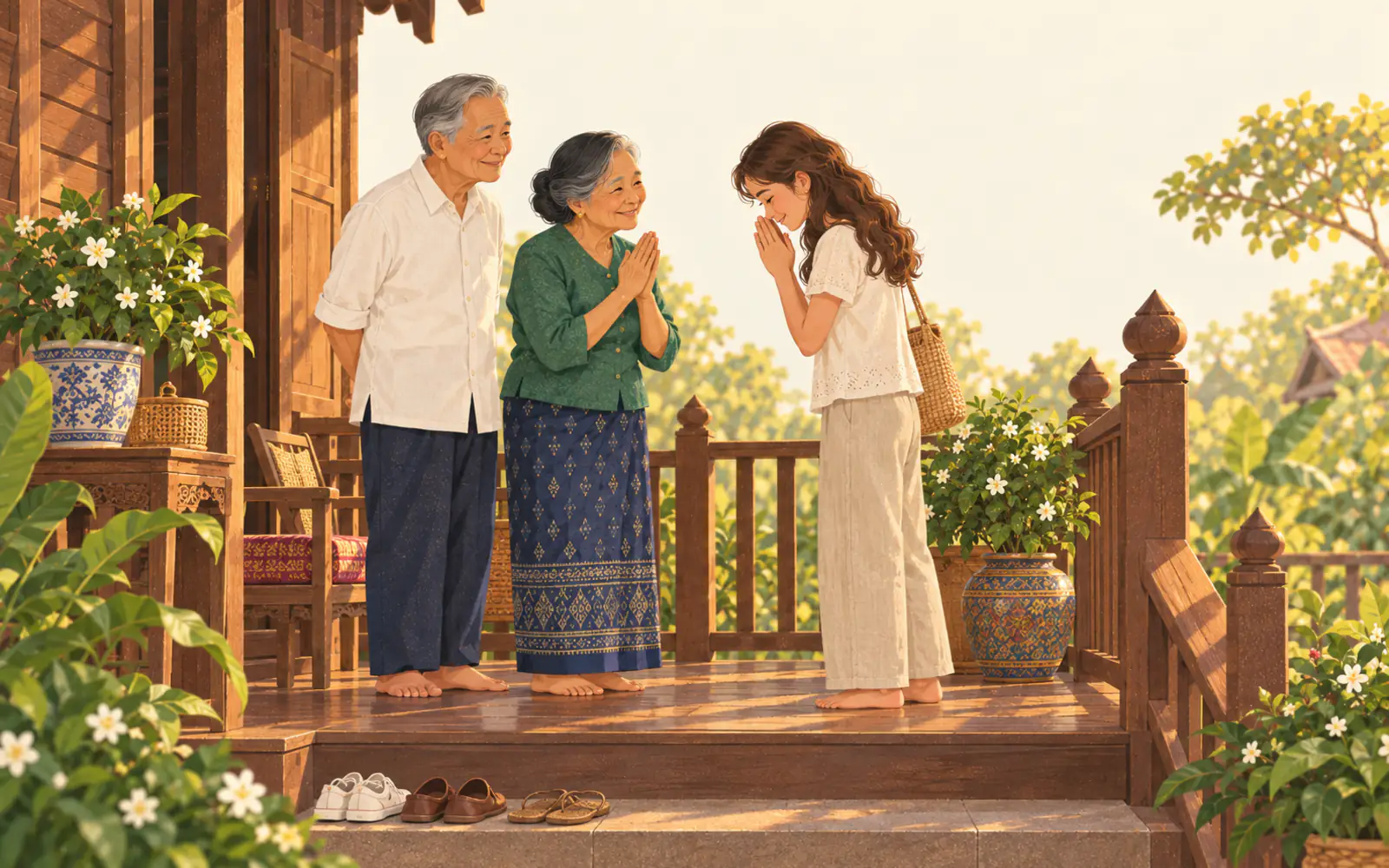
It’s the first Thai you ever noticed. Mum on the phone with Yai, saying something that ended in kha, kha, kha. Your uncle answering every sentence with a short khrap. Two tiny words that seem to mean nothing and somehow do all the work.
They’re worth getting right, and they’re easy. Here’s what they mean, who says which, and when your family will expect them.
What does ka mean in Thai?
ค่ะ (kha) is a polite ending that women and girls put at the end of a sentence. It has no meaning you can translate word for word. What it adds is tone: respect, softness, a sense that you’re speaking nicely.
In questions and requests, it changes. Wikipedia’s summary of Thai grammar puts it simply: used in a question or a request, the falling-tone ค่ะ becomes the high-tone คะ. Both are romanized kha, so the difference is easy to miss on the page and easy to hear in a voice. Here’s the question form in a real family line:
ยายสบายดีไหม
yaai sa-baai dii mai
ยายสบายดีไหมครับ
yaai sa-baai dii mai khrap
ยายสบายดีไหมคะ
yaai sa-baai dii mai kha
How are you, Yai?
Literally: “grandma well good (question)”
ยาย stands in for “you”. End the question with ครับ (men) or คะ (women).
Draft: waiting for a native speaker’s review.
Switch the card to the female version and you’ll see ยายสบายดีไหมคะ: a question, so it ends in คะ. Answer her “I’m fine” and you’re back to the statement form, ค่ะ.
What does khrap mean?
ครับ (khrap) is the same idea for men and boys. Unlike the women’s pair, it doesn’t change between statements and questions: ครับ works everywhere.
Its literal meaning has mostly worn away. Wiktionary traces it to an older phrase meaning roughly “I am willing to receive (your request)”, which tells you something about where politeness in Thai comes from: a little bow, built into the grammar. Wiktionary also notes that the affirming sense of ค่ะ was once used by noblemen and is now often used by women. Language moves.
Here’s the most common place you’ll meet both:
สวัสดีครับ
sa-wat-dii khrap
สวัสดีครับ
sa-wat-dii khrap
สวัสดีค่ะ
sa-wat-dii kha
Hello. (polite, to an elder)
Literally: “hello (polite ending)”
With elders and people you’ve just met, the ครับ/ค่ะ and a wai carry the respect.
Draft: waiting for a native speaker’s review.
Who says which? It’s about the speaker, not the listener
This is the part people most often get backwards. The ending matches who is speaking, not who you’re talking to. A woman says ค่ะ to her grandfather, her boss and the man at the noodle stall. A man says ครับ to his mum, his sister and Yai.
| Who’s speaking | Statements, thanks, “yes” | Questions and requests | Softer, friendlier |
|---|---|---|---|
| A man | ครับ khrap | ครับ khrap | นะครับ |
| A woman | ค่ะ kha (falling tone) | คะ kha (high tone) | นะคะ |
| Anyone, with friends your age | often nothing | often nothing | นะ na on its own |
นะ (na) is a different kind of particle. It softens rather than raises, a bit like “…okay?” or a smile in the voice. It sits happily in front of the polite ending:
อะไรนะ
a-rai na
อะไรนะครับ
a-rai na khrap
อะไรนะคะ
a-rai na kha
Sorry, what was that?
Literally: “what, (soft)”
นะ turns a sharp “what?” into a gentle “sorry?”. Here it’s นะครับ for men, นะคะ for women.
Draft: waiting for a native speaker’s review.
Without นะ, “what?” can sound sharp. With it, and with the polite ending after, it becomes a gentle “sorry, what was that?”, which is exactly what you want when Yai says something too fast.
What do they add to a sentence?
Three things, mostly.
- Politeness. ขอบคุณ (khorp khun) is “thank you”. ขอบคุณครับ or ขอบคุณค่ะ is “thank you”, said properly to someone who matters.
- Softness. A bare sentence can sound clipped. The ending rounds it off.
- A whole answer on its own. Wiktionary lists both words as expressing affirmation or assent. Said alone, ครับ or ค่ะ means a polite “yes”, “I see” or “I’m listening”. Keep saying it while an auntie tells a long story and you’re doing your part of the conversation.
ขอบคุณ
khorp khun
ขอบคุณครับ
khorp khun khrap
ขอบคุณค่ะ
khorp khun kha
Thank you.
Add the kin word and it’s personal: ขอบคุณค่ะย่า, ขอบคุณครับย่า. With elders, keep ครับ/ค่ะ.
Draft: waiting for a native speaker’s review.
Do you use khrap and ka with family?
With elders, yes. Yai, Ta, aunties, uncles, your parents’ friends and anyone a few years older than you will expect the polite ending, and they notice it warmly when they hear it. If you’re not sure what to call each of them, see Thai family words: what to call whom.
With cousins and friends your age it’s different. The ending often drops away, and the same warmth comes from tone and slang instead:
ว่าไง
waa ngai
Hey, what’s up? (casual)
Literally: “say how”
Same warmth, no particle. For cousins and friends your age, not for elders.
Draft: waiting for a native speaker’s review.
Notice the note on that card: same warmth, no particle. Say it to Yai, though, and it lands as a bit cheeky. That shift between talking up and talking sideways is a whole topic of its own; we wrote about it in why your Thai might sound like your mum’s.
Is it rude to leave it off?
Usually it’s not rude, just plainer. A 2017 Chulalongkorn University study of interpreted cooking classes found that listeners didn’t treat missing polite endings as impolite. That was one setting, not a family dinner, so don’t stretch it too far. With elders, in a real apology and in a heartfelt thank-you, the ending is still the kind thing to add.
But if you forget it halfway through a call with Yai, nothing breaks. She hears a grandchild trying to talk to her, and that’s what counts. Add it next time, and it will start arriving on its own.
Why is it spelled ka, kha, kah, krub and khrap?
Because there’s no single way to write Thai in English letters. The Royal Institute system writes khrap and kha; Wiktionary also lists the learner-style kráp. Add guesses from people typing what they hear and you get krap, krub, ka and kah. They’re all the same two words. This site uses khrap and kha.
There’s also a real reason khrap often sounds like “khap”. A Payap University study of Standard Thai accents notes that in clusters where the second sound is r or l, the r or l is often simplified away in casual speech. ครับ starts with exactly that kind of cluster, so in everyday talk many people say something closer to khap. In chats you’ll even see it spelled that way, คับ or ค้าบ, and the women’s ending stretched into ค่า. Those read as friendly and casual, not formal.
You may also hear a lighter, warmer ending such as จ้า (jaa), which Thai speakers use in less formal talk with friends or with someone younger, so you’ll often hear it from Yai or an auntie answering you. It’s an affectionate cousin of ครับ and ค่ะ, not a replacement you need to learn first.
What about gender identity?
The two endings are tied to gender, so for some people choosing one is also a way of saying who they are. Research is still small here, so read these as examples, not rules. A 2025 Kasetsart University study of three Thai LGBTQ films found that the transgender characters spoke in the way that matched their gender identity rather than their sex at birth, and that the films signalled gender mainly through these sentence endings. A 2026 Chulalongkorn paper on Thai toms (people assigned female at birth who have a masculine identity and are attracted to women) describes some toms using ครับ with friends or family and switching to ค่ะ in more formal settings. The same paper stresses that tom identities vary a lot, so there’s no single pattern to expect.
The simple, respectful rule: use the ending that feels right for you, and don’t correct anyone else’s.
The first place you’ll use them: “how are you” with Yai. See how are you in Thai for the replies, too.
Practising so it comes out on its own
The fastest way to stop thinking about these endings is to hear them on every line until your mouth adds them for you. In Reply Thai, you choose ครับ or ค่ะ once, and every phrase follows, so each reply you practise already ends the way you’d say it.
Reply Thai for iPhoneComing soonThe endings turn up in almost every first phrase. See them at work in hello in Thai, thank you in Thai, and on a real video call with Yai.
Thai words on this page are a draft until a native speaker has reviewed them.
Questions people ask
What does ka mean in Thai?
ค่ะ (kha) is a polite ending that women and girls put at the end of a sentence. It has no dictionary meaning of its own; it adds politeness and softness. In questions and requests it changes tone and spelling to คะ (kha). Said on its own, ค่ะ works as a polite “yes”.
What does khrap mean?
ครับ (khrap) is the polite ending men and boys put at the end of a sentence, the male partner of ค่ะ. It goes on statements and questions alike, and on its own it means a polite “yes” or “I'm listening”. It probably comes from an older phrase meaning roughly “I receive (your request)”.
Do you say ka or khrap to a man?
It depends on you, not on him. The ending matches the speaker: a woman says ค่ะ to everyone, men included, and a man says ครับ to everyone, women included. Who you're talking to changes whether you use one, not which one.
Is it rude not to say khrap or ka?
Usually not rude, just plainer. With elders, strangers and in a real thank-you or apology, the ending is expected and warmly noticed. With cousins and friends your age it often drops away. If you forget it with Yai, she will most likely hear a grandchild trying, not bad manners.
Why is it spelled ka, kha, kah, krub and khrap?
Thai has no single romanization everyone uses. The Royal Institute system writes khrap and kha; other systems and chat spellings give krap, krub, ka or kah. They're all the same two words. In everyday speech the r in khrap is often not pronounced, so you'll hear something closer to “khap”.
Sources
All links read on .
- Wikipedia: Thai language, Particles section (page checked 14 Oct 2026)
- Wiktionary: ครับ (khrap), senses, etymology and alternative forms (page checked 14 Oct 2026)
- Wiktionary: ค่ะ (kha), senses and related terms (page checked 14 Oct 2026)
- Jeffery, P. D. (2006). The social stratification of Standard Thai accents in Chiang Mai. Payap University, Research No. 208 (June 2006)
- Pleechompu, Maiklad and Prasannam (2025). Sex differentiation in Thai LGBTQ movies: first-person pronouns and sentence-final particles. Journal of Studies in the Field of Humanities 32(1) (29 June 2025)
- Siri and Saisuwan (2026). Constructing tom identities in interaction. Journal of Mekong Societies 22(1), 103–116 (April 2026)
- Laojariyakun, T. (2017). Effects of different first-person pronouns and politeness sentence-ending particles in interpreting. Chulalongkorn University thesis
In the glossary: ครับ (khrap), ค่ะ (kha)
How we write and check our guidesReport a mistake
Letters from the in-between
One email when there’s something worth reading: new guides, stories from other luk khrueng, and a phrase for your next family call. No spam, ever.