Thank you in Thai: khorp khun khrap, khorp khun ka
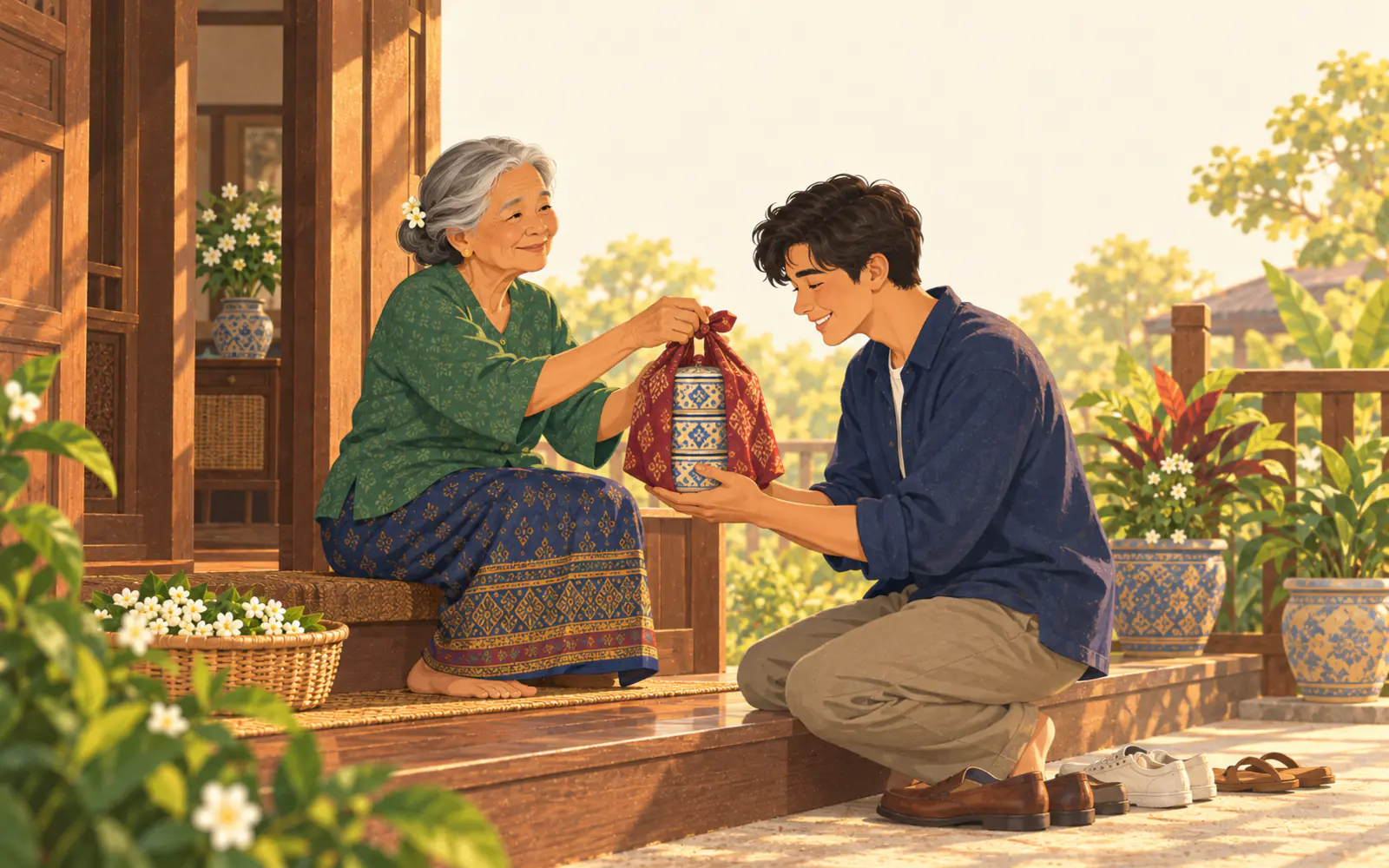
Somebody hands you a plate, a bag of mangoes for the flight, or an envelope at New Year, and the moment calls for two words. Thank you is one of the first things most of us learn in Thai, and also one of the easiest to say warmly. Here’s the word, the ending that goes with it, and how to thank the people who matter most.
How do you say thank you in Thai?
Thank you in Thai is ขอบคุณ (khorp khun). On its own it’s correct, friendly and a little bare. Most of the time you’ll add a polite ending:
ขอบคุณ
khorp khun
ขอบคุณครับ
khorp khun khrap
ขอบคุณค่ะ
khorp khun kha
Thank you.
Add the kin word and it’s personal: ขอบคุณค่ะย่า, ขอบคุณครับย่า. With elders, keep ครับ/ค่ะ.
Draft: waiting for a native speaker’s review.
The word is made of two parts. Wiktionary gives the first half as “to acknowledge” and คุณ as “favour, kindness”. So the thought underneath is close to “I acknowledge your kindness”. That’s a nice thing to know the next time you say it in a hurry at a 7-Eleven.
You’ll see it spelled khob khun, kob kun, khop khun and a few more. Romanization of Thai isn’t standardised, so all of these point to the same word. On this site we write khorp khun.
Is it khorp khun ka or khorp khun khrap?
It’s about who is speaking, not who you’re thanking. Men add ครับ (khrap): ขอบคุณครับ (khorp khun khrap). Women add ค่ะ (kha): ขอบคุณค่ะ (khorp khun kha). Wikipedia’s Thai language article describes the two particles exactly this way: one for male speakers, one for female speakers.
So if you’re searching “khob khun ka” or “khop khun krap meaning”, both mean “thank you”, said politely, by a woman and by a man. If you grew up hearing mostly your mum’s Thai and your ขอบคุณ comes out with her ending attached, that’s common and nothing to be embarrassed about.
What these little endings do in every other sentence is a whole topic of its own. Our guide to ka and khrap covers what they mean and when they change.
What’s the difference between khorp khun and khorp jai?
ขอบใจ (khorp jai) is the casual thanks. Wiktionary marks it as colloquial and “used to thank a person of equal or lower status”, so it belongs with friends and anyone younger, not with your elders.
ขอบใจนะ
khorp jai na
Thanks.
Literally: “thank-heart (softener)”
ขอบใจ is thanks for friends and anyone younger. Up the family ladder it’s always ขอบคุณ. ขอบคุณนะ is a warm in-between that fits anyone.
Draft: waiting for a native speaker’s review.
In family terms: to cousins your age, younger siblings and kids, ขอบใจนะ is lovely. Up the family ladder, to parents, aunties, uncles and grandparents, it’s always ขอบคุณ. If you can’t tell where someone sits, ขอบคุณนะ is a warm in-between that fits anyone.
Polite vs casual: thank you in Thai at a glance
| Say it to | Thai | Romanization | Feel |
|---|---|---|---|
| Elders, strangers, anyone older (man speaking) | ขอบคุณครับ | khorp khun khrap | polite, warm |
| Elders, strangers, anyone older (woman speaking) | ขอบคุณค่ะ | khorp khun kha | polite, warm |
| Friends, people your age | ขอบคุณ | khorp khun | friendly, neutral |
| Friends, younger siblings, kids | ขอบใจนะ | khorp jai na | casual, close |
| Someone who thanked you | ไม่เป็นไร | mai pen rai | “no worries” |
How do you thank a Thai grandparent or elder?
Two small changes make a thank-you sound like family. First, use the kinship word. In Thai you usually call relatives by their family title, not “you”. The Wikipedia article on Thai honorifics notes that kinship terms are used as pronouns to show respect or closeness. So to your dad’s mum, ย่า (yaa), it’s ขอบคุณค่ะย่า or ขอบคุณครับย่า (khorp khun kha yaa, khorp khun khrap yaa): “thank you, grandma”. For your mum’s mum, swap in ยาย (yaai). Not sure who is who? Our guide to Thai family words sorts it out.
Second, keep the polite ending. With elders, ครับ or ค่ะ stays on.
For the bigger thank-yous, at the end of a visit or when someone has really looked after you, there’s a phrase built for exactly that:
ขอบคุณที่ดูแลหลานนะ
khorp khun thii duu lae laan na
ขอบคุณที่ดูแลหลานนะครับ
khorp khun thii duu lae laan na khrap
ขอบคุณที่ดูแลหลานนะคะ
khorp khun thii duu lae laan na kha
Thank you for looking after me.
Literally: “thank-you that look-after grandchild (softener)”
หลาน is you, the grandchild. To an aunt or uncle it works just the same.
Draft: waiting for a native speaker’s review.
หลาน is you, the grandchild, so you’re thanking them for looking after their grandchild. It works for an aunt or uncle too.
Then there’s the gesture. The wai, palms together with a small bow, is common as a way to say thank you as well as hello. Wikipedia notes that the higher the hands and the lower the bow, the more respect it shows. A wai with your thank-you to Yai doesn’t need to be perfect; the effort is what she sees. If you want the finer points, our temple etiquette guide covers the wai in more detail. And if someone younger wais you, return it.
How do you reply when someone thanks you?
The usual answer is ไม่เป็นไร (mai pen rai): literally “it’s nothing”, in practice “no worries” or “you’re welcome”.
ไม่เป็นไร
mai pen rai
It’s okay. / No worries.
Literally: “not be anything”
What you say when someone apologises to you. Careful: after an offer it can sound like “no thanks”.
Draft: waiting for a native speaker’s review.
Wiktionary lists “it’s nothing”, “no problem” and “not at all” among its meanings, which is why it works as a reply to thanks. The Thailand Foundation describes how the same phrase is used after an apology, to show all is forgiven, and after an offer, to decline politely without brushing off the other person’s goodwill. That last one is the trap: if Yai offers you more rice and you say ไม่เป็นไร, she may hear “no thanks”. More about the phrase in the glossary.
With elders, add your ครับ or ค่ะ here too.
How do you thank someone for a meal?
You can say ขอบคุณ, and you should. But in a lot of Thai families, the thank-you the cook is really waiting for is praise for the food. This is the big one:
ไม่มีใครทำอร่อยเท่ายาย
mai mii khrai tham a-roi thao yaai
Nobody cooks like you, Yai.
Literally: “not have who make delicious equal grandma”
The big compliment. Works for mum too: ไม่มีใครทำอร่อยเท่าแม่.
Draft: waiting for a native speaker’s review.
It works for mum too: ไม่มีใครทำอร่อยเท่าแม่ (mai mii khrai tham a-roi thao mae).
Food is how a lot of Thai families say they care, starting with the greeting at the door. Our page on “have you eaten yet?” explains that greeting, how to answer it, and how to turn down a third helping without hurting anyone.
What about thanking your parents for everything?
Some thank-yous are bigger than a sentence. Thai has a word for gratitude you repay over a lifetime: กตัญญู (ga-tan-yuu), remembering what your parents and grandparents gave you and giving back. A study of Thai gratitude in an ageing society frames it as children repaying a mother’s kindness. You’ll hear the word at family occasions and in temple talks. It has its own entry in our glossary too.
You don’t have to carry all of that in two words. A ขอบคุณ with the right kinship word, said to their face, already carries a lot of it.
Practise the thank-yous before the next family day
Reply Thai’s Family meals and Big family days moments practise these as replies: thank you with your own ครับ or ค่ะ, the reply to thanks, and “nobody cooks like you, Yai”, so they’re ready when the plate or the envelope comes your way.
Reply Thai for iPhoneComing soonThai words on this page are a draft until a native speaker has reviewed them.
Questions people ask
How do I say thank you in Thai?
Say ขอบคุณ (khorp khun) and add a polite ending: ขอบคุณครับ (khorp khun khrap) if you're a man, ขอบคุณค่ะ (khorp khun kha) if you're a woman. With friends, the ending can drop off.
Is it khorp khun ka or khorp khun khrap?
It depends on who is speaking, not who you are thanking. Men say khorp khun khrap and women say khorp khun kha. Khob khun ka, kob kun ka and khop khun krap are just other spellings of the same words.
What's the difference between khorp khun and khorp jai?
ขอบคุณ (khorp khun) is the everyday thank you that fits anyone. ขอบใจ (khorp jai) is colloquial thanks for friends and people younger than you. Up the family ladder, to parents, aunties and grandparents, use ขอบคุณ.
How do you reply when someone thanks you in Thai?
ไม่เป็นไร (mai pen rai), “it's nothing, no worries”, is the usual reply, with ครับ or ค่ะ added for elders. Careful: after an offer, the same words can sound like “no thanks”.
How do I thank my Thai grandma?
Use her kinship word instead of “you” and keep the polite ending, for example ขอบคุณค่ะย่า or ขอบคุณครับย่า, “thank you, grandma”. A wai, palms together with a small bow, makes it warmer still.
Sources
All links read on .
- Wiktionary: ขอบคุณ, Thai (etymology, usage notes; page checked 14 Oct 2026)
- Wiktionary: ขอบใจ, Thai (colloquial thanks, usage notes; page checked 14 Oct 2026)
- Wikipedia: Thai language (particles ครับ and ค่ะ; page checked 14 Oct 2026)
- Wikipedia: Thai honorifics (kinship terms used as terms of address; page checked 14 Oct 2026)
- Wikipedia: Wai (gesture) (gratitude, returning a wai; page checked 14 Oct 2026)
- Thailand Foundation: Understanding “Mai Pen Rai” (1 October 2025)
- Wiktionary: ไม่เป็นไร, Thai (senses incl. it's nothing, not at all, no thank you; page checked 14 Oct 2026)
- Intarat, S. et al.: Development of a Causal Model of Influence on Gratitude (katanyu) of Thais in an Aging Society, Journal of Multidisciplinary in Social Sciences 15(2) (published 9 May 2023)
How we write and check our guidesReport a mistake
Letters from the in-between
One email when there’s something worth reading: new guides, stories from other luk khrueng, and a phrase for your next family call. No spam, ever.