Thai Chinese families: history, identity and home
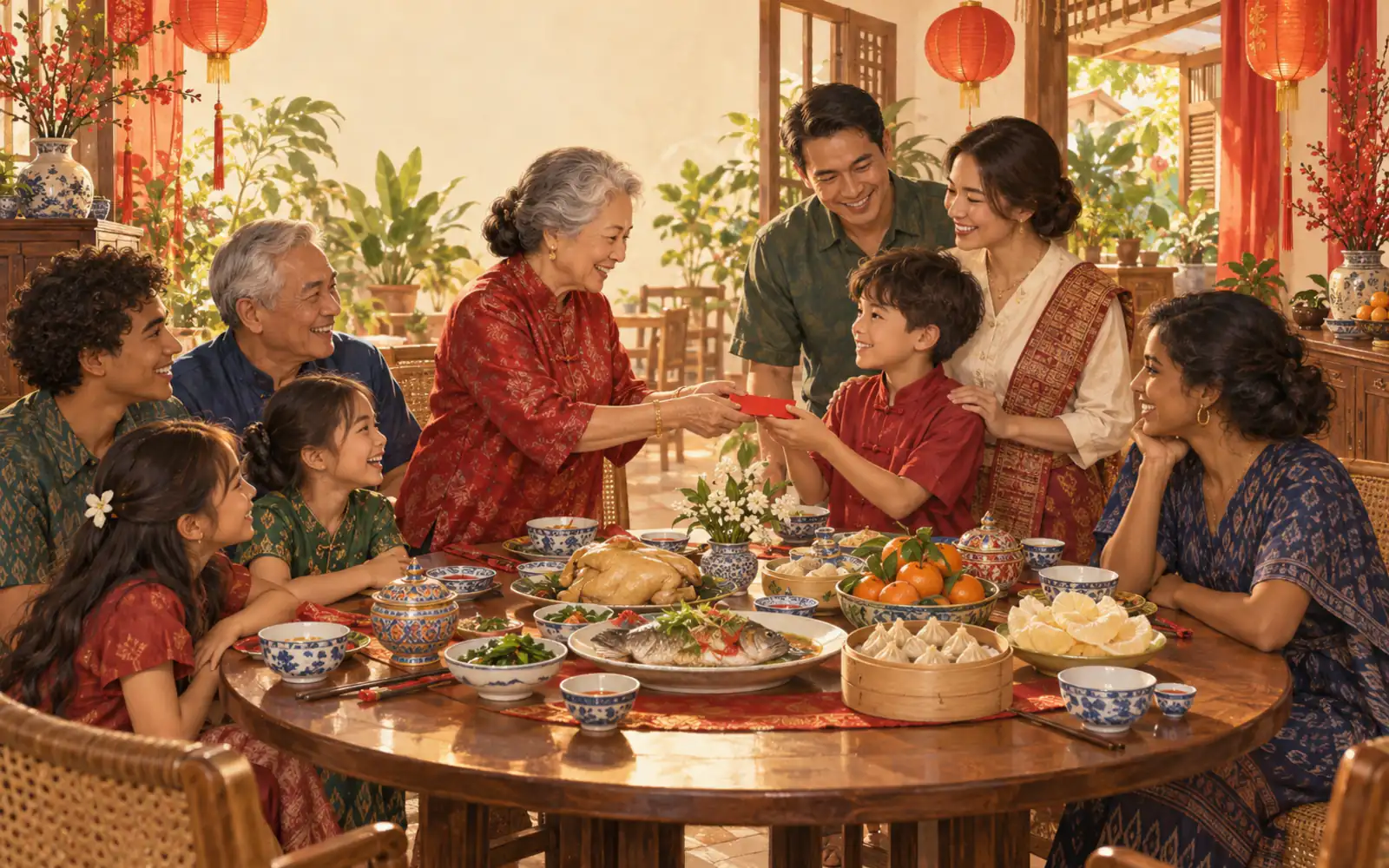
Maybe it came up at a funeral, or over oranges at Chinese New Year: “Well, your great-grandfather came from China, of course.” Of course. Nobody had mentioned it before, because to them it never needed saying.
If your Thai family turns out to be Thai Chinese too, you’re in very large company. This guide covers who Thai Chinese people are, how they became part of Thailand, and how it shows up at home today.
Who are Thai Chinese people?
Thai Chinese (also called Chinese Thai or Sino-Thai) are Thais whose ancestors came from China, mostly from the south. Chinese people had been living in Siam for centuries, and under King Chulalongkorn (Rama V, who reigned until 1910) the Thai state kept an open immigration policy to attract more Chinese labour, according to historian Thak Chaloemtiarana. Wikipedia gives rough figures of about 230,000 Chinese in Siam in 1825 and about 792,000 by 1910.
Most families trace back to southern Chinese dialect groups, of which Teochew is by far the largest (Library of Congress; Wikipedia).
How many people is that today? Honestly, nobody knows exactly, because after generations of marriage there’s no clean line to count. The US Library of Congress country study estimated that in 1987 about 11 per cent of Thailand’s population, roughly 6 million people, were of Chinese origin, which gave Thailand the largest Chinese population in Southeast Asia. Wikipedia gives a rough 2013 figure of 9.3 to 10 million, about 13 per cent, citing Minority Rights Group; we haven’t checked that figure at its source. Treat both as estimates, not a census.
Are Thai people Chinese?
No. Thai is its own nationality, language and culture. But the honest answer has a second half: a lot of Thai families have Chinese ancestry, often further back than anyone talks about.
Even Thai royalty is part of this story. Thak notes that King Prajadhipok (Rama VII) spoke of having Chinese blood in a 1927 speech during a visit to Chinese schools. Thak’s conclusion about modern Thailand is worth quoting: “to most Thai today, we (Thai) are them (Sino-Thai), and ‘them’ are us.”
So nobody gets to rank who is “more” Thai. A family that lights incense for Chinese ancestors and a family that never has are both Thai. If you want the longer answer to what makes someone Thai, see what do you call a Thai person.
What does luk jin mean?
Luk jin (also written luk jiin) means “children of the Chinese”. Thak describes it as an earlier term suggesting a second- or third-generation Sino-Thai, and notes that today a Thai is more likely to say they “have Chinese blood”. An even older word, jek, picked up negative connotations and is no longer preferred.
It’s a different word from luk khrueng. People with Thai and Chinese ancestry usually aren’t called luk khrueng; that term mostly means one Thai parent and one from further away. Our guide to what luk khrueng means covers that side.
How did Chinese families become Thai?
Partly over generations, through marriage, school and work. Partly through state policy, which wasn’t always kind.
Surnames. Thai surnames became legally required in 1913, with the Surname Act under King Vajiravudh (Rama VI) (Wikipedia). Thak describes the decree as urging Thais to adopt family names “in contrast to Chinese clan names”, and notes that some local Chinese families adopted Thai surnames too. Over the following decades many more changed or masked their clan names with Thai ones. Wikipedia notes these surnames often contain a hint of the original Chinese name, though not always. That’s why a Thai surname on a passport may say little about a great-grandfather from China.
The nationalist years. Thak also notes a 1914 essay, The Jews of the Orient, attributed to the same king, which portrayed the Chinese negatively. Under Field Marshal Phibun, who became prime minister in December 1938, the Library of Congress study describes Thai nationalism as “anti-Chinese in character”: regulations checked Chinese immigration and heavy taxes fell on foreign-owned businesses, most of them Chinese. In 1939 Phibun closed Chinese schools, while making naturalization easier, and Chinese-language newspapers were banned. Between 1939 and 1942, Sino-Thai serving in the bureaucracy and the military were urged to discard their Chinese surnames (Thak).
By 1970, more than 90 per cent of Chinese born in Thailand were estimated to have taken Thai citizenship (Library of Congress). If your grandparents grew up in that era, it can explain a lot: why some families kept their Chinese side quiet, and why your mum may not speak her grandmother’s dialect.
A confident comeback. Thak traces a shift by the 1990s, as a well-educated Sino-Thai middle class grew more self-assured. The 1990 novel Lod lai mangkorn (Through the Dragon Design) and the TV drama made from it were embraced by Sino-Thai viewers as a more realistic portrayal of their own families.
How does Thai-Chinese identity show up at home?
Often quietly, in habits more than labels.
Chinese New Year. For many families it’s the biggest gathering of the year, and often the clearest sign that the family has Chinese roots at all. We cover how it works in our Chinese New Year guide for Thai-Chinese families.
Qingming. On 4, 5 or 6 April depending on the year, Chinese families traditionally visit their ancestors’ graves to sweep them and offer food, incense and joss paper (Wikipedia). Thailand is among the places it’s observed, and many Thai-Chinese families keep it (Wikipedia). If you’re on a trip home in April, you may find yourself at a cemetery with a broom and a picnic, which is exactly as warm as it sounds.
Ancestors. Remembering the ancestors runs through both of those days. If your family has a small altar with photos and incense, that’s what it’s for. Funerals in Thai-Chinese families can also follow different customs from the ones in our Thai funeral etiquette guide, so ask a relative what to expect.
Names and food. Some of the most common Thai nicknames, like Tee and Muay, come from Chinese; see Thai nicknames explained. And in plenty of homes, the heritage lives in the kitchen: the dish only one aunt can make, cooked once a year for a reason nobody explains until you ask.
What if your Thai parent is Thai Chinese?
Then you have three threads, not two, and that’s fine. Maybe your mum is Thai Chinese and your dad is from Sweden, Britain or the US. You may be luk khrueng and have a Chinese great-grandfather, and the family offerings at Chinese New Year are as much yours as Songkran is.
A few gentle ways in:
- Ask the elders. Which town did the family come from? What was the old surname? These questions usually land as interest, not intrusion, and the answers disappear when the elders do.
- Keep the customs you can. Join the offerings, eat the once-a-year dish, help sweep the grave if you’re home in April.
- Say it your way. Thai, Thai Chinese, Thai-Swedish-with-a-Chinese-great-grandpa: all true, and nobody gets to grade it.
Growing up between homes has its own rhythm; our essay on life between two homes is about exactly that. And if you want one Thai sentence for the moment someone asks where you’re really from:
โตเมืองนอกแต่ใจยังเป็นคนไทย
toh mueang nork tae jai yang pen khon thai
โตเมืองนอกแต่ใจยังเป็นคนไทยครับ
toh mueang nork tae jai yang pen khon thai khrap
โตเมืองนอกแต่ใจยังเป็นคนไทยค่ะ
toh mueang nork tae jai yang pen khon thai kha
I grew up abroad, but I’m Thai at heart.
Literally: “grow abroad but heart still is Thai-person”
Says both halves, on your terms. ยัง (still) says the Thai part never left. โตเมืองนอก comes up a lot with family.
Draft: waiting for a native speaker’s review.
Every autumn many Thai-Chinese families also eat jay for nine days: see our guide to Thailand’s vegetarian festival (Kin Jay).
Practise being Thai, your way
In Reply Thai, the Thai and proud moment is built for this: talking about the food you grew up with and where your family is from, in Thai, without having to explain everything.
Reply Thai for iPhoneComing soonThai words on this page are a draft until a native speaker has reviewed them.
Questions people ask
Are Thai people Chinese?
No. Thai is its own nationality, language and culture. But many Thai families have Chinese ancestry: the US Library of Congress estimated about 11 per cent of the population in 1987, later figures quoted on Wikipedia run a little higher, and most Thai Chinese identify simply as Thai.
What does luk jin mean?
Luk jin (also written luk jiin) means “children of the Chinese”. A historian of Thai literature describes it as an earlier term suggesting a second- or third-generation Sino-Thai. Today people more often say they “have Chinese blood”, and the old word jek is no longer preferred.
How many Thai people are of Chinese descent?
Nobody has an exact count. The US Library of Congress estimated about 6 million people, 11 per cent of the population, in 1987. Wikipedia gives a rough 2013 figure of 9.3 to 10 million, about 13 per cent, citing Minority Rights Group. Treat both as estimates, not a census.
Why do Thai Chinese families have Thai surnames?
Surnames became legally required in Thailand in 1913 under King Vajiravudh (Rama VI), and some local Chinese families adopted Thai ones too. Later, during the Phibun regime’s 1939–1942 campaign, Sino-Thai in the bureaucracy and the military were urged to discard their Chinese surnames.
Can you be both Thai and Chinese?
Yes. Most Thai Chinese are Thai citizens who call themselves Thai and also keep Chinese customs at home, such as ancestor offerings and Chinese New Year. One historian sums up the modern view as “we (Thai) are them (Sino-Thai), and ‘them’ are us.”
Sources
All links read on .
- Thak Chaloemtiarana: Are We Them? Textual and Literary Representations of the Chinese in Twentieth-Century Thailand. Southeast Asian Studies 3(3), Kyoto University (December 2014)
- Library of Congress Country Studies: Thailand (1987), The Chinese (countrystudies.us edition, page checked 14 Oct 2026)
- Library of Congress Country Studies: Thailand (1987), Phibun and the Nationalist Regime (countrystudies.us edition, page checked 14 Oct 2026)
- Wikipedia: Thai Chinese (background: population estimates, dialect groups; page checked 14 Oct 2026)
- Wikipedia: Thai name (background: Surname Act 1913; page checked 14 Oct 2026)
- Wikipedia: Qingming Festival (background: date and customs; page checked 14 Oct 2026)
How we write and check our guidesReport a mistake
Letters from the in-between
One email when there’s something worth reading: new guides, stories from other luk khrueng, and a phrase for your next family call. No spam, ever.