Thai Buddhist funeral etiquette for people with Thai family
Last checked . Rules change; confirm with the family and the temple.
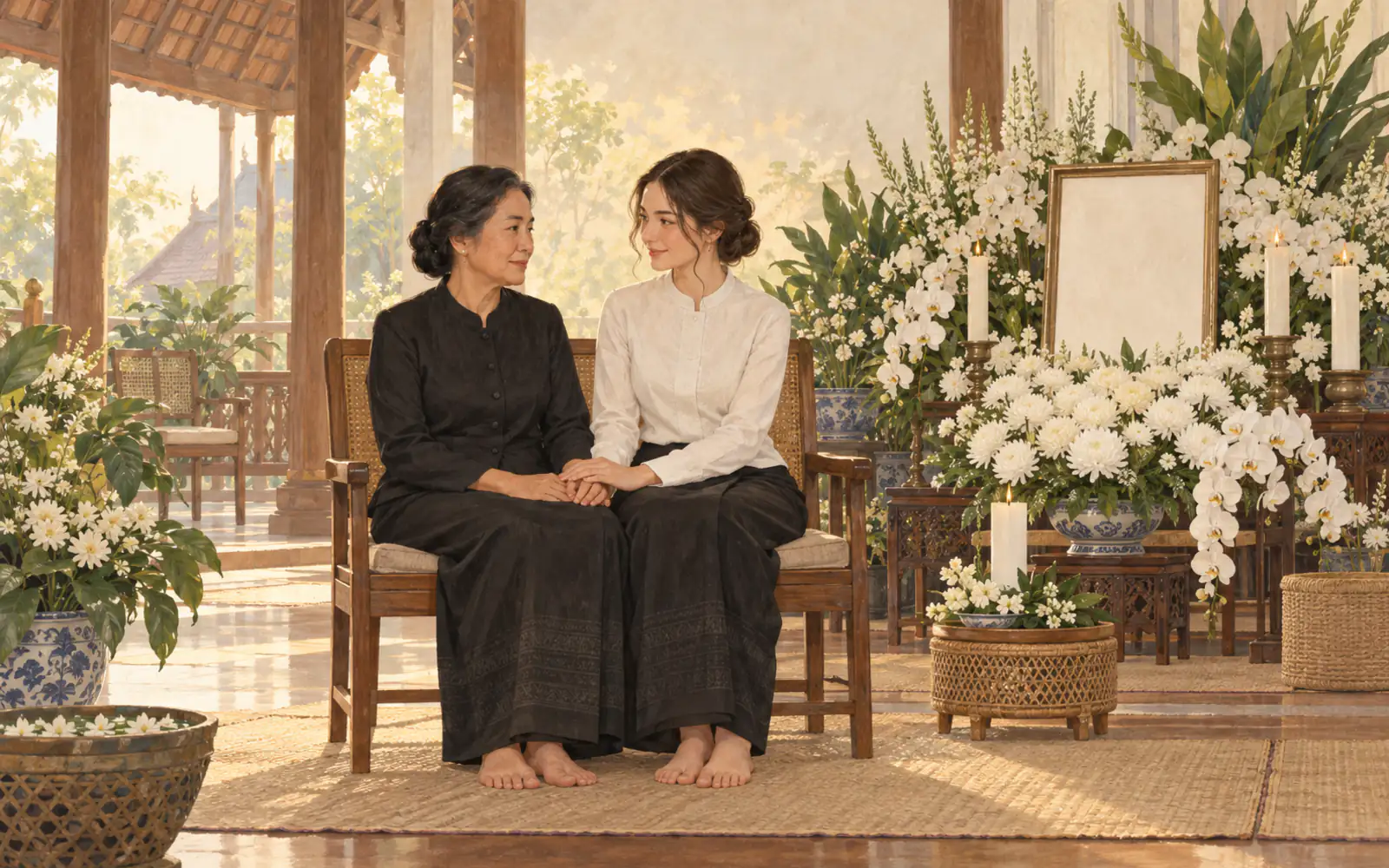
Customs vary by region and family. Thai funerals differ between regions, temples and households, and Chinese-Thai, Muslim and Christian families have their own rites. What follows is what usually happens at a Thai Buddhist funeral, from the sources we read on 13 October 2026. When you’re unsure, ask a relative or the temple. What your family does wins.
Someone in your Thai family has died. Maybe you’re booking a flight tonight, maybe you’re watching from the other side of the world. Maybe you’ve never been to a Thai funeral and nobody has time to explain.
That’s okay. This guide walks you through what usually happens at a งานศพ (ngaan sop), a funeral, so you can be there for your family without worrying about getting it wrong.
What usually happens at a Thai Buddhist funeral?
Most Thai Buddhist funerals follow four stages. The details, and how long each one lasts, depend on the family and the region.
- The water-pouring rite, รดน้ำศพ (rot naam sop). Usually the first rite, shortly after the death. The person who has died lies with the right hand held out, and guests go up one by one to pour scented water over the palm. It’s a way of saying goodbye and asking forgiveness (BuddhaNet describes the same rite of pouring water over one hand). The Thailand Foundation’s guide says to come to this rite if you knew the person yourself.
- The chanting evenings. Monks come to chant each evening, traditionally at home and today usually at a temple, with the coffin at the front. The host family serves a light meal, offers a robe and gifts to the monks, and shares the merit with the person who has died by กรวดน้ำ (gruat naam), pouring water.
- The cremation. On the cremation day the coffin may be carried three times around the crematorium, anti-clockwise (Thailand Foundation, Wikipedia). Guests come up in turn to place a small sandalwood-scented flower and incense on a tray or under the coffin. The host family invites guests up to place them.
- Merit-making afterwards. The family makes merit for the person again at 7, 50 and 100 days after the death, often with monks, and then once a year. This is ทำบุญ (tham bun), making merit, and there’s more on it in our guide to tak bat and merit making.
How long does a Thai funeral last?
It varies. The chanting evenings usually run for three, five or seven days, according to both the Thailand Foundation and Wikipedia. The Foundation adds that it can be one day, or go on for up to 100 days before the cremation. Some families wait a long time to cremate, for example 100 days or a year.
Cremation is generally avoided on Fridays and on some royal days, the Foundation says, so dates can shift. Check the schedule with your family before you book anything.
What should I wear to a Thai funeral?
Black or white, modest and plain. The Thailand Foundation says Thais generally wear white and black, avoid short or revealing clothes, and keep make-up and accessories light.
For the rest (covering shoulders and knees, taking your shoes off, keeping your feet pointed away from the monks), the temple rules apply. They’re all in our Thai temple etiquette guide, along with how to wai and bow. If you’ll be helping the family, wear something you can move and kneel in.
What do I do when I arrive?
Go to the family first, wai, and say a few quiet words (see the next section). Then pay your respects, first at the Buddha image and then at the coffin. Many guests light incense there: one stick is the number traditionally used to pay respect to someone who has died, according to Thairath. Watch what others do and follow them.
During the chanting, sit quietly and follow what others do. You don’t need to know the words. Keep your phone silent and away.
If you aren’t Buddhist, the Thailand Foundation’s guide says you can greet the family, stand quietly before the coffin and skip the incense and the bows to the Buddha image. During the prayers you can simply sit and listen. Being there is what counts.
What should I say at a Thai funeral?
Less than you think. A wai and one short line is enough.
With close family, say เสียใจด้วยนะ (sia jai duai na): “I’m so sorry.” Men often add ครับ (เสียใจด้วยนะครับ, sia jai duai na khrap) and women add คะ after นะ (เสียใจด้วยนะคะ, sia jai duai na kha). Adding their kin name makes it warmer: เสียใจด้วยนะป้า (sia jai duai na paa), “I’m so sorry, Paa.” Not sure what to call whom? Our guide to Thai family words helps.
With elders you don’t know well, the formal version is ขอแสดงความเสียใจด้วย (khor sa-daeng khwaam sia jai duai), “Please accept my condolences.”
If you want to offer help, มีอะไรให้ช่วยบอกได้เลยนะ (mii a-rai hai chuai bork dai loei na) means “If there’s anything I can do, just tell me.” Funerals run over several evenings and there may be practical things to help with. Offering to help is a kind thing to do.
If the Thai won’t come out, say it in English, or just wai. Your family will understand.
How much money do you give at a Thai funeral?
There’s no fixed amount, and you don’t have to give. The Thailand Foundation’s guide says it isn’t compulsory how much you offer, or whether you offer at all, and that some hosts say clearly they don’t accept money.
Still, many guests give the host family some money to help with the costs. Hosting a funeral is expensive: the family feeds guests every evening and makes offerings to the monks.
We haven’t found a reputable source that gives amounts, so we won’t guess. What’s usual depends on the family, the region and how close you were. Ask a relative quietly what people in your family usually give. As close family, you may be asked to help in other ways instead, or as well.
I’m flying in. Which days matter most?
If you can only make one day, the Thailand Foundation says the cremation day is the one to choose. The chanting evenings are calmer, with more time to sit with your family. You don’t need to be there every day.
Before you book, ask your family:
- When is the cremation? It may be days away, or months.
- Is there anything they want you to bring or do?
- Are there any family customs you should know about?
If you’re rushing to the airport, our guide to which passport to enter Thailand on may save you one worry at the border.
Can I take part from abroad?
Yes, in your own way. Not everyone can fly in, and that’s nothing to feel guilty about.
- Ask the family whether someone can keep you updated, or call you during a quiet moment. Not every family will want a phone out during the chanting, so let them decide.
- The later days. The merit-making at 7, 50 and 100 days, and sometimes a later cremation, are further chances to be there in person or to call on the day.
- Send your condolences. A message or call to the closest relatives, even just เสียใจด้วยนะ, means a lot. If you want to contribute money, ask a relative whether and how to send it.
- Make merit where you are. If there’s a Thai temple near you, you can ask whether you can make merit there for the person who has died.
What if I don’t know any of the rituals?
Then you’re far from alone, and it’s okay. Funerals don’t come with a rehearsal, and nobody expects you to know every step. Nobody is checking.
What your family will remember is that you came, or called, or sent your love. Sit at the back if that feels easier. Copy what others do, a beat late. Ask a cousin in a whisper. If you cry in front of everyone, that’s fine. If you don’t, that’s fine too.
Grief doesn’t need to be done in the right language. You’re part of this family, and you belong in the room.
If it’s your grandparent and you’re far away, see When Yai dies and you are far away.
What we couldn’t confirm
- Money amounts. We found no reputable source with figures, so we give none. Ask your family.
- Joining online. We found no reputable source on how Thai temples or families include relatives remotely. It varies, so ask.
- Regional details. Northern, northeastern and southern customs can differ from the outline above, and so can Chinese-Thai family funerals. Your relatives are the best guide.
Thai words on this page are a draft until a native speaker has reviewed them.
Questions people ask
What happens at a Thai Buddhist funeral?
Usually a water-pouring rite where guests pour scented water over the hand of the person who has died, then evenings of monks chanting, often for three, five or seven days, then a cremation at the temple. The family makes merit again at 7, 50 and 100 days. Details vary by region and family.
What should I wear to a Thai funeral?
Black or white, and modest: covered shoulders and knees, nothing short or revealing, light make-up and jewellery.
How much money should I give at a Thai funeral?
There is no fixed amount, and giving is not compulsory. Many guests give money to help the host family, and some families say they don't accept money. Ask a relative what is usual in your family.
What do you say to the family at a Thai funeral?
Very little. A wai and a quiet เสียใจด้วยนะ (sia jai duai na), “I’m so sorry”, is enough with close family. With elders you don't know, the fuller ขอแสดงความเสียใจด้วย (khor sa-daeng khwaam sia jai duai) is more formal.
Which day should I attend if I can only make one?
The Thailand Foundation's guide says guests don't need to come every day, and if you can only come once, the cremation day is preferred. In our view, the chanting evenings give you more time to sit with the family.
Can I join a Thai funeral from abroad?
Ask the family. Some may be able to keep you in the loop by phone or video, and there are later merit-making days at 7, 50 and 100 days, and sometimes a later cremation, that you may be able to join in person.
Sources
All links read on . Details change; confirm with the family and the temple before you act.
- Thailand Foundation: Thai funerals, an overview guide (21 August 2024)
- Wikipedia: Thai funeral (background)
- BuddhaNet (Buddha Dharma Education Association): Buddhist funeral rites in Thailand and other Southeast Asian countries
- Thairath: how many incense sticks, and what each number means (Thai, 22 July 2026)