Thai vegetarian festival 2026: kin je, dates and rules
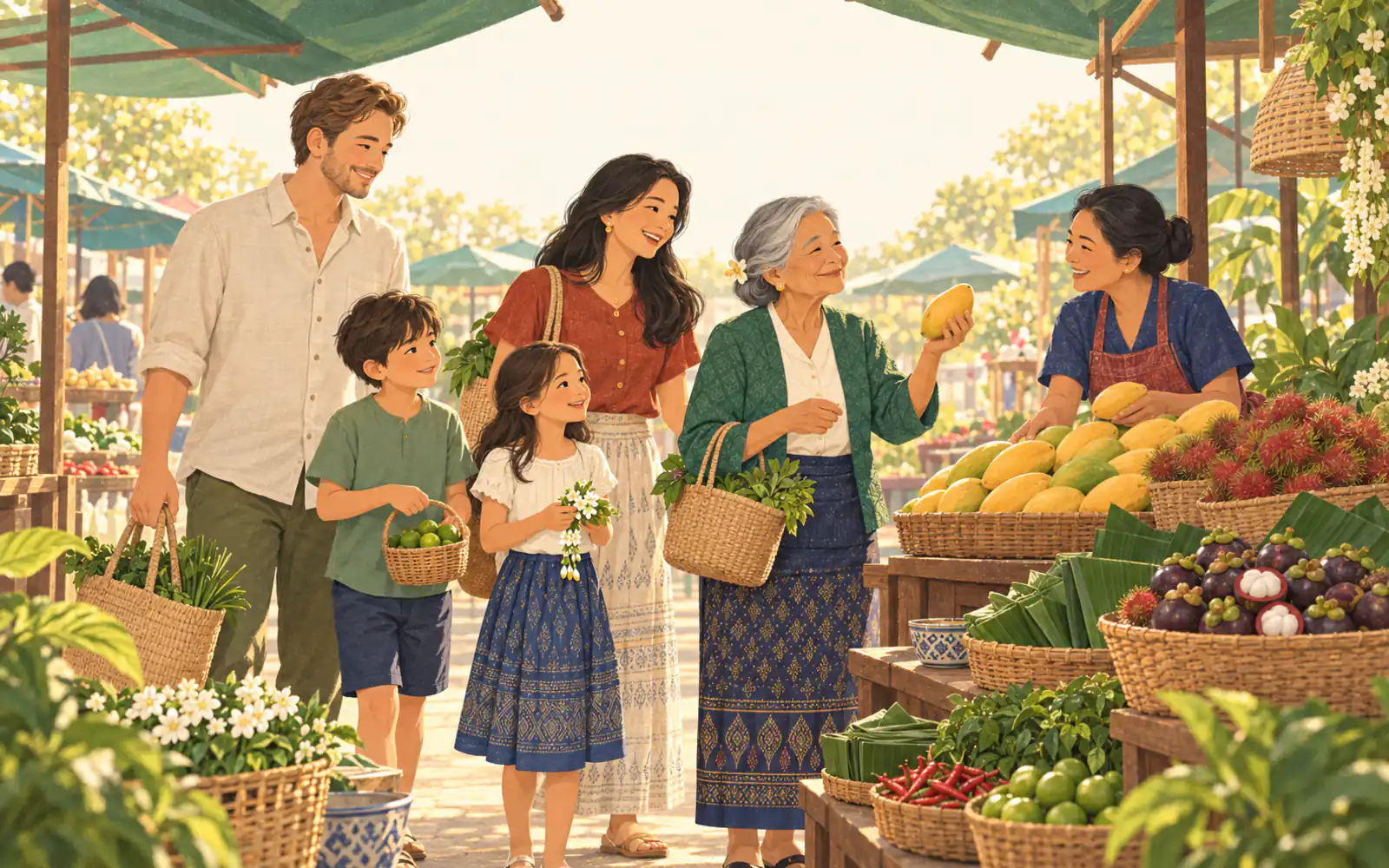
If your family is Thai-Chinese, there’s a week every autumn when Yai’s kitchen changes. The meat disappears, the garlic goes back in the cupboard, someone finds a white shirt, and little yellow flags turn up on food stalls all over town. That’s thetsakan kin je, the vegetarian festival. Here’s what it is, when it is, and how to sit at Yai’s table without breaking the rules.
What is the Thai vegetarian festival?
It’s a nine-day Taoist festival honouring the Nine Emperor Gods, kept mainly by Thai-Chinese families and shrines. Kin je means “eating je”, and that’s the heart of it: for nine days, people eat food with no animal products, keep their thoughts clean, wear white and make merit at Chinese shrines.
It follows the Chinese lunar calendar, running from the first to the ninth night of the ninth lunar month. TAT says the tradition in Phuket was handed down through generations of the island’s Thai-Chinese Hokkien community, and the festival is also kept by Chinese communities in Malaysia, Singapore and Indonesia.
In 2026 the festival runs 10–18 October. The Tourism Authority of Thailand lists those dates for Bangkok, Phuket, Nakhon Sawan, Mae Sot, Korat and Chumphon. Some venues differ by a day or two: one shrine in Trang runs 10–19 October, and Hat Yai’s venues run between 8 and 19 October.
For 2027, there’s no official listing yet. The Hong Kong Observatory’s lunar calendar puts the first nine days of the ninth lunar month at 30 September to 8 October 2027, so expect the festival around then, and check TAT’s listings nearer the time. It isn’t a public holiday, so it won’t appear in our Thai public holidays 2027 table.
What is je food?
Je food is stricter than “vegetarian” in the Western sense. TAT describes it as food with no meat, poultry, seafood or dairy, and no pungent vegetables such as garlic and onions. The Thaiger adds that all animal products are out, and that garlic and onions are avoided because they’re thought to stir up strong emotions. The Thai-language Wikipedia entry lists eggs and honey among the animal products left out, and adds chives and coriander to the strong-smelling plants; some cooks skip hot spices too.
What’s left is better than it sounds: tofu in every texture, mushrooms, beans and legumes, the swaps The Thaiger names for meat. Stricter keepers also cook in separate, well-scrubbed pots and use their own dishes for the nine days.
What do the yellow flags mean?
During the festival, stalls and restaurants selling je food fly yellow flags with red lettering. If you can’t read the flag, the colour is the message: this stall is je. You’ll see them on market stalls, in Chinatown and in shopping-centre food courts. Our guide to Thai food by region covers what the same stalls sell the rest of the year.
Why do people wear white?
White stands for purity, of body and of mind. TAT notes that participants wear white for the festival. On the eve of the first day, shrines hold a ceremony to welcome the Nine Emperor Gods, with devotees in white waiting for them to arrive.
The “clean” part isn’t only about clothes. Keepers are expected to keep their thoughts and speech clean, and devout participants also give up alcohol and sex for the nine days. How strict a family is varies a lot.
What happens at the Phuket Vegetarian Festival?
Content note: this section describes body piercing.
Phuket is where TAT says the festival began, among Chinese tin miners in the 19th century. A story TAT reported in 2015 dates it to 1825, when a visiting Chinese opera troupe fell ill with malaria and recovered after keeping the vegetarian diet and praying to the Nine Emperor Gods. The Thaiger says the history is unclear, and that this is the most widely accepted account.
In 2026, TAT lists daily street processions from 11 to 18 October, with more than 40 shrines in the big night procession on 11 October, a fire-walking ritual, and farewell rites on 18 October when the gods are sent back.
The processions are known for the Ma Song, spirit mediums believed to be possessed by the gods. In a trance, some pierce their cheeks or tongues with blades, skewers or other objects, which devotees understand as an act of devotion. This is a Phuket practice above all; the family down the road keeping kin je is not doing anything of the kind. If you go with children, the processions come with a lot of firecrackers, so think about ear protection and a spot further back from the road.
Where can I join in in Bangkok?
In Yaowarat, Bangkok’s Chinatown. Thailand NOW lists the 2026 Chinatown vegetarian festival around Odeon Circle on Yaowarat Road, and The Thaiger points to Yaowarat Soi 6, by the old market, for stalls. TAT also lists nine-day events at Bangkok shrines. Go hungry and follow the yellow flags.
How do Thai-Chinese families keep it at home?
Mostly quietly, and every family differs. Kin je can mean Yai or Ama switching the household kitchen to je for nine days, the family visits a shrine, and someone makes a run to the market for je dishes. Some relatives keep all nine days; others keep a day or two, or eat je at home and normally outside. Abroad, families can keep it at home, cooking je, or by visiting a Chinese temple where there is one.
If your family has Chinese roots and you’ve never quite worked out which customs come from where, our guide to Thai-Chinese families is a good start, and Chinese New Year for Thai-Chinese families covers the other big date. The festival’s rules about purity sit close to the everyday beliefs in Thai superstitions in the family.
How can I join in as a luk khrueng?
You don’t need to be devout to eat je with Yai. A few things that help:
- Respect her table. If her kitchen is je this week, don’t bring a takeaway with meat into it, and don’t ask her to make you “just a bit of chicken”.
- Ask, don’t assume. Some families keep separate pots and dishes. If you’re helping cook, ask which ones to use.
- Eat with enthusiasm. Je food takes work. Praising it is the easiest win of the week.
ไม่มีใครทำอร่อยเท่ายาย
mai mii khrai tham a-roi thao yaai
Nobody cooks like you, Yai.
Literally: “not have who make delicious equal grandma”
The big compliment. Works for mum too: ไม่มีใครทำอร่อยเท่าแม่.
Draft: waiting for a native speaker’s review.
Asking for seconds says the same thing without words:
ขออีกได้ไหม
khor iik dai mai
ขออีกได้ไหมครับ
khor iik dai mai khrap
ขออีกได้ไหมคะ
khor iik dai mai kha
Can I have some more?
Literally: “ask-for more can question”
Asking for seconds is itself the biggest compliment. Be ready for a very full plate.
Draft: waiting for a native speaker’s review.
And at a festival stall, where some je dishes still come with chilli:
ไม่เผ็ดนะ
mai phet na
ไม่เผ็ดนะครับ
mai phet na khrap
ไม่เผ็ดนะคะ
mai phet na kha
Not spicy, OK?
Literally: “not spicy (softener)”
นะ makes it a friendly request, not an order. Men say นะครับ, women นะคะ.
Draft: waiting for a native speaker’s review.
Customs vary
- How strict. Some people keep all nine days, some only part. Eggs, spices and separate cookware divide families.
- The dates. The festival follows the lunar calendar, and some shrines start a day early or finish a day late. TAT’s 2026 listing shows venues in Trang and Hat Yai differing from the 10–18 October core.
- The origin story. The 1825 opera-troupe account is the one most often told for Phuket, but sources call the history unclear.
- The meaning of white. TAT and most sources say purity; the Thai-language Wikipedia entry also links white to mourning in Chinese custom.
What your family does wins.
Practise for Yai’s table
Reply Thai’s Family meals moment covers being fed, praising the cook and saying no kindly, which is most of kin je week.
Reply Thai for iPhoneComing soonThai words on this page are a draft until a native speaker has reviewed them.
Questions people ask
When is the vegetarian festival in Thailand in 2026?
The Tourism Authority of Thailand lists 10–18 October 2026 for Bangkok, Phuket and most of the country. A few venues in Trang and Hat Yai start or finish a day or two either side.
What can't you eat during kin je?
Je food has no meat, poultry, fish, seafood or dairy, and stricter keepers avoid eggs too. It also leaves out pungent vegetables such as garlic and onions, and often strong spices. Tofu, mushrooms and beans take the place of meat.
What do the yellow flags on food stalls mean?
A yellow flag with red lettering means the stall or restaurant is selling je food during the festival.
Why do people wear white for the vegetarian festival?
White stands for purity of body and mind. Participants wear it for the nine days, especially at shrine ceremonies.
Is the face piercing part of every vegetarian festival?
No. The Ma Song spirit mediums who pierce their cheeks in street processions are best known from Phuket's festival. Most families who keep kin je simply eat je food, wear white and visit a shrine.
Sources
All links read on .
- TAT Newsroom: Thailand celebrates Vegetarian Festival 2026 across the country (6 October 2026)
- TAT Newsroom: TAT highlights Phuket Vegetarian Festival 2026 as a distinctive cultural experience (6 October 2026)
- TAT Newsroom: Thailand's Vegetarian Festival, a feast for the spirit and the senses (14 October 2025)
- TAT Newsroom: Chinese Thainess celebrated across Phuket during the annual Vegetarian Festival (30 October 2015)
- Thailand NOW (Ministry of Foreign Affairs): Thai Vegetarian Festival 2026 (event page, checked 14 Oct 2026)
- Hong Kong Observatory: Gregorian–lunar calendar conversion table for 2026 (checked 14 Oct 2026)
- Hong Kong Observatory: Gregorian–lunar calendar conversion table for 2027 (checked 14 Oct 2026)
- The Thaiger: Celebrating the Vegetarian Festival 2022, where to go and what to eat (2022)
- Wikipedia (Thai): Vegetarian festival, food rules and practices (background; checked 14 Oct 2026)
- Wikipedia: Nine Emperor Gods Festival (background; checked 14 Oct 2026)
How we write and check our guidesReport a mistake
Letters from the in-between
One email when there’s something worth reading: new guides, stories from other luk khrueng, and a phrase for your next family call. No spam, ever.