Doraemon in Thai, Fan Chan: what we grew up with
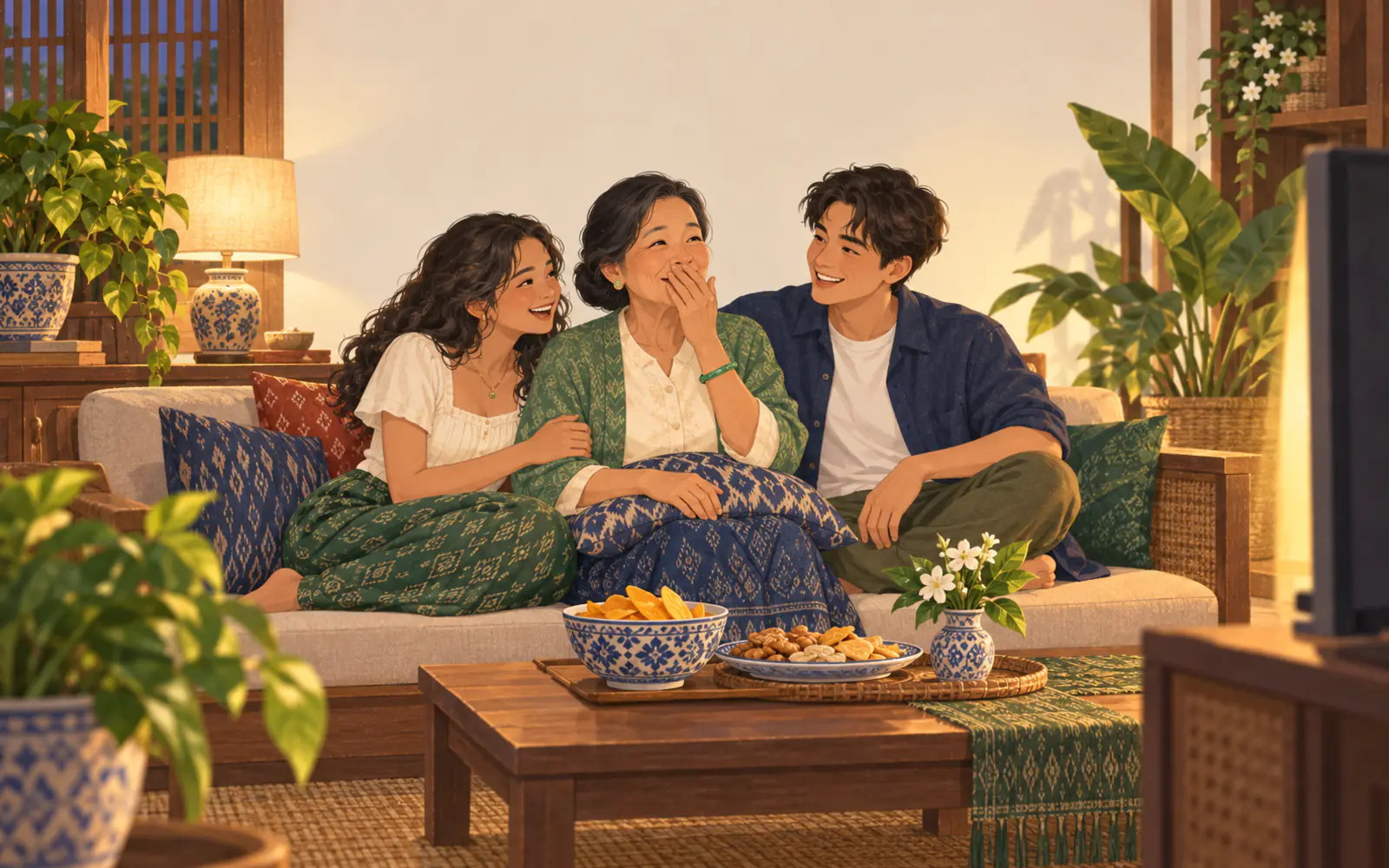
At school, nobody knew why you laughed at a blue robot cat speaking Thai. Nobody had seen the film your cousins quote every Songkran. Nobody else went quiet when a certain 1980s pop song came on at a family party. If any of that sounds familiar, this page is for you. It’s a little shelf of the Thai pop culture many luk khrueng share, the stuff that was “just TV” in Thailand and a secret language everywhere else.
Every date below is checked. The feelings are yours.
Which cartoons did we watch dubbed in Thai?
The big three, for a lot of families, were Japanese anime with Thai voices. Hearing them in another language still feels slightly wrong.
Doraemon (โดเรมอน, do-re-morn). Thai Wikipedia dates the first Thai broadcast to 5 September 1982, on Channel 9. It credits Chantana Tharajan as Doraemon’s Thai voice, and notes that the Thai voice cast stayed largely the same over the years. So the voice you remember may be the same one your mum heard. Many of us wished for his door that goes anywhere, straight to Thailand.
Crayon Shin-chan (ชินจังจอมแก่น, chin-jang jorm gaen). The cheeky five-year-old arrived on Channel 3 in 1996, in a Monday and Tuesday 17:30 slot, and came back again in 2010. For many of us, some parents weren’t sure about him, which made him funnier.
Detective Conan (ยอดนักสืบจิ๋วโคนัน, yort nak suep jiu kho-nan). The anime premiered in Japan on 8 January 1996, and it has aired in Thai on several Thai channels, including MCOT. For many of us, everyone had a theory about who did it before the ad break.
If you happen to be in Bangkok soon: Time Out Bangkok reports a Detective Conan 30th anniversary exhibition at ICONSIAM Hall, 6th floor (as reported in July 2026; it runs until 8 November 2026). It’s the first time the exhibition has come to Southeast Asia. Check the dates and tickets before you go.
Why does everyone talk about Fan Chan?
Because it’s the film about a childhood many of us only saw in the holidays, and it still makes people cry. (For more films to watch with family, see our best Thai movies list.)
Fan Chan (แฟนฉัน, faen chan), known in English as My Girl, opened in Thailand on 3 October 2003. It follows Jeab, who travels home from Bangkok and remembers his childhood friendship with a girl called Noi-Naa in a small town in Phetchaburi in the 1980s. The soundtrack is Thai pop of the era. It was the debut film of six young Thai directors, and after its success, the three companies behind it (GMM Pictures, Tai Entertainment and Hub Ho Hin) merged to form the studio GTH.
That’s a big part of why it lands for so many of us. It’s nostalgia for a Thai small town you may have only visited in the holidays: the school uniforms, the bikes, the songs your parents knew. You don’t have to have lived it to miss it.
Which other nostalgic Thai films do people quote?
A few that come up again and again, all released by GTH, the studio Fan Chan helped create:
- Hello Stranger (กวน มึน โฮ, guan muen hoh), 2010, directed by Banjong Pisanthanakun. Two Thai strangers travel around South Korea together. It grossed ฿130 million in Thailand, and made a trip to Seoul look like the most romantic thing in the world.
- SuckSeed (ซักซี้ด ห่วยขั้นเทพ, sak-siit huai khan thep), released 17 March 2011, the feature debut of director Chayanop Boonprakob. Three secondary school students start a rock band to impress girls, and they are gloriously bad at it. For many, the soundtrack of being sixteen and hopelessly in love.
- Pee Mak (พี่มาก..พระโขนง, phii maak phra-kha-nong), released 28 March 2013, again by Banjong Pisanthanakun. A comedy take on the Mae Nak ghost legend, and Wikipedia lists it as the highest-grossing Thai film of all time, a record it set in 2013. Scary for a minute, then the whole room laughs.
Thai cinema is also famous for its หนังผี (nang phii), ghost films. If that’s not your thing, a sincere กลัว (glua, “I’m scared”) on the sofa usually gets a laugh from the cousins.
What was always on TV at Yai’s house?
The ละคร (la-khorn), the evening TV drama. Wikipedia describes lakorn as mostly prime-time, starting around 20:30, on channels like 3, 5 and 7. A series usually runs about three months, each one is a complete story, and plenty of them borrow from Thai folklore, ghosts included.
What the encyclopedia can’t capture is the sofa: mum and the aunties shouting at the villain, someone explaining the plot you missed, the gossip afterwards. For lots of luk khrueng, lakorn did quiet language work too. If your Thai sounds like an elegant drama heroine, that may be why. We wrote about that in why your Thai sounds like your mum. And watching one together today still counts as practice. It’s also an easy thing to share on a video call with Yai.
What music do half Thai kids remember?
Usually whatever the grown-ups played.
- Luk thung (ลูกทุ่ง, luuk thung), “child of the fields”, is Thai country music. Wikipedia credits the name to a 1964 TV show by Chamnong Rangsikul. It’s the sound of long car journeys upcountry and every village party.
- Bird Thongchai (Thongchai McIntyre) released his debut album in 1986 and is counted among the most commercially successful singers in Thai music history. In many homes, his were the songs mum sang along to.
We won’t print lyrics here. You already know the chorus anyway.
And the snacks on the trip home?
No sources needed for this part, just your memory. The ones that come up again and again: มาม่า (maa-maa) instant noodles at midnight, ข้าวเหนียวมะม่วง (khaao niao ma-muang) when mango season came, a ซาลาเปา (saa-laa-pao) from the shop steamer, green ลอดช่อง (lort chorng) over ice, and a bag of ชาเย็น (chaa yen), Thai iced tea, the colour of a sunset. For what eating means in a Thai family, see have you eaten yet?.
How can you watch these together now?
Streaming rights change by country and by month, so we won’t promise a platform. Check what’s streaming where you live, and look for the Thai title too, since films are sometimes listed under it.
Then make it an event. Watch Fan Chan with your mum and ask which bits looked like her childhood. Put on a Doraemon episode in Thai for your own kids and see whether the voice still sounds like home. Ask Yai who her favourite luk thung singer is. You don’t need perfect Thai for any of it. Understanding some of it is enough, and laughing at the right moment counts for a lot.
Does nostalgia for “two childhoods” make sense?
Yes. Your childhood happened in two places at once, even if one of them was mostly on a screen. Cartoons dubbed in Thai, a lakorn on in the background, a film your family quotes: these belong to you as much as to anyone who grew up around the corner from a Bangkok 7-Eleven. If you want words for that in-between feeling, start with what “luk khrueng” means.
In Reply Thai, the Thai and proud moment is where this lives: the food you grew up with, where your family is from, and a small collection called Thai things I grew up with, with cartoons, films, music and snacks from home. Tap the heart on the ones that are yours. It only ever grows.
Reply Thai for iPhoneComing soonThai words on this page are a draft until a native speaker has reviewed them. Thai titles are the names families commonly use, and spellings vary.
Questions people ask
What is the Thai movie Fan Chan about?
Fan Chan (My Girl), released in Thailand on 3 October 2003, follows a childhood friendship between a boy and a girl in a small town in Phetchaburi in the 1980s, told as a flashback with a soundtrack of Thai pop from that era. It was the debut film of six young Thai directors.
When did Doraemon start airing in Thailand?
Thai Wikipedia dates the first Thai broadcast of the Doraemon anime to 5 September 1982, on Channel 9. It credits Chantana Tharajan as the Thai voice of Doraemon and says the Thai voice cast stayed largely the same over the years.
Was Crayon Shin-chan shown on Thai TV?
Yes. Thai Wikipedia lists Crayon Shin-chan on Channel 3 from 1996 to 2002, and again in 2010 to 2011, with its first slot with its first slot at 17:30 on Monday and Tuesday evenings.
What are good Thai movies to watch with family?
Fan Chan (2003) is the gentle classic about growing up in a 1980s Thai small town. SuckSeed (2011) is a comedy about three schoolboys in a terrible rock band. Pee Mak (2013) is a ghost comedy that Wikipedia lists as the highest-grossing Thai film of all time, a record it set in 2013. What's streaming differs by country, so check your local services.
Is it strange to feel nostalgic for Thai TV if I grew up abroad?
Not at all. A childhood can happen in two places at once. Cartoons dubbed in Thai, a lakorn on in the background and a film everyone in your family quotes are part of your story, whether you watched them in Thailand or on a laptop far away.
Sources
All links read on .
- Thai Wikipedia: โดราเอมอน (Doraemon), Thai broadcast from 5 September 1982 on Channel 9, Thai voice cast
- Thai Wikipedia: เครยอนชินจัง (Crayon Shin-chan), Thai broadcast on Channel 3 from 1996
- Wikipedia: Case Closed (Detective Conan), anime premiered 8 January 1996
- Thai Wikipedia: ยอดนักสืบจิ๋วโคนัน (Detective Conan), broadcast information in Thailand
- Time Out Bangkok (10 July 2026): Detective Conan 30th Anniversary TV Series Exhibition at ICONSIAM
- Wikipedia: Fan Chan (2003 film)
- Wikipedia: GMM Tai Hub (GTH), formed after the success of Fan Chan
- Wikipedia: Hello Stranger (2010 film)
- Wikipedia: SuckSeed (2011 film)
- Wikipedia: Pee Mak (2013 film)
- Wikipedia: Thai television soap opera (lakorn)
- Wikipedia: Luk thung
- Wikipedia: Thongchai McIntyre (Bird)
How we write and check our guidesReport a mistake
Letters from the in-between
One email when there’s something worth reading: new guides, stories from other luk khrueng, and a phrase for your next family call. No spam, ever.