Kin khao reu yang meaning: why Thai families ask
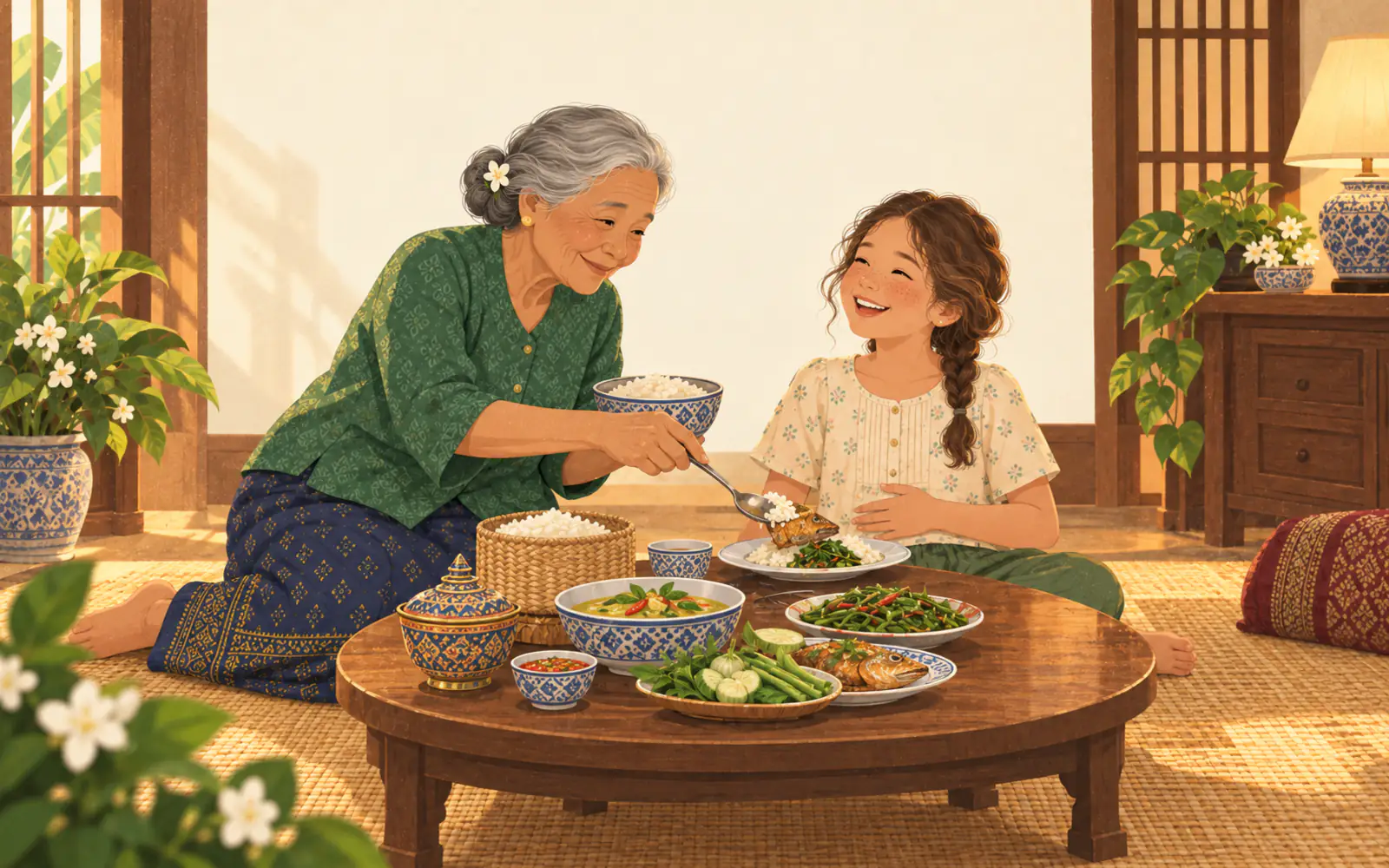
You walk in the door, or Yai’s face fills the phone screen, and before hello has even finished, there it is: have you eaten yet? It can feel like a check-up on your diet. It isn’t. In Thai, it’s one of the warmest ways to say hello.
กินข้าวหรือยัง
gin khaao rue yang
Have you eaten?
Literally: “eat rice or yet”
In Thai families, this is how love sounds.
Draft: waiting for a native speaker’s review.
What does kin khao reu yang mean?
กินข้าวหรือยัง (gin khaao rue yang) literally means “eat rice or yet?”, so “have you eaten yet?”. You’ll also see it spelled kin khao reu yang or kin khao rue yang. Romanization varies; the Thai is the same.
The rice part makes sense once you know that ข้าว (khaao) means both rice and food. Wikipedia’s Thai cuisine article notes that “the words for rice and food are the same” and that rice is so central to the Thai diet that a common greeting asks whether you’ve eaten rice yet.
But the meaning people actually hear is closer to “how are you?” or “I’ve been thinking about you”. The Nation, a Thai English-language newspaper, describes the question as something people ask instead of “how are you” and calls it “the ultimate expression of care”.
Is it really a greeting, or are they asking about lunch?
It’s a greeting. Linguists call this kind of talk phatic communication: words whose main job is social, not to exchange information. English has “how are you?”, which nobody expects a medical report for. Chinese has a similar “have you eaten?”; the Kasa study below mentions it too.
A 2021 study by Deeana Kasa of Kasetsart University watched how Thai speakers actually greet each other. Eating came up as one of the main topics of greetings, next to wellbeing, work and travel. The paper gives กินข้าวหรือยัง as an everyday example and says greetings like this express the speaker’s care and do not intend to invite the hearer to the meal or to intrude on their privacy. Its conclusion is a nice one: Thai greetings place importance on “care and attention”.
The same study also notes that this can confuse people who aren’t native Thai speakers. If you’ve ever answered with a full list of what you ate, you were not wrong. You were just answering a different question than the one being asked.
We looked for a reliable source on where the greeting comes from, and on the popular stories about it, and couldn’t find one we trust. So we’re leaving the history out.
How do you reply to gin khaao rue yang?
Short, true and warm is all it takes. The everyday answer:
กินแล้ว
gin laew
กินแล้วครับ
gin laew khrap
กินแล้วค่ะ
gin laew kha
I’ve eaten.
Literally: “eat already”
The everyday answer. With mum you can drop ครับ/ค่ะ; keep it for Yai and older relatives.
Draft: waiting for a native speaker’s review.
If you haven’t eaten, ยัง (yang) means “not yet”. Fair warning: in a lot of families, “not yet” is less an answer than a starting pistol.
Then do the part that matters most: ask back. With your grandmother on your mum’s side, that’s ยายกินข้าวหรือยัง (yaai gin khaao rue yang), “Have you eaten, Yai?”. In Thai family talk you use the kinship word instead of “you”, so swap in whoever you’re talking to. Our guide to Thai family words has the full list.
With mum you can usually drop the polite ending. With Yai and older relatives, add ครับ or ค่ะ. If your Thai already has those on every line, that’s fine; here’s why your Thai sounds like your mum.
Why does my Thai family keep feeding me?
Because in a lot of Thai families, food is how love gets said out loud. The question at the door, the extra dish nobody asked for, the spoonful that lands on your rice the moment you look away: it’s all the same sentence. In many families you’ll hear กินเยอะๆ (gin yer yer), “eat lots”, far more often than “I love you”.
It fits how Thai meals work. Dishes are shared by everyone and served at the same time, and Wikipedia notes it’s customary to put out more dishes than there are guests. Plenty is the point. An empty plate isn’t a finished meal, it’s an opening.
How do you say no to more food without hurting anyone?
This is where the third helping comes in. You’ve eaten. You’ve eaten again. Your plate is somehow full. Saying no is fine, as long as the no sounds like thank you. Three answers, from gentlest to firmest:
Take a little. You accept the offer, just smaller. Many elders like this one.
ขอนิดเดียวพอ
khor nit diao phor
ขอนิดเดียวพอครับ
khor nit diao phor khrap
ขอนิดเดียวพอค่ะ
khor nit diao phor kha
Just a little, please.
Literally: “ask-for tiny-bit enough”
The middle way: you accept her offer, but only a spoonful. Elders love this one.
Draft: waiting for a native speaker’s review.
Say you’re full. อิ่มแล้ว (im laew), “I’m full”, with a smile. Better still, add praise: อิ่มแล้ว อร่อยมากเลย (im laew, a-roi maak loei), “I’m full. It was so delicious.” The compliment is the thank-you the cook is waiting for.
Say you really can’t. When the serving spoon keeps hovering, this is soft and honest, so nobody takes it as a refusal of their cooking.
กินไม่ไหวแล้ว
gin mai wai laew
กินไม่ไหวแล้วครับ
gin mai wai laew khrap
กินไม่ไหวแล้วค่ะ
gin mai wai laew kha
I can’t eat any more.
Literally: “eat not manage already”
ไม่ไหว means “I can’t manage”. Soft and honest, so nobody at the table takes it as a refusal of their food.
Draft: waiting for a native speaker’s review.
What usually doesn’t work is a flat “no” with no warmth around it. The words can be tiny; the smile does the rest.
How do you talk back in the language of food?
If food is how your family says it cares, you can answer in the same language. A few small moves go a long way:
- Ask first. Be the one who says กินข้าวหรือยัง on the video call before they do. It tends to get a big smile.
- Ask for more of the one dish you love. Asking for seconds is a compliment, so be ready for a very full plate.
- Say the big one. For the person who cooked:
ไม่มีใครทำอร่อยเท่ายาย
mai mii khrai tham a-roi thao yaai
Nobody cooks like you, Yai.
Literally: “not have who make delicious equal grandma”
The big compliment. Works for mum too: ไม่มีใครทำอร่อยเท่าแม่.
Draft: waiting for a native speaker’s review.
It works for mum too, with แม่ (mae) instead of ยาย (yaai). You don’t need perfect tones for this one to land.
If your family mostly sees you on a screen, the video call with Yai phrases start with exactly this greeting. And if you’re wondering where to start in general, learning Thai to talk to your family is built around answers like these.
Practise the family meal before the next one
The Family meals moment in Reply Thai is built for this: “I’ve eaten”, “I’m full”, “just a little”, “can I have some more” and “nobody cooks like you, Yai”, practised as replies so they’re ready when the plate comes round a third time.
Reply Thai for iPhoneComing soonFor more Thai that sounds strange in English and lovely in Thai, see Thai phrases that are funny when translated literally, or look up กินข้าวหรือยัง in the glossary.
Thai words on this page are a draft until a native speaker has reviewed them.
Questions people ask
What does kin khao reu yang mean?
Literally “eat rice or yet?”, so “have you eaten yet?”. In practice it is a greeting, close to “how are you?”. A 2021 study of Thai greetings describes questions like this as a way to show care for the person you meet, not to invite them to a meal or intrude on their privacy.
How do I reply to gin khaao rue yang?
Say กินแล้ว (gin laew, “I’ve eaten”) if you have, or ยัง (yang, “not yet”) if you haven’t. Add ครับ or ค่ะ for Yai and older relatives. Then ask them back, for example ยายกินข้าวหรือยัง (yaai gin khaao rue yang), “Have you eaten, Yai?”
Is “have you eaten yet” an invitation to eat?
Usually not. A researcher who observed Thai greetings found the question expresses care rather than an invitation. In a family kitchen, though, saying “not yet” may well end with a plate in front of you.
Is it rude to say I’m already full?
No. อิ่มแล้ว (im laew, “I’m full”) with a smile is a normal, kind answer. It lands even softer with praise for the food, or if you accept just a little with ขอนิดเดียวพอ (khor nit diao phor), “Just a little, please.”
Why is the Thai word for food the same as rice?
Rice is the centre of a Thai meal, and the word ข้าว (khaao) covers both rice and food. So “eat rice” simply means “eat”, which is why the greeting asks about rice.
Sources
All links read on .
In the glossary: กินข้าวหรือยัง (gin khao rue yang)
How we write and check our guidesReport a mistake
Letters from the in-between
One email when there’s something worth reading: new guides, stories from other luk khrueng, and a phrase for your next family call. No spam, ever.