Sak yant rules, meaning and respect: a family guide
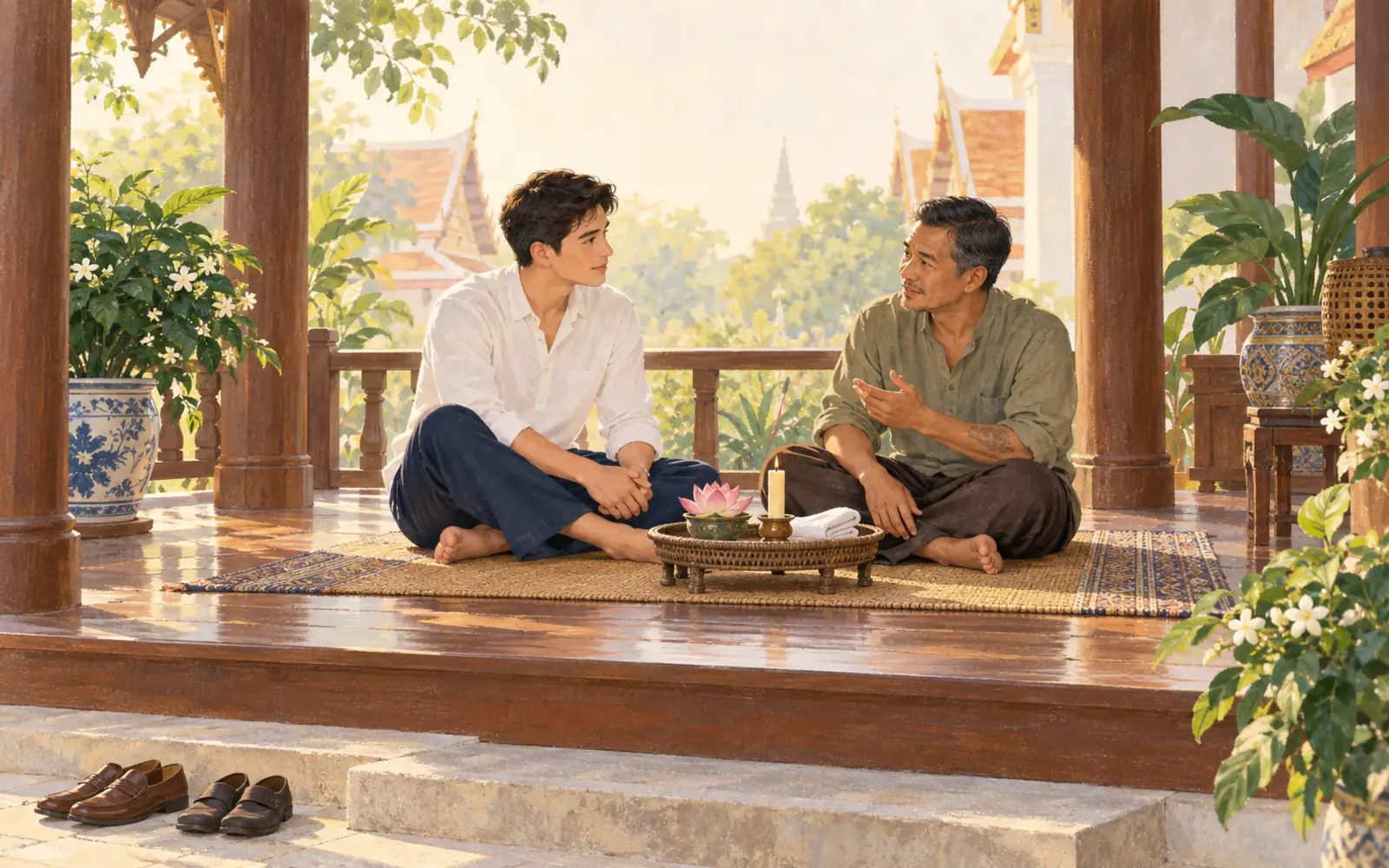
Maybe it’s the faded lines on your uncle’s shoulder. Maybe it’s the tiger on a cousin’s back, or a row of script nobody at the dinner table can quite read. Sak yant is everywhere in some Thai families and completely absent in others. Either way, it’s worth knowing what it is before anyone asks if you want one.
This page explains the meaning, the ajarn and his rules, the famous wai kru at Wat Bang Phra, and the health side. Beliefs and practice vary a lot between ajarns, temples and families. Practice varies by ajarn; ask yours.
What is a sak yant?
Sak means to tattoo and a yant is a yantra: a sacred design built from circles, triangles, squares and figures, believed to carry protective and auspicious power. A sak yant is a yantra tattooed onto the body, in ink or, for an invisible yant, in oil (Thailand Foundation, 2023).
Three strands meet in it, according to the same source:
- Brahmin-Hindu roots: the geometry and the idea of the yantra itself.
- Buddhism: Buddhist chants and symbols that complemented or replaced the original elements, and a chant of respect to the Buddha, the Dhamma and the Sangha.
- Older beliefs about the natural world: animal figures, such as the tiger for power, reflecting the regional belief that non-human beings hold spiritual power.
The writing is usually in Khom script, an adaptation of old Khmer script used to write Thai, Pali and Sanskrit, and still treated as sacred. In the north, Lanna script is common. The words are abbreviated Pali chants, Brahmin spells or both.
The same yantras also appear outside the skin: on cloth carried with you or kept at home, on rolled metal charms, and on the headband and armband muay thai fighters wear.
Where does sak yant come from?
The honest answer: long ago, and nobody can date it precisely. Wikipedia’s summary of the published research places the practice’s beginnings in the Khmer Empire around the ninth century, drawing on much older indigenous practices. We treat the details as background, not settled fact.
Sak yant is closely tied to protection. Wikipedia notes it is commonly worn by people in jobs seen as dangerous, from soldiers and police to taxi drivers. In many families, it’s simply what a grandfather or an uncle had.
What happens when you receive a sak yant?
Traditionally, the tattoo is given by an ajarn, a teacher with sacred knowledge, or by a senior monk. Bangkok Biz News describes the usual shape of it:
- You become his student. You present offerings to the ajarn and ask to be taken on.
- The design is chosen together. It comes partly from what you want and partly from what the ajarn recommends, because a yant should suit the person.
- Every mark is chanted. The ajarn recites a chant with each part of the design.
- The yant is blessed. Afterwards, the ajarn invokes his own teachers to bless it.
Wikipedia’s article on Wat Bang Phra describes the traditional method as a single long, thin needle, and notes that modern yants are done with an electric tattoo machine. You’ll also see “bamboo tattoo” advertised to tourists. Whatever the tool, what makes it a sak yant, to the people who keep the tradition, is the ajarn, the chanting and the promise, not the needle.
Among Thai Buddhists, there’s also a debate about monks giving tattoos at all. A 2026 study from Kasetsart University argued the practice sits uneasily with the monastic code, while noting a ritual can still serve as a symbol of keeping the precepts. Not every ajarn is a monk. This is a discussion inside the tradition; it isn’t ours to settle.
What are the sak yant rules?
When you receive a yant, the ajarn gives you rules. Each ajarn has his own, so write down the list yours gives you, and ask if anything is unclear. The rules commonly cited include:
- don’t abuse or speak badly of your parents;
- don’t commit adultery;
- respect your teachers;
- avoid certain foods the ajarn names;
- keep good conduct, make merit and stay out of bad company.
Traditionally, breaking the rules is said to make the yant lose its power, and keeping a pure mind and body and respecting your teachers is said to bring success in life (Thailand Foundation; Bangkok Biz News). Whatever you believe about its power, many people see the rules as the heart of it: a sak yant is a promise to live a certain way, worn where you can’t forget it.
What is the wai kru at Wat Bang Phra?
Wai kru means paying respect to your teachers. Sak yant disciples attend a wai kru before and after receiving a tattoo, to thank the masters, ask forgiveness for any wrongs and renew their commitments (Thailand Foundation).
The best-known is the yearly ceremony at Wat Bang Phra in Nakhon Chai Si district, Nakhon Pathom province, held in honour of the late Luang Phor Pern, a monk famous for his tiger and Hanuman yants. In 2026 it took place on 7 March, with devotees from across Thailand and visitors from abroad (The Standard). Wikipedia describes it as held once a year in March, so expect it usually around then.
Two things to know if you go:
- Some people go into a trance. Thais call it khong khuen: devotees with animal yants move like the animal, a tiger growling or leaping. Believers see it as the yant’s power showing. Give them space.
- There are rules for taking part. The Standard reports that participants keep the five precepts, and that restrictions apply to some people, including children, pregnant or menstruating women, and people who have acted against certain moral rules. Ask the temple what applies to you.
Dates and conditions are set by the temple. Check the date and the temple’s notices before you go. Venue details last checked 14 October 2026.
You don’t need the big gathering. Many people simply pay respect to their own ajarn, privately, before and after.
How do you choose an ajarn respectfully?
We don’t recommend individual ajarns or studios: we can’t check them, and a sak yant is for life. What we can offer is how families usually go about it:
- Ask your family first. Many Thai families know someone they trust, or know a temple a grandparent went to. That’s a better start than a sign saying “sak yant” on a tourist street.
- Visit before you decide. Watch, ask, come back another day. Taking your time is a sign of respect, not doubt.
- Ask what the design means and which rules come with it, before you begin.
- Ask about hygiene (below). It’s always fine to ask.
- Greet the ajarn with a wai, and thank him at the end.
สวัสดีครับ
sa-wat-dii khrap
สวัสดีครับ
sa-wat-dii khrap
สวัสดีค่ะ
sa-wat-dii kha
Hello. (polite, to an elder)
Literally: “hello (polite ending)”
With elders and people you’ve just met, the ครับ/ค่ะ and a wai carry the respect.
Draft: waiting for a native speaker’s review.
ขอบคุณ
khorp khun
ขอบคุณครับ
khorp khun khrap
ขอบคุณค่ะ
khorp khun kha
Thank you.
Add the kin word and it’s personal: ขอบคุณค่ะย่า, ขอบคุณครับย่า. With elders, keep ครับ/ค่ะ.
Draft: waiting for a native speaker’s review.
If you’re a woman, know that monks keep strict rules about physical contact with women, and the 2026 Kasetsart study discusses how they apply to tattooing. Many monks don’t tattoo women, and many women go to a lay ajarn instead. That’s about the monk’s discipline, not a judgement about you, and not every ajarn is a monk.
Is sak yant safe?
A sak yant is still a needle in your skin, so the same health rules apply as for any tattoo.
- The main risk is infection. The UK Health Security Agency warns that tattooing carries a risk of bloodborne viruses such as hepatitis B, hepatitis C and HIV. Australia’s healthdirect says this may happen when contaminated equipment is used.
- Setting matters. A 2012 review by CDC researchers found no definitive evidence of extra hepatitis C risk from professional parlours, but a significant risk from tattoos done in prisons or by friends.
- Choose a place that uses sterile procedures and equipment. healthdirect suggests asking how they sterilise their equipment and whether they reuse needles, and asking friends or family where they went and how clean it was. Any good ajarn or tattooist will understand the question.
- If you take medicines, healthdirect notes you may need to avoid some beforehand, but check with your doctor before stopping or changing any. If you have health questions, ask your doctor before you go ahead.
How do you look after a new sak yant?
A new tattoo is a skin wound and can take weeks to heal. healthdirect’s advice is to follow your tattooist’s aftercare instructions, clean the area with running water and a little soap and pat it dry, don’t pick or scratch it, avoid swimming and baths until it has healed, and avoid tight or dirty clothing over it.
Watch for signs of infection. healthdirect says a tattoo may be infected if it becomes painful, bleeds a lot or weeps pus, and that you should see a doctor, as you may need antibiotics. The NHS describes cellulitis, a skin infection, as skin that is painful, hot and swollen, usually red (less obvious on brown or black skin), sometimes with feeling unwell, and says early antibiotics can stop it becoming more serious. In Thailand, go to a clinic or hospital.
How do you show respect, as a visitor or as family?
The core idea is “high and low”. In Thai culture the head is the highest, most sacred part of the body and the feet the lowest, which is why sacred objects are kept high (Thailand Foundation, 2024). For sak yant that means:
- Keep sacred designs high on the body. In 2011 a well-known sak yant master told MGR Online that tattooing images of the Buddha and other sacred figures in low places, such as an ankle, is deeply disrespectful, and that he had refused foreigners who asked him for that.
- A yant is not a Buddha image, and a Buddha image is not decoration. In 2011 Thailand’s culture minister said “foreigners see these tattoos as a fashion”, and the ministry asked parlours to stop and asked provincial governors to inspect tattoo studios and seek their cooperation (AP via NBC News, 2 June 2011). It was a request, not a law: the minister wanted a law against it, but a ministry official said the practice was not yet illegal under Thai law.
- Be modest about it at the temple and with elders. Covering up at a temple is good manners anyway; see our temple etiquette guide.
If you’re a visitor: you’re not doing anything wrong by being curious or by receiving a yant. Treat it as what it is to the people around you: a blessing with rules, from a teacher.
If you’re Thai by family: you may feel you need permission, or that you’re “not Thai enough” to wear one. You don’t need to prove anything. The better question is what it means in your family. Ask your grandfather or your uncle what his yant is, who gave it, and whether he kept the rules. Some families love it; some would rather you didn’t. Both are allowed, and the conversation is worth having either way.
What we couldn’t confirm
- A precise origin date. Published accounts differ; we give the outline only.
- The exact timing rule for the Wat Bang Phra wai kru. We confirmed it is yearly and was held on 7 March 2026; we didn’t find an official rule for how the date is set each year. Ask the temple.
- Sak-yant-specific health guidance. The health advice above is general tattoo guidance from health bodies; we found none written for sak yant or for Thailand specifically. See a doctor if in doubt.
- The history of the “bamboo” method. Sources we could check describe a long metal needle as the traditional tool; we couldn’t find an independent source on bamboo, so we make no claim about it.
Learn more in Reply Thai
Reply Thai’s At the temple guide has a Sacred objects section with cards on amulets, Yai’s amulet and “Sak yant, explained”, each with sources and the same reminder: practice varies by ajarn, so ask yours.
Thai words on this page are a draft until a native speaker has reviewed them. Last checked 14 October 2026.
Questions people ask
What are the rules of a sak yant?
Each ajarn gives his own list, so ask yours and write it down. Commonly cited rules include not abusing your parents, not committing adultery, respecting your teachers and avoiding certain foods. Traditionally, breaking them is said to make the yant lose its power.
Is it disrespectful for a foreigner to get a sak yant?
Not in itself: foreigners receive yants and attend the Wat Bang Phra wai kru. What offends is treating it as fashion, especially sacred images placed low on the body. In 2011 Thailand's culture ministry asked tattoo parlours to stop giving Buddha images to tourists; the minister said foreigners saw them as a fashion.
Was there a law against foreigners getting Buddhist tattoos?
No law, according to the 2011 reporting we read. The culture ministry asked tattoo parlours to stop, asked provincial governors to inspect studios and seek their cooperation, and the minister wanted a law against it. A ministry official said tattooing religious images was not yet illegal under Thai law.
When is the Wat Bang Phra wai kru festival?
It's held once a year at Wat Bang Phra in Nakhon Pathom, usually in March; in 2026 it was on 7 March. Participants are asked to keep the five precepts. Check the date with the temple before you go.
Is sak yant safe?
Any tattoo carries a risk of infection, including bloodborne viruses such as hepatitis B, hepatitis C and HIV if equipment isn't clean. A 2012 review found no definitive evidence of extra hepatitis C risk from professional parlours, but a significant risk from tattoos done in prisons or by friends. Choose a place that uses sterile equipment, and ask whether they reuse needles.
Sources
All links read on .
- Thailand Foundation: Yantra, from sacred geometry to sacred tattoos (2 March 2023)
- Bangkok Biz News: Thai sak yant, the ajarn, the ceremony and the rules (Thai, c. February 2024)
- The Standard: the wai khru at Wat Bang Phra, Nakhon Pathom (Thai, 7 March 2026)
- Associated Press via NBC News: Thailand wants to stop Buddha tattoos for tourists (2 June 2011)
- MGR Online: the culture minister and a sak yant master on sacred images tattooed low on the body (Thai, 31 May 2011)
- Thailand Foundation: Feet low, head high, a guide to Thai etiquette (16 February 2024)
- Kasetsart University, Journal of Buddhist Development Studies: monks, sak yant and the Vinaya (Thai, English abstract, 10 February 2026)
- UK Health Security Agency: Tattooing and body piercing, infection prevention and control (5 March 2025)
- Tohme and Holmberg (CDC), Clinical Infectious Diseases 54(8), 2012: hepatitis C transmission through tattooing and piercing, a critical review
- NHS: Cellulitis (reviewed 18 April 2024)
- healthdirect (Australian Government): Body piercings and tattoos (last reviewed December 2024)
- Wikipedia: Sak Yant (background)
- Wikipedia: Wat Bang Phra (background)
How we write and check our guidesReport a mistake
Letters from the in-between
One email when there’s something worth reading: new guides, stories from other luk khrueng, and a phrase for your next family call. No spam, ever.