Muay thai for beginners: the basics and the wai kru
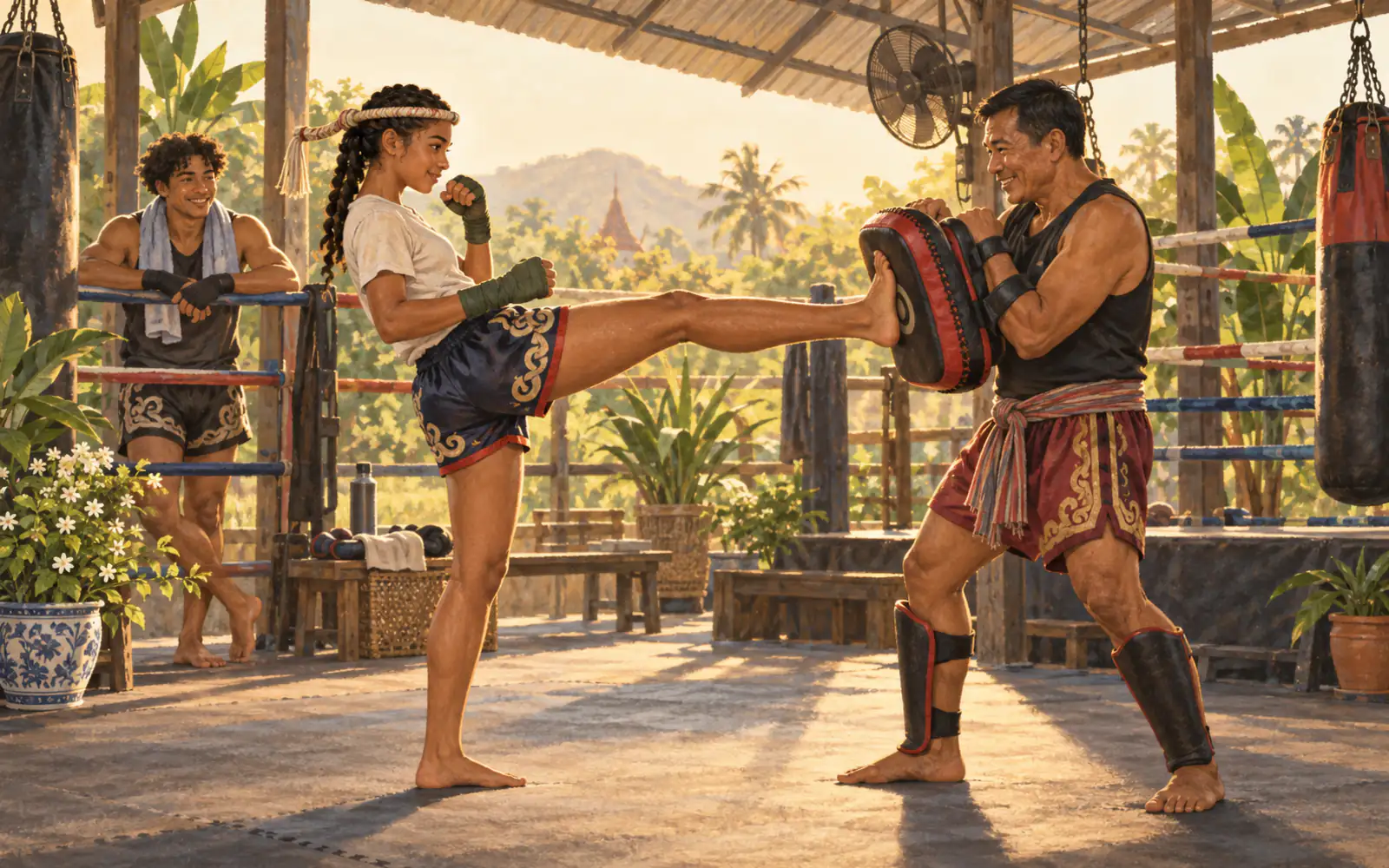
In a lot of Thai families there is one uncle who knows exactly when the fights are on. The TV goes up, the room goes quiet for the first round, and then it absolutely does not stay quiet. If you grew up half-watching from the doorway, this page is the explainer nobody gave you, plus how to try it yourself.
What is muay thai?
Muay thai, often called Thai boxing, is a Thai martial art and full-contact combat sport. Its nickname is the art of eight limbs, because it uses fists, elbows, knees and shins: eight points of contact where boxing uses two. Fighters also grip each other in the clinch, which is where many of the knees come from.
Where does muay thai come from?
From Thailand, but the when is where people start arguing.
The modern sport is fairly young. British boxing entered the curriculum at Suan Kulap College in Bangkok in 1913, and Siam’s first permanent ring was built there in 1921. Under King Rama VII (1925–1935), fights got codified rules, referees and timed rounds. Gloves, first used in training and against foreign boxers, replaced the older rope bindings on the hands.
Before that, there was a wider family of fighting styles, now grouped as muay boran, “old boxing”. It included grappling and techniques that the ring rules later dropped. If you want the regional styles and how they differ, see our guide to muay boran.
Older origin stories are debated, and the sources don’t agree:
- TAT’s 2017 explainer says the wai kru reportedly dates to the Sukhothai kingdom, and retells the story of Nai Khanom Tom beating ten Burmese fighters in 1774. IFMA’s history page places the sport’s roots in the Sukhothai and Ayutthaya kingdoms and calls Nai Khanom Tom’s story one of the “tales” that still echo.
- Wikipedia’s summary notes that the surviving evidence is too thin to prove a much longer history, and that scholars think the Nai Khanom Tom story probably took shape in the 20th century.
- The anthropologist Peter Vail, writing in 2014, argues that some of what is presented as muay thai’s ancient tradition has been built up more recently, as the sport became a national symbol.
None of that makes the sport any less Thai, or any less yours. It just means we’d rather tell you honestly than pick a date. Your uncle may have a firm view. Let him.
What is the wai kru ram muay?
It’s the part before the fight that looks like a dance, and it’s the bit that matters most to a lot of Thai fans.
- Wai kru means paying respect to the teacher. The word kru is the same teacher you’ll hear in a classroom. TAT’s explainer stresses that it is about gratitude to a boxer’s mentors, and to the past teachers of the line, not just a show.
- Ram muay is the slow routine that follows. Ram is classical-style dancing and muay is boxing. TAT compares it to an improvised dance that can vary from night to night, and Wikipedia notes that a ram muay often holds clues about who trained the fighter and where they’re from.
Typically the boxer circles the ring, stops at each corner, and bows three times, for the Buddha, the Dhamma and the Sangha. Wikipedia describes the whole ritual as a thank-you to the boxer’s teacher, parents and ancestors. If you’ve been to a temple with your family, the bows will feel familiar; our temple etiquette guide explains the same three bows.
The live music is part of it too. TAT describes a small ensemble playing through the wai kru and every fight: two-sided drums, the ching (small cymbals) and the pi chawa, the reedy pipe that gives the music its rising, wailing sound.
What do the headband and armbands mean?
- The mongkhon is the headband worn into the ring and through the ritual. It’s traditionally presented by the trainer, and many boxers have it blessed by a monk. After the wai kru the trainer takes it off and may leave it in the corner for luck. Today it’s worn as a tribute to the boxer’s gym.
- The pra jiad are armbands. They’re said to come from wartime, when young men tore off a piece of a loved one’s clothing to carry into battle. Some schools abroad now use coloured pra jiad to show rank.
IFMA calls both symbols of courage, gratitude and spiritual protection. Treat them like you’d treat anything given by a teacher: not as a costume. Sacred tattoos are a separate subject with their own etiquette; our sak yant guide covers them.
Is muay thai in the Olympics?
Not as an Olympic event, but its world federation is recognised by the International Olympic Committee. According to the International Federation of Muaythai Associations (IFMA), the IOC’s Executive Board gave it provisional recognition on 6 December 2016, and full recognition followed in 2021, during the Tokyo Games. Recognition is not the same as being on the Games programme.
How do you start muay thai abroad?
If there’s a muay thai class near you, a few practical pointers, from the “wish someone had told me” file:
- Look for a beginners’ class, not an open fight-team session. Ask who coaches it and how long they’ve trained and taught.
- First class kit: comfortable sportswear and water. Many gyms lend gloves at first; ask before you buy. Shin guards and a mouthguard come later, before any sparring.
- Tell the coach about injuries. A good coach adjusts; a coach who doesn’t is information too.
- Expect technique first: stance, the teep (push kick), the round kick, pad work. Sparring is something you work up to, not day one.
- Go at your own pace. Nobody is checking how Thai you are by how hard you kick. Being the only one in class with a Thai mum is not a performance target.
How long it takes to “learn” muay thai depends on how often you train and what you want from it, and we haven’t found a reliable source that puts a number on it, so we won’t either.
Can you train in Thailand on a family trip?
If you’d like to try a session while you’re there, ask ahead rather than just turning up. A few things to think about:
- Heat. Training in Thai heat is harder than at home. Mornings and evenings are cooler.
- Ask your family. Someone always knows someone. A relative’s recommendation, and an introduction, often beats any online list.
- Show respect the Thai way. Greet the trainer politely when you arrive and thank them at the end, with a wai. These two lines cover it:
สวัสดีครับ
sa-wat-dii khrap
สวัสดีครับ
sa-wat-dii khrap
สวัสดีค่ะ
sa-wat-dii kha
Hello. (polite, to an elder)
Literally: “hello (polite ending)”
With elders and people you’ve just met, the ครับ/ค่ะ and a wai carry the respect.
Draft: waiting for a native speaker’s review.
ขอบคุณ
khorp khun
ขอบคุณครับ
khorp khun khrap
ขอบคุณค่ะ
khorp khun kha
Thank you.
Add the kin word and it’s personal: ขอบคุณค่ะย่า, ขอบคุณครับย่า. With elders, keep ครับ/ค่ะ.
Draft: waiting for a native speaker’s review.
For who’s who in a Thai room (and why the trainer isn’t called by first name alone), our guide to Thai family words explains how Thai uses titles and age.
Is muay thai on UNESCO’s living-heritage list? Where it stands, and which Thai traditions are, is in Thailand on UNESCO’s living-heritage list.
Say it like family, ringside or on the call
Reply Thai won’t teach you a round kick. It does help with the polite hello and the thank-you, practised as replies, so they come out naturally with the trainer, and with the uncle who will want a full report afterwards.
Thai words on this page are a draft until a native speaker has reviewed them.
Questions people ask
Why is muay thai called the art of eight limbs?
Because it uses eight points of contact: two fists, two elbows, two knees and two shins. That combination is what sets it apart from boxing, which uses only the fists.
Where does muay thai come from?
From Thailand. Modern muay thai grew out of older bare-hand fighting, now called muay boran, and took its present shape under King Rama VII (1925–1935), when codified rules, referees, timed rounds and gloves came in. Stories that date it back many centuries are debated: scholars think the famous Nai Khanom Tom story probably took shape in the 20th century.
What is the wai kru ram muay?
It is the ritual a boxer performs in the ring before a fight, with live music. The wai kru pays respect to the teacher; the ram muay is a slow, personal routine. Together they show respect and gratitude to the boxer’s teachers, and Wikipedia adds parents and ancestors.
What is the headband in muay thai?
It is the mongkhon, traditionally presented to the boxer by the trainer and often blessed by a monk. The trainer takes it off after the wai kru. The pra jiad are the armbands. IFMA describes both as symbols of courage, gratitude and spiritual protection.
Is muay thai an Olympic sport?
Not on the Olympic programme, but its federation is recognised. IFMA says the International Olympic Committee gave it provisional recognition on 6 December 2016 and full recognition in 2021, during the Tokyo Games.
Do I need to be fit before my first muay thai class?
No. A beginners’ class is where fitness starts. Tell the coach about any injuries, go at your own pace, and expect most of the first sessions to be technique and pad work rather than sparring.
Sources
All links read on .
- Tourism Authority of Thailand (TAT News): “Wai Kru Muay Thai Ritual: Why It Matters” (15 March 2017)
- International Federation of Muaythai Associations (IFMA): History of Muaythai (undated; read 14 October 2026)
- International Federation of Muaythai Associations (IFMA): About us, on IOC recognition (undated; read 14 October 2026)
- Peter Vail, “Muay Thai: Inventing Tradition for a National Symbol”, SOJOURN: Journal of Social Issues in Southeast Asia 29(3), November 2014 (ISEAS abstract; read 14 October 2026)
- Wikipedia: Muay Thai (history, rules, mongkhon and pra jiad; read 14 October 2026)
- Wikipedia: Wai khru ram muay (read 14 October 2026)
- Wikipedia: Muay boran (read 14 October 2026)
- Wikipedia: Pi chawa (read 14 October 2026)
How we write and check our guidesReport a mistake
Letters from the in-between
One email when there’s something worth reading: new guides, stories from other luk khrueng, and a phrase for your next family call. No spam, ever.