Muay boran vs muay thai: the old styles, explained
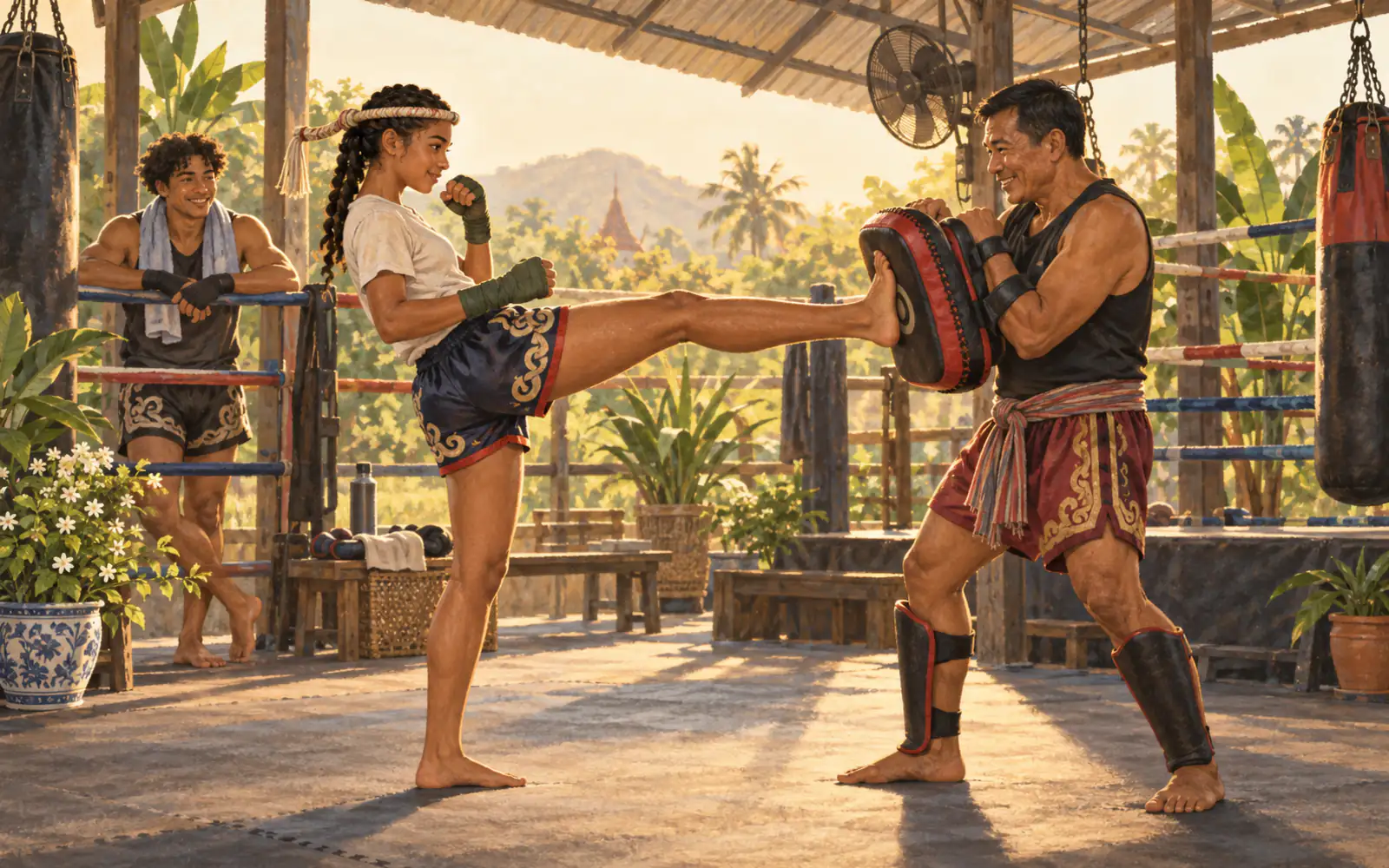
Ask an older relative about muay thai and you might get two answers: the fights on Sunday television, and something older, from a temple fair or a grandfather’s story, that didn’t look quite like the ring. That older thing has a name now: muay boran.
What is muay boran?
Muay boran means, roughly, “old boxing”. It isn’t one martial art with one rulebook. Wikipedia describes it as an umbrella term for the older unarmed fighting arts of Thailand, from before the modern equipment and rules, and notes that the label itself only became common fairly recently.
What sits under the umbrella are regional styles, each shaped by the teachers and the places that kept it going. A 2025 opinion piece in the Bangkok Post, by Somsak Wiwatpaisal and later republished by the Siam Society, makes exactly this point: behind the televised ring fights is a “diverse” legacy of traditions that developed differently across the country over centuries.
How is muay boran different from muay thai?
The short version: muay thai is the ring sport; muay boran is what came before the ring.
According to Wikipedia’s summary, Thai fight competitions were modernised in the 1920s and 1930s, bringing in referees, boxing gloves, timed rounds and Western-style rings. Many traditional techniques were banned or simply didn’t work under the new rules, and the older styles declined. The name “muay thai” itself was used to tell Thai boxing apart from Western boxing.
The differences people usually point to:
- Hands. Before gloves, fighters wrapped their hands and forearms in hemp rope, which protected the fists.
- What’s allowed. Modern muay thai is a stand-up ring sport with rules about what you can do. The older styles also included grappling, according to Wikipedia.
- Purpose. A ring fight is scored or won inside a set time. The older styles were taught as fighting arts, with the stance and footwork of their region.
How old the older styles are is a genuinely debated question. You’ll see very early dates quoted online (Wikipedia mentions a 7th-century origin for Lopburi and a 13th-century date for “muay thai boran”) but the article itself is flagged as needing better sources. We don’t repeat any date as settled.
What are the four regional styles?
Two old sayings, quoted in the Bangkok Post piece, sum up three of them: “Heavy fist Korat. Clever Lopburi. Graceful Chaiya.” And: “Straight punches, Lopburi. Kicks, Korat. Elbows and knees, Chaiya.” The two sayings don’t quite agree on Korat, which is a fair warning about how much of this lives in memory rather than in writing.
Muay Chaiya (south)
From Chaiya, in the south. The Bangkok Post piece describes a tight, compact way of moving in which every joint is both weapon and defence, a low and balanced stance, and blocks that can hurt. Its signature is elbows and knees. The author links it to southern fishing and farming life: a fighter “equally adept on a boat or muddy ground”. TAT describes Chaiya as focused on defensive counter-attacks.
Muay Korat (northeast)
From Korat, in the northeast. The Bangkok Post piece credits it with a precise, powerful short-range kick and big swinging punches, with the front foot planted and the rear foot on its toes. TAT calls it the style known for powerful strikes.
Muay Lopburi (central)
From central Thailand. Known for straight punches and tactical cleverness, including uppercuts and hidden movements, according to the Bangkok Post piece. TAT describes it as recognised for movements meant to deceive.
Muay Tha Sao (north)
From the north, according to TAT, which describes it as emphasising speed and agility. Wikipedia calls it more recent than the other styles, with defence as its strength: stance changes to adapt to the opponent and to guard against leg kicks. The Bangkok Post piece names a Tha Sao school but doesn’t describe the style’s techniques.
Is muay boran making a comeback?
There’s more of it to see than there was a generation ago. The Bangkok Post piece credits the 2003 film Ong-Bak with putting the “ancient style” in the spotlight, and commercial and fitness versions with drawing young people in.
Official events now put the regional styles on stage. In March 2025 the Tourism Authority of Thailand promoted the 17th World Wai Kru Muay Thai Ceremony at Ayutthaya Historical Park, held at Wat Mahathat and Wat Langkha Khao, with live demonstrations of Chaiya, Korat, Tha Sao and Lopburi. TAT expected about 5,300 attendees, including 1,800 international visitors. The 2024 edition’s programme had also listed showcases of Muay Chaiya, Korat, Tha Sao and Lop Buri.
Not everyone reads the renewed interest the same way. The anthropologist Peter Vail, writing in 2014, argues that some of what is presented as muay thai’s ancient tradition has been built up more recently, as the sport became a national symbol. That’s a debate among researchers, not a verdict on any teacher, and it sits alongside the Bangkok Post piece’s own worry.
The same Bangkok Post piece is also a warning. Its author worries that few keepers of the traditional knowledge remain, that some groups have merged all the styles into one “standard” form, and that others sell a showy, invented “ancient” muay thai for the market. He calls on the Ministry of Culture and the Ministry of Tourism and Sports to consult folk experts and historical research, so each regional style keeps its own identity.
Where is muay boran taught?
We aren’t recommending schools on this page. The evidence we’d want for a recommendation (independent, repeated, dated coverage) isn’t there yet for most places, and online listings are easy to make.
What we can tell you is what one serious source names. The Bangkok Post piece lists traditional houses that keep particular styles alive, among them Muay Chaiya Ban Khru Praeng (the Chaiya boxing house of Master Praeng), Muay Tha Sao Phraya Phichai, the Master Lek boxing house of Ban Chang Thai, and the Master Bua School of Korat Boxing at Im Temple, led by Master Tui. It also names the Muay Thai Teachers Association and the Siam Yuth Association, which have researched historical texts. We’re reporting what the piece says, not recommending anyone; check directly before you go.
If you’re looking for a teacher, three questions help:
- Which style? A real teacher will name the regional style and where it comes from, rather than “ancient muay thai” in general.
- Whose line? Ask who taught them and who taught their teacher. In these traditions, the teacher’s line matters.
- Is it a show or a class? Demonstrations are lovely to watch. Learning is slower, plainer and more repetitive.
What does the wai kru have to do with it?
Respect for the teacher runs through all of it. TAT calls the wai kru “a time-honoured tradition of paying homage to their masters”, and our muay thai beginners’ guide explains the ritual, the music and the headband. In a class, that respect starts with how you greet your teacher. If you don’t know where to start, start with the polite hello and a wai, the same one you give Yai:
สวัสดีครับ
sa-wat-dii khrap
สวัสดีครับ
sa-wat-dii khrap
สวัสดีค่ะ
sa-wat-dii kha
Hello. (polite, to an elder)
Literally: “hello (polite ending)”
With elders and people you’ve just met, the ครับ/ค่ะ and a wai carry the respect.
Draft: waiting for a native speaker’s review.
How the wai itself works (who bows lower, when) is in our guide to the Thai wai.
Ask your family what they remember
If your grandparents grew up near Chaiya, Korat, Lopburi or the north, ask them. Did they see fights at a temple fair? Did anyone in the family train? Were the hands wrapped in rope or in gloves? Those memories are exactly the kind of knowledge the Bangkok Post piece worries about losing, and they’re yours to keep.
Thai words on this page are a draft until a native speaker has reviewed them.
Questions people ask
What is the difference between muay boran and muay thai?
Muay boran is the umbrella name for Thailand’s older fighting styles. Muay thai is the modern ring sport that grew out of them after the 1920s and 1930s, when competitions brought in referees, boxing gloves, timed rounds and Western-style rings, and many older techniques were banned or no longer practical.
What are the regional styles of muay boran?
The four usually named are Muay Chaiya from the south, Muay Korat from the northeast, Muay Lopburi from central Thailand and Muay Tha Sao from the north. TAT’s 2025 description: Chaiya focuses on defensive counter-attacks, Korat on powerful strikes, Tha Sao on speed and agility, and Lopburi on movements meant to deceive.
What did fighters wear before boxing gloves?
Hemp rope wrapped around the hands and forearms, which protected the fists, according to Wikipedia. Gloves came in with the ring rules of the 1920s and 1930s.
Can you still see muay boran in Thailand?
Yes. The World Wai Kru Muay Thai Ceremony at Ayutthaya Historical Park, which the Tourism Authority of Thailand promotes, included live demonstrations of the Chaiya, Korat, Tha Sao and Lopburi styles in March 2025.
How do I find a real muay boran teacher?
Ask which regional style and which teacher’s line they come from. A Bangkok Post opinion piece from 2025 warns that some groups blend all the styles into one standard form or sell a showy “ancient” style for the market, and that few keepers of the traditional knowledge remain.
Sources
All links read on .
- Somsak Wiwatpaisal, “Keep Muay Thai’s roots alive”, Bangkok Post opinion (27 March 2025), republished by the Siam Society Knowledge Hub (19 July 2026)
- Tourism Authority of Thailand (TAT News): 17th World Wai Kru Muay Thai Ceremony in Ayutthaya, 16–17 March 2025 (11 March 2025)
- Tourism Authority of Thailand (TAT News): World Wai Kru Muay Thai Ceremony returns in its 16th year (7 March 2024)
- Peter Vail, “Muay Thai: Inventing Tradition for a National Symbol”, SOJOURN: Journal of Social Issues in Southeast Asia 29(3), November 2014 (ISEAS abstract; read 14 October 2026)
- Wikipedia: Muay boran (background; read 14 October 2026)
How we write and check our guidesReport a mistake
Letters from the in-between
One email when there’s something worth reading: new guides, stories from other luk khrueng, and a phrase for your next family call. No spam, ever.