Thai desserts your family makes, and what they mean
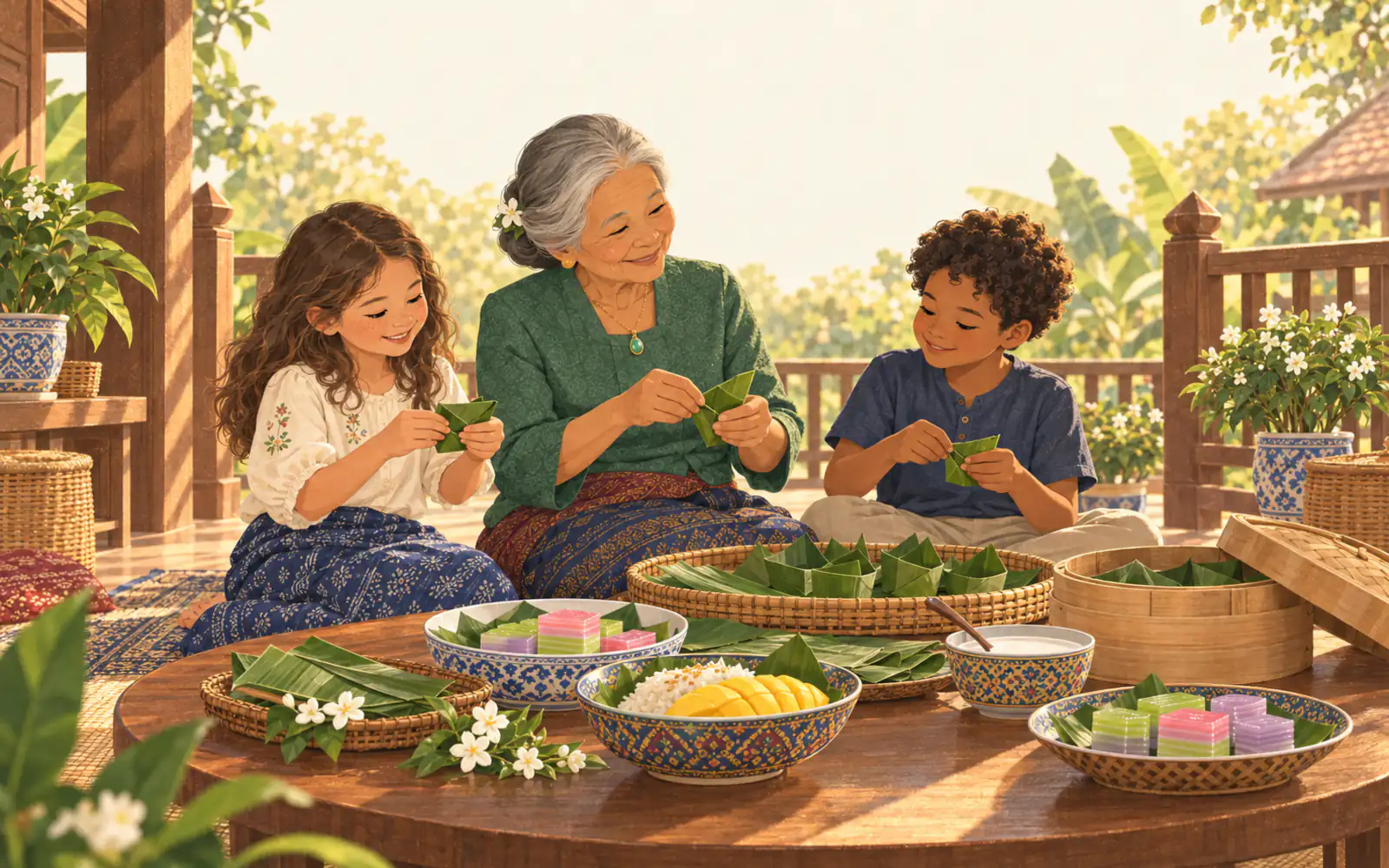
Some families say it with words. A lot of Thai families say it with a little plastic box of something sweet, pressed into your hand as you leave, “for the road”. If you grew up with a Thai mum or Yai, you probably know the feeling of not knowing the name of the thing you’re eating, only that it tastes like her kitchen.
This page is a field guide to those sweets: what they are, what they mean, and when families make them. It is not a recipe book. The best recipe for your family’s version is the one in your Yai’s head.
What counts as a Thai dessert?
In Thai the word is khanom, and it’s wider than “dessert”. Wikipedia’s list of Thai desserts describes khanom as a snack or sweet food made from flour. So a market snack and a plate of something sweet after dinner can both be khanom.
The sweets on this page share a short list of things: rice or rice flour (often glutinous, “sticky”, rice), coconut milk, sugar, eggs, pandan leaf for colour, and fruit. What changes is the technique: steamed, boiled, set in layers or shaped by hand.
When is mango sticky rice season?
Mango sticky rice (khao niao mamuang) is the one everyone knows: sticky rice soaked in sweet, slightly salty coconut milk, next to slices of ripe mango. Thailand even had a moment over it in April 2022, when the rapper Milli ate a bowl on stage at Coachella and, as NBC News reported, set off a mango sticky rice rush back home.
The season is the hot season. The MICHELIN Guide’s piece on Thai mangoes puts the peak for ripe mangoes at March to May, with April and May the best months because the trees flower in December. Nam dok mai, the sweet, smooth everyday mango, is sold all year. Many people, though, swear by ok rong, a paler, more fibrous mango with a stronger scent, as the best one for the dish.
How it works, in short, as Wikipedia describes it: the rice is soaked, then steamed. Coconut milk is warmed with sugar and salt without boiling, mixed into the rice and left to soak in, and the rest of the coconut milk is drizzled on top. Wikipedia also notes that in the North and Northeast, plain sticky rice is an everyday staple, eaten with the hands and without coconut. So if your family’s version skips the coconut, that’s a different habit, not a shortcut. Our guide to Thai food by region explains where sticky rice is everyday rice.
Ask Yai: which mango does she wait for? How long does she soak the rice? Does she add the salt to the coconut milk or save it for the topping? Those three answers are most of the recipe.
What are the golden desserts at weddings and big family days?
If there’s a tray of bright yellow-gold sweets at a wedding or a house-warming in your family, you’re looking at the egg-yolk desserts. Three of them are especially common:
- Thong yip: a small golden sweet of egg yolk and sugar.
- Thong yot: “golden drops” of egg yolk, as National Geographic puts it.
- Foi thong: long golden strands of egg yolk cooked in hot sugar syrup.
Their names carry the meaning. Thong means gold, so they’re wishes for prosperity, and the Thailand Foundation’s guide to the auspicious desserts explains each name: thong yip suggests “catching” wealth without hardship, thong yot plenty of money that keeps flowing, and foi thong, with its long unbroken threads, lasting love. That’s why foi thong is a wedding classic.
They’re part of a wider set often called the nine auspicious Thai desserts. One common list, from that same guide: thong yip, thong yot, foi thong, thong ek (first place, for promotions and success), dara thong (golden stars), met khanun (support), khanom chan (layers, for moving up in life), khanom thuai fu (growth) and sane chan (charm). Lists vary a little from source to source, and from family to family.
Where they came from is a story with a twist. National Geographic credits Maria Guyomar de Pinha, a cook of Portuguese and Japanese descent at the court of King Narai in the 17th century, with popularising sweets made from egg yolks and sugar. It says foi thong derives from Portugal’s fios de ovos, “egg threads”, and that thong yot was inspired by ovos moles from Aveiro. If your family is part Portuguese or Brazilian and part Thai, that’s quite a dessert table.
If you’re going to a Thai wedding, our guide to money envelopes at Thai weddings covers the other thing people bring.
What is khanom chan, the layer cake?
Khanom chan means “layer dessert”. Wikipedia describes a steamed sweet typically made from tapioca flour, rice flour and coconut milk, often coloured green with pandan, built up one layer at a time. Plenty of us ate it by peeling the layers off one by one.
It’s on the auspicious list because, as the Thailand Foundation puts it, the layers signify progress and accomplishment: a wish for moving up in life. The patience is the technique: each layer has to be completely set before the next one goes on.
What is bua loy?
Bua loy is small, chewy balls of glutinous rice flour in warm, sweet, slightly salty coconut milk. The balls are boiled until they float, and Wikipedia translates the name as “floating lotus”. Tasting Table notes the balls are often coloured, with pandan for green, and that with a poached egg it becomes bua loi kai wan.
It’s an easy one to make with kids: rolling the balls is the fun part, and an uneven ball tastes exactly the same.
What is tub tim grob?
Tub tim grob (also spelled thapthim krop) means “crispy rubies”. Small cubes of water chestnut are coloured red and boiled in tapioca flour, then eaten with coconut milk and ice, which is exactly what you want on a hot afternoon.
What is luk chup?
Luk chup are tiny sweets shaped and painted like fruit and vegetables: mini mangoes, cherries, aubergines. The Thailand Foundation describes the filling as a paste of mung beans, coconut milk, sugar and salt, hand-painted with food colour and coated in a thin agar or gelatin jelly. They turn up at festivals, religious ceremonies and as gifts.
Their history is debated. A 2026 academic review in a Thai journal sets out two views: that luk chup grew out of Portuguese marzipan in the Ayutthaya period, or that it began later, in the Rattanakosin period. Its key evidence is a handwritten letter saying luk chup was a favourite royal dish of King Mongkut (Rama IV), which suggests it existed by his reign. Either way, it’s a dessert that rewards a steady hand, and it’s a lovely thing to make with an older relative who has one.
Why do desserts turn up at temple days and celebrations?
The Thailand Foundation says luk chup is loved at festivals and religious ceremonies, and that the auspicious desserts, with their names full of good wishes, are given at occasions from weddings to house-warmings. If you’re joining your family at the temple, our Thai temple etiquette guide covers what to wear and where to sit.
Whatever your family brings, it’s usually made or bought with care, so this is a good moment to say thank you to whoever got up early to make it.
How do you ask for it less sweet, or ask for more?
Thai desserts can be very sweet. If you’re ordering at a market stall, this is the phrase:
หวานน้อย
waan noi
หวานน้อยครับ
waan noi khrap
หวานน้อยค่ะ
waan noi kha
Less sweet, please.
Literally: “sweet little”
Street tea comes very sweet. หวานน้อย asks for less; ไม่หวาน means no sugar at all.
Draft: waiting for a native speaker’s review.
At home, the more useful phrase is the opposite one. Asking for more is the best compliment a cook can get:
ขออีกได้ไหม
khor iik dai mai
ขออีกได้ไหมครับ
khor iik dai mai khrap
ขออีกได้ไหมคะ
khor iik dai mai kha
Can I have some more?
Literally: “ask-for more can question”
Asking for seconds is itself the biggest compliment. Be ready for a very full plate.
Draft: waiting for a native speaker’s review.
And if you want the recipe, start by helping. มีอะไรให้ช่วยไหม (mii a-rai hai chuai mai), “Anything I can help with?”, is how a lot of family recipes get passed on: standing next to someone at the stove, then writing it down afterwards. For more ways to talk about food with your family, see why Thai families ask “have you eaten yet?”.
How do you get Yai’s version written down?
Recipes in Thai families often live in hands, not notebooks. “Some coconut milk, not too much, until it looks right.” A few things help:
- Cook it with her, don’t just watch. Measure what she uses as she goes, quietly, with your own spoons.
- Ask the “why” questions. Why this mango? Why the salt? Why steam, not boil? The answers carry the technique.
- Record it on a video call if she’s far away. Our video call with Yai phrases get you through the hello.
- Write the family name for it, even if it’s not the “official” one. That’s part of the recipe too.
And when you taste it at the end, there’s only one right thing to say:
ไม่มีใครทำอร่อยเท่ายาย
mai mii khrai tham a-roi thao yaai
Nobody cooks like you, Yai.
Literally: “not have who make delicious equal grandma”
The big compliment. Works for mum too: ไม่มีใครทำอร่อยเท่าแม่.
Draft: waiting for a native speaker’s review.
The Family meals moment in Reply Thai practises these replies, so “more, please” and “nobody cooks like you, Yai” are ready when the dessert comes out.
Thai words on this page are a draft until a native speaker has reviewed them.
Questions people ask
What are the most common Thai desserts?
Family favourites include mango sticky rice (khao niao mamuang), bua loy (chewy rice-flour balls in warm coconut milk), khanom chan (a steamed layer cake), tub tim grob (red water-chestnut “rubies” in coconut milk over ice), luk chup (mung-bean sweets shaped like tiny fruits) and the golden egg-yolk sweets thong yip, thong yot and foi thong.
When is mango season for mango sticky rice?
Ripe Thai mangoes peak in the hot season. The MICHELIN Guide puts the peak at March to May, with April and May the best months. Nam dok mai mangoes are sold all year, but many people consider ok rong the best mango for the dish.
What are the nine auspicious Thai desserts?
A set of sweets whose names carry good wishes, given at events from weddings to house-warmings. One common list: thong yip, thong yot, foi thong, thong ek, dara thong, met khanun, khanom chan, khanom thuai fu and sane chan. Lists vary a little from source to source.
Why is foi thong served at Thai weddings?
Foi thong is long golden threads of egg yolk cooked in sugar syrup. The long threads stand for lasting love, so it is a classic wish for a long life together at weddings.
Are Thai golden egg desserts Portuguese?
Partly. National Geographic credits Maria Guyomar de Pinha, a cook of Portuguese and Japanese descent at the court of King Narai in the 17th century, with popularising sweets of egg yolk and sugar. It says foi thong derives from the Portuguese fios de ovos (egg threads).
Sources
All links read on .
- MICHELIN Guide: How well do you know your mangoes? (Chawadee Nualkhair, 19 April 2019)
- National Geographic: How the Portuguese influenced Thailand’s cuisine (Arundhati Hazra, 3 April 2025)
- Thailand Foundation: Nine auspicious Thai desserts (8 June 2022)
- Thailand Foundation: Luk chup, the artful Thai dessert (17 March 2025)
- Poomduang, T. & Tanthaveewiwat, I. (2026). The roots of luk chup: a reflection on the origin of luk chup in Thailand. Journal of Social Science and Cultural 10(7), 32–46 (25 June 2026)
- NBC News: Thai rapper’s Coachella performance unleashes mango sticky rice frenzy (20 April 2022)
- Tasting Table: Bua loy, the floating Thai dessert you should know (24 August 2022)
- Wikipedia: Mango sticky rice (background, read 2026-10-14)
- Wikipedia: List of Thai desserts (background, read 2026-10-14)
- Wikipedia: Thapthim krop (background, read 2026-10-14)
- Wikipedia: Khanom chan (background, read 2026-10-14)
- Wikipedia: Bua loi (background, read 2026-10-14)
How we write and check our guidesReport a mistake
Letters from the in-between
One email when there’s something worth reading: new guides, stories from other luk khrueng, and a phrase for your next family call. No spam, ever.