What language is spoken in Thailand? Thai, Isan and more
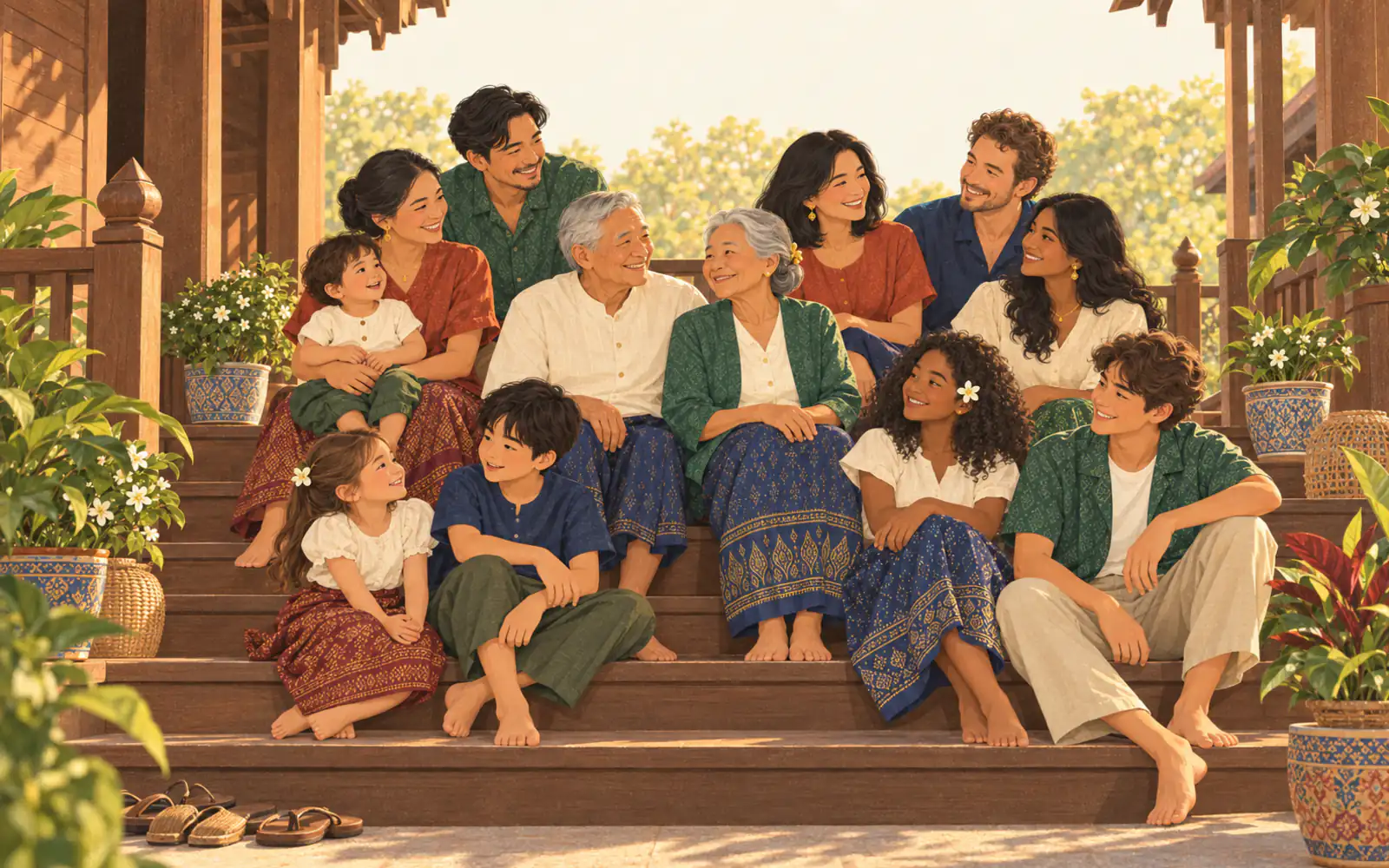
Ask a Thai friend what language they speak and they’ll say Thai. Ask what they speak with their grandmother and the answer is often different. Thailand runs on one official language, and lives in many. If your mum switches into something you can’t quite follow every time she calls home, this is probably why.
What is the official language of Thailand?
Thai, often called Central Thai or Standard Thai. It’s the only language of government and school, the language of national TV, and it’s written in the Thai script, and it’s built on the speech of the central region and Bangkok.
That’s the Thai most courses teach, and the Thai of the Reply Thai app. It gets you understood everywhere in the country, including by relatives who speak something else at home.
Which languages do Thai families speak at home?
The big four are Central Thai and three regional languages. Wikipedia’s article on the languages of Thailand compiles these speaker numbers from the government’s 2011 report to the UN on racial discrimination and Mahidol University’s language maps (the report itself counts about 13 million Lao Isan people in the Northeast alone):
| Language | Also called | Where it’s the home language | Speakers (approx.) |
|---|---|---|---|
| Central Thai | Standard Thai | Bangkok, the Central plains, the East and West | 20.0 million |
| Isan | Lao of Thailand, Northeastern Thai | the Northeast (Isan) | 15.2 million |
| Northern Thai | Kham Mueang, Lanna | the North | 6.0 million |
| Southern Thai | Pak Tai | the South | 4.5 million |
| Northern Khmer | Thai Khmer | Surin, Sisaket and Buriram | 1.4 million |
| Pattani Malay | Yawi, Malayu | Pattani, Yala and Narathiwat | 1.4 million |
Smaller languages fill in the rest: Phu Thai, Kuy, Karen and dozens more. The map below colours each province by its main local language. It’s a simplification, so treat the lines as soft.
Where each language is the main local one
- Central Thai (Standard Thai, the official language)
- Northern Thai (Kham Mueang, Lanna)
- Isan (Lao of Thailand, Northeastern Thai)
- Southern Thai (Pak Tai)
- Pattani Malay (Yawi, Malayu)
- Northern Khmer (Thai Khmer, Surin Khmer)
Approximate. Each province shows only its main local language; real language areas cross province lines, cities mix everyone, and nearly everyone also speaks Central Thai.
What is Central Thai?
Central Thai is the national standard and the home language of Bangkok and the central plains. It isn’t one single accent either. Local accents in the central region have their own tunes, and some are a point of pride: Suphan Buri’s official provincial slogan praises its “pleasant-sounding local dialect”. If your family’s Thai sounds a little different from the newsreader’s, you’re in good company.
What is Isan?
Isan is the language of the Northeast, and the biggest regional language in Thailand. It’s essentially the Lao language as spoken in Thailand, usually written informally in Thai script. The Thai government has historically counted it as a dialect of Thai; most linguists count it as its own language. For a heritage speaker it’s often simply the language Yai speaks.
We’ve written a whole page on it: Isan words for visiting family, with the small set of words that go a long way (and the one that makes every aunt smile).
What is Northern Thai (Kham Mueang)?
Northern Thai, called Kham Mueang (“the speech of the mueang”) or Lanna, is the language of the old Lanna kingdom: Chiang Mai, Chiang Rai, Lampang, Lamphun, Phrae, Nan, Phayao, Mae Hong Son and Uttaradit. About 6 million people speak it. It has its own traditional script, Tai Tham, which today you’ll mostly see in temples. Our page on Northern Thai (Kham Mueang) covers where it’s spoken and what to expect on a visit north.
What is Southern Thai (Pak Tai)?
Southern Thai, or Pak Tai, is spoken from the south of Prachuap Khiri Khan down to the Malaysian border, by about 4.5 to 5 million people. Of the regional languages it’s the closest to Central Thai in words and grammar, but it’s spoken fast and with different tones, which is why visitors from Bangkok sometimes struggle. More in our guide to Southern Thai (Pak Tai).
Who speaks Pattani Malay?
In the three southern border provinces, Pattani, Yala and Narathiwat, the main community language is Pattani Malay, also called Yawi. It belongs to the Malay family, not the Thai one, and historically was written in Jawi, a form of the Arabic script. The 2011 government report counts about 1.4 million Malay-descended Thais in the border provinces, where they make up most of the population; many also speak Southern Thai and Central Thai.
Who speaks Khmer and Kuy in Thailand?
In the lower Northeast, near Cambodia, many families speak Northern Khmer. In the 2000 census it was the language of about 47% of people in Surin, 26% in Sisaket and 28% in Buriram. Kuy, an unrelated language of the same Austroasiatic family, is spoken in villages in Surin and Sisaket, by roughly 400,000 people. Wikipedia notes that younger Northern Khmer speakers are shifting towards Central Thai, so this is often a grandparents’ language now.
A little further north, in Mukdahan, Nakhon Phanom, Kalasin and Sakon Nakhon, you’ll also hear Phu Thai, a Tai language with about half a million speakers.
What are the hill-country languages?
The highlands of the North and West, across 20 provinces, are home to peoples often called “hill tribes” in English, each with its own language. The government’s 2002 count of highland communities found about 438,000 Karen, 154,000 Hmong, 103,000 Lahu, 69,000 Akha, 46,000 Mien and 38,000 Lisu people, among others. Several of these languages are written in the Latin alphabet. Some luk khrueng have a Karen or Hmong parent rather than a Central Thai one; that’s Thai by family too.
What about Chinese in Thai families?
Lots of Thai families have Chinese roots, and older relatives may still speak a Chinese variety at home. Teochew is by far the most common: one estimate cited by Wikipedia puts 56% of Thai Chinese as Teochew, followed by Hakka, Hainanese, Cantonese and Hokkien. Teochew families were long the majority in Bangkok, Chonburi and Chachoengsao. Younger generations have mostly shifted to Central Thai, which is why Ah Ma might greet you in Teochew and your cousins in Thai. Our guide to Chinese New Year in a Thai-Chinese family has more on those homes.
Is any of these “proper” Thai?
All of them are proper. Wikipedia’s article on Northern Thai notes that the 1921 Compulsory Education Act banned schools and temples from teaching in anything but Central Thai, and its article on Isan describes how the language has long been looked down on. That history is why some parents didn’t pass their home language on, and why some of us feel shy about the Thai we do have.
So, plainly: no dialect is wrong, low or “village”. Isan isn’t broken Thai; Kham Mueang isn’t a funny accent. If your Thai came from a Northeastern grandmother or a Southern dad, it sounds like where your family is from. We wrote more about that in why my Thai sounds like my mum.
How do you handle a language you only half understand?
You don’t need to learn four languages. Central Thai is understood everywhere, and most relatives will switch to it for you. What helps most is being able to say, kindly, where you are. These lines from the Reply Thai app work in any family:
ฟังออก แต่พูดไม่ค่อยเก่ง
fang ork, tae phuut mai khoi geng
ฟังออก แต่พูดไม่ค่อยเก่งครับ
fang ork, tae phuut mai khoi geng khrap
ฟังออก แต่พูดไม่ค่อยเก่งค่ะ
fang ork, tae phuut mai khoi geng kha
I can follow it, but I’m not great at speaking.
Literally: “listen out, but speak not very skilled”
The honest answer to “do you understand Thai?”. It tells them to keep talking to you.
Draft: waiting for a native speaker’s review.
สำเนียงอาจจะแปลกๆ
sam-niang aat ja plaek plaek
สำเนียงอาจจะแปลกๆครับ
sam-niang aat ja plaek plaek khrap
สำเนียงอาจจะแปลกๆค่ะ
sam-niang aat ja plaek plaek kha
My accent might be a bit funny.
Literally: “accent maybe strange-strange”
Say it with a laugh. Doubling แปลก softens it to “a bit odd”.
Draft: waiting for a native speaker’s review.
ภาษาไทยเรียกว่าอะไรนะ
phaa-saa thai riak waa a-rai na
ภาษาไทยเรียกว่าอะไรนะครับ
phaa-saa thai riak waa a-rai na khrap
ภาษาไทยเรียกว่าอะไรนะคะ
phaa-saa thai riak waa a-rai na kha
What’s it called in Thai?
Literally: “Thai language call that what (soft)”
Describe the thing first (“the thing for the rain”), then ask. Relatives love filling the gap.
Draft: waiting for a native speaker’s review.
That last one turns a gap into a conversation: ask what something is called “in Thai”, and you’ll often get the home-language word too, with a story.
Want to see where your family is from? The map of Thailand’s 77 provinces shows each province’s region, capital, main language and what it’s known for.
Which language would you love an app for next?
Pick up to 3. We read every vote. No promises, but this shapes what we build.
Voting opens soon. Nothing is collected yet.
Thank you, your vote is in. See what people want next.
Thai words on this page are a draft until a native speaker has reviewed them.
Questions people ask
What language is spoken in Thailand?
Thai, also called Central or Standard Thai, is the official language and the language of school, government and national TV. Most people also grow up with a regional language at home: Isan in the Northeast, Northern Thai (Kham Mueang) in the North, Southern Thai (Pak Tai) in the South, and Pattani Malay in the far south.
How many languages are spoken in Thailand?
Mahidol University’s Ethnolinguistic Maps of Thailand, cited in the Thai government’s 2011 report to the UN, count 62 ethnolinguistic groups in five language families: Tai, Austroasiatic, Sino-Tibetan, Austronesian and Hmong-Mien.
Is Isan a dialect of Thai?
The Thai government has historically treated Isan, Northern Thai and Southern Thai as dialects of Thai, while most linguists classify them as separate languages. Isan is very close to Lao. Either way, it’s a full language with its own words, music and jokes, not bad Thai.
Do people in Thailand speak Lao?
In a way, yes: Isan, the home language of much of the Northeast, is essentially the Lao language as spoken in Thailand, written informally in Thai script. The Thai government’s 2011 report to the UN counts about 13 million Lao Isan people in the Northeast alone.
What language do Thai-Chinese families speak?
Older Thai-Chinese family members may speak Teochew, the most common Chinese variety in Thailand, or Hakka, Hainanese, Cantonese or Hokkien. Younger generations have largely shifted to Central Thai, so many families mix both.
Sources
All links read on .
- Wikipedia: Languages of Thailand (speaker table compiled from the Royal Thai Government’s 2011 CERD report and the Ethnolinguistic Maps; Khmer share by province from the 2000 census; Chinese varieties)
- Royal Thai Government, report to the UN Committee on the Elimination of Racial Discrimination, CERD/C/THA/1-3 (2011): 62 ethnolinguistic groups, highland communities, Malay-descended Thais
- Ethnolinguistic Maps of Thailand (Mahidol University Institute of Language and Culture for Rural Development, Office of the National Culture Commission, 2004; PDF, Thai)
- Wikipedia: Isan language
- Wikipedia: Lanna language (Northern Thai, Kham Mueang)
- Wikipedia: Southern Thai language
- Wikipedia: Patani Malays
- Wikipedia: Northern Khmer dialect
- Wikipedia: Kuy language
- Wikipedia: Phu Thai language
- Wikipedia: Thai Chinese (Teochew, Hakka, Hainanese, Cantonese and Hokkien)
- Thai Wikipedia: Suphan Buri province (the provincial slogan praising its local dialect)
How we write and check our guidesReport a mistake
Letters from the in-between
One email when there’s something worth reading: new guides, stories from other luk khrueng, and a phrase for your next family call. No spam, ever.