Tak bat and merit making with your Thai family
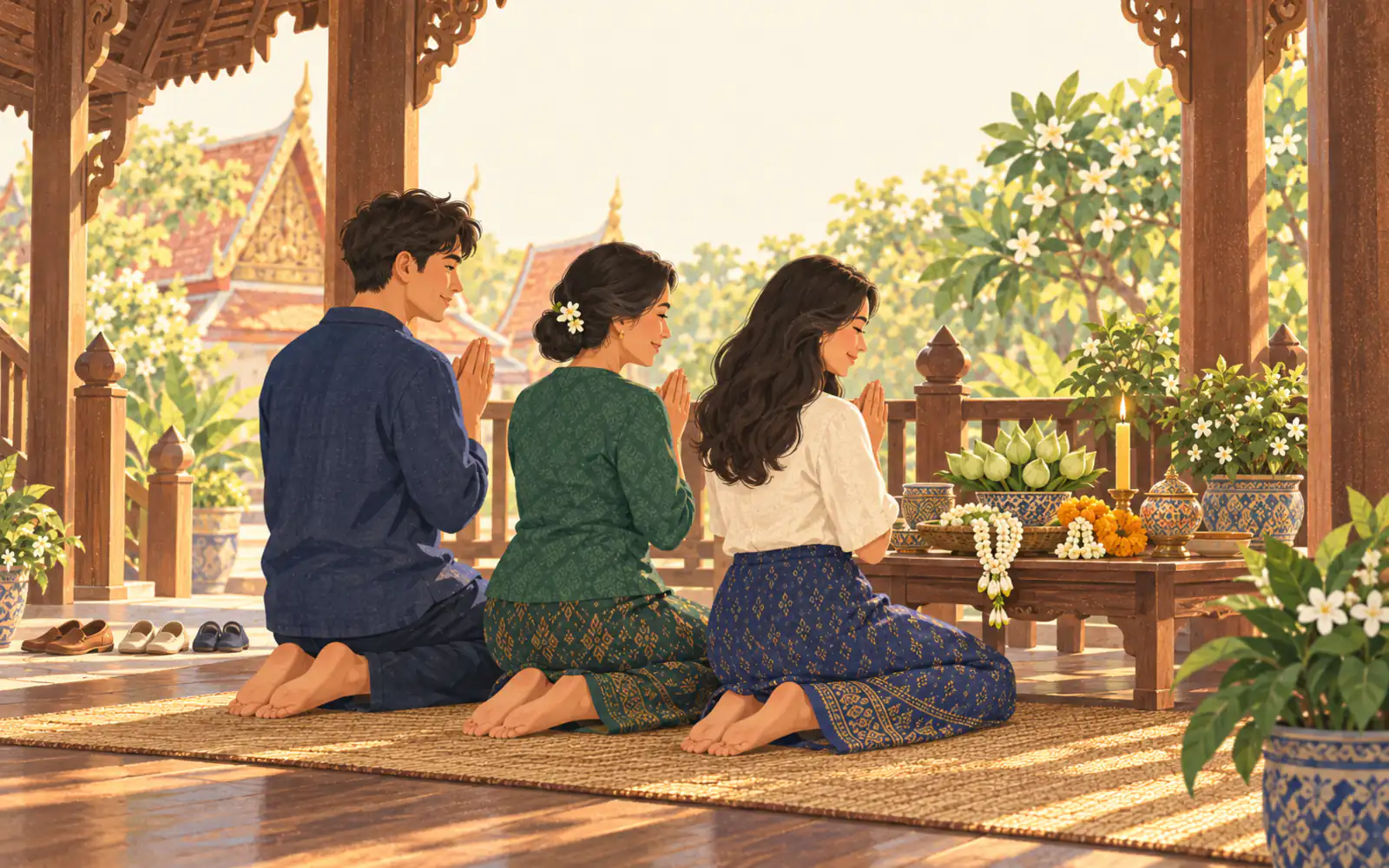
Someone in your Thai family is up before the birds, rice cooker already steaming, and you’ve been told to “come and give to the monks”. If you’ve never done it, it can feel like walking into a ceremony halfway through. It’s simpler than it looks, and nobody expects you to know the chants. Here’s what merit making is, how tak bat works step by step, and how families make merit on the days that matter.
What is merit making (tham bun)?
Tham bun means making merit. In Buddhist teaching, merit is the result of good deeds that cleanse the mind, and the three classic ways to make it are giving, keeping the precepts and meditation, as Bhikkhu Khantipalo’s Lay Buddhist Practice lays out. In everyday Thai life, the Thailand Foundation lists the common forms as giving alms to monks, making offerings at temples, releasing animals and community service.
The giving that families do most is food. Monks eat only between dawn and noon, and the food comes from what people give. So the morning offering, tak bat, is the heart of a lot of family merit making.
How does tak bat work, step by step?
Bhikkhu Khantipalo describes the alms round as starting around six in the morning, once there’s enough light for the monks, who walk barefoot, to see the ground. Here’s what that looks like from your side of the bowl.
- Get the food ready. Rice is the base. Khantipalo describes everything from a spoonful of plain rice to curries in small plastic bags and sweets wrapped in banana leaves. Your family will probably have it sorted already; your job may just be carrying the tray.
- Shoes off? Follow your family. Many people take their shoes off and sit on the ground to give, as a sign of respect, but customs vary.
- Be lower than the monk. Givers squat or kneel and raise their hands in a wai before offering. Some hold the food up to the forehead for a moment and make a silent wish.
- Place the food in the bowl. The monk opens his bowl and you place the food in, gently. Don’t touch the monk or his robe.
- No small talk. The monk stands in silence, doesn’t ask for anything and doesn’t thank you. That’s not coldness: the giving is the point.
- The blessing. If the monks chant a blessing, keep your hands in a wai until they finish.
Women and monks. A monk’s discipline says he must not touch a woman, so women place food in the bowl without touching him. For other offerings, a woman places the item on a cloth the monk holds out. Our Thai temple etiquette guide explains the rule, plus what to wear and how to bow.
What should you give the monks?
Rice and whatever the household is cooking is the classic answer. There’s also a health angle: monks eat what they’re given. In 2022 Wat Chonlaprathan promoted a “4 add, 2 reduce” formula from a Thai monks’ health project backed by the Thai Health Promotion Foundation: add brown rice, vegetables, fish and low-fat milk; cut the sugar; and never offer cigarettes. It’s a nice thing to suggest if Yai’s alms tray is mostly sweets.
What is the water pouring afterwards?
This is gruat naam. While the senior monk chants the blessing, you pour clean water slowly, in a continuous stream, from a small vessel into a bowl or glass. The Royal Thai Army Chaplain Division’s guide says to name the person you’re dedicating the merit to clearly, often a relative who has died, and to finish before the second monk takes over the chant. Then the water goes onto the ground outdoors, away from the house, never into a spittoon or anywhere dirty.
After the big alms-giving at the end of Buddhist Lent, tak bat thewo, Thai PBS describes people chanting for loving-kindness and pouring water to share the merit with relatives and those who have died. For the dates of the holy days, see Buddhist holy days in Thailand 2027.
When do Thai families make merit?
Birthdays. Birthday merit making is a custom of its own. For a bigger one with monks invited home, the Chaplain Division’s guide says it’s customary to invite one more monk than the age of the person celebrating.
For someone who has died. Families make merit for the person at 7, 50 and 100 days after a death. The Thai funeral etiquette guide covers those days.
Ordinations and holy days. A son’s ordination is one of the biggest merit-making days a family has; see a Thai ordination in the family.
Regional days. Some communities have their own. The Mon communities of central Thailand, for example, offer honey to monks once a year in tak bat nam phueng, according to the Thailand Foundation.
If you’re helping prepare, this is the most useful line in the kitchen:
มีอะไรให้ช่วยไหม
mii a-rai hai chuai mai
มีอะไรให้ช่วยไหมครับ
mii a-rai hai chuai mai khrap
มีอะไรให้ช่วยไหมคะ
mii a-rai hai chuai mai kha
Anything I can help with?
Literally: “have what let help question”
The everyday offer in any Thai kitchen. Add ป้า at the end to make it hers.
Draft: waiting for a native speaker’s review.
What is a sangkhathan set?
Sangkhathan is an offering to the community of monks as a whole rather than to one monk you pick. You’ll see ready-made yellow buckets of supplies sold for it, but those are just one convenient form. Thai Wikipedia notes that some sets were padded with cheap filler, and that anything genuinely useful to the temple counts: practical supplies chosen with the monks’ needs in mind are the spirit of it. Money is usually not handed to a monk directly; the Chaplain Division’s guide recommends a written offering slip instead of cash.
Can you make merit from abroad?
Yes. Writing about Songkran abroad, the Thailand Foundation describes Thai temples such as Wat Thai in Los Angeles and Wat Thai Washington, D.C. as community hubs where people go to make merit, and Thai communities abroad gathering to offer food to monks. Call ahead and ask how and when they do it.
If the family is making merit in Thailand, for a birthday or for someone who has died, ask whether you can join. You could offer to chip in towards the food, and a video call during the chanting can mean a lot. Sort the details in the family LINE group.
How do you bring kids along?
Kids are part of it, and always have been: Khantipalo describes children calling out that the monk has come. Give them one job, like handing over a bag of rice or holding the water vessel with you. Explain beforehand that it’s a quiet time, so the silence doesn’t feel like a telling-off. If they get it slightly wrong, nobody minds.
Not sure about shoes, at the alms round or at the temple? Practise asking:
ต้องถอดรองเท้าไหม
torng thort rorng thao mai
ต้องถอดรองเท้าไหมครับ
torng thort rorng thao mai khrap
ต้องถอดรองเท้าไหมคะ
torng thort rorng thao mai kha
Do I need to take my shoes off?
Literally: “must take-off shoes (question)”
Ask before any building at the wat. The answer is almost always yes.
Draft: waiting for a native speaker’s review.
Customs vary
Every family and region does merit making a bit differently: whether you stand, crouch or kneel, what’s cooked, whether there’s water pouring, how many monks come, and whether shoes come off. What we couldn’t confirm from an official source is a single “correct” set of foods, or a rule on shoes at the alms round, so ask the elders. What your family does wins.
Practise for the big family days
Reply Thai’s “Big family days” lessons let you rehearse the lines for merit-making mornings, temple visits and family gatherings, so you can offer to help and follow along.
Reply Thai for iPhoneComing soonMore words like tham bun and tak bat are in the glossary.
Thai words on this page are a draft until a native speaker has reviewed them.
How to give alms (tak bat)
- Get the food ready before dawn. Prepare rice and a little food, plus a drink such as milk if you like. Monks eat only between dawn and noon, so the alms round is early, often around six in the morning.
- Get lower than the monk. Many people take their shoes off and sit or crouch on the ground as a sign of respect; follow what your family does. Givers squat or kneel so they are lower than the monk.
- Wai and make a quiet wish. Raise your hands in a wai. Some people hold the food up to the forehead for a moment and make a silent wish.
- Place the food in the bowl. When the monk opens his bowl, place the rice and food in it gently. Don't touch the monk or his robe. Women don't hand anything straight into a monk's hand.
- Stay quiet. The monk stands in silence, doesn't ask for anything and doesn't say thank you. Keep it quiet too: giving is the point.
- Receive the blessing and pour the water. If the monks chant a blessing, keep your hands in a wai. Families often pour water in a steady stream from a small vessel while the monks chant, to share the merit, then pour it onto the ground outdoors, never anywhere dirty.
Questions people ask
What is tak bat?
Tak bat is giving food to Buddhist monks in their alms bowls on the early-morning alms round. It is one of the most common ways Thai families make merit, often around six in the morning, because monks eat only between dawn and noon.
What do you give monks in the morning?
Rice and food, from a spoonful of plain rice to curries in small bags and sweets. A Thai health project promoted by Wat Chonlaprathan suggests brown rice, vegetables, fish and low-fat milk, less sugar, and never cigarettes.
Can women give alms to monks?
Yes. Women give alms just as men do. A monk's discipline says he must not touch a woman, so women place food in the bowl without touching the monk or his robe, and for other offerings place them on a cloth the monk holds out.
What is the water pouring after merit making?
It's called gruat naam. While the monks chant a blessing, you pour water slowly from a small vessel to share the merit, often with a relative who has died. Afterwards the water is poured onto the ground outdoors, never into a dirty place.
What is sangkhathan?
Sangkhathan is an offering to the community of monks as a whole rather than to one chosen monk. The ready-made yellow buckets are one form, but anything genuinely useful to the temple counts.
Can I make merit from abroad?
Yes. Thai temples abroad, such as Wat Thai in Los Angeles and Wat Thai Washington, D.C., work as community hubs where people go to make merit, and Thai communities abroad gather at temples to offer food to monks. You can also ask your family in Thailand how to join their merit-making day.
Sources
All links read on .
- Thailand Foundation: Thai funerals, an overview guide (21 August 2024)
- Bhikkhu Khantipalo, The Blessings of Pindapata, The Wheel No. 73 (Buddhist Publication Society, 1964; Access to Insight edition 2006, checked 14 Oct 2026)
- Bhikkhu Khantipalo, Lay Buddhist Practice, The Wheel No. 206 (Buddhist Publication Society; Access to Insight, checked 14 Oct 2026)
- Royal Thai Army Chaplain Division: preparing a merit-making ceremony (Thai, checked 14 Oct 2026)
- Thai PBS: Tak bat thewo, once a year after the end of Buddhist Lent (Thai, 6 October 2025)
- The Active (Thai PBS): Wat Chonlaprathan invites Buddhists to give alms the '4 add, 2 reduce' way (Thai, 15 May 2022)
- Thailand Foundation: Understanding Thai Traditions (10 September 2025)
- Thailand Foundation: Tak Bat Nam Phueng, the honeyed merit-making (29 September 2025)
- Thailand Foundation: Songkran Abroad, how Thai communities celebrate around the world (16 April 2026)
- TruePlookpanya: Buddhist etiquette (Thai, checked 14 Oct 2026)
- Wikipedia (Thai): Tak bat (background; page checked 14 Oct 2026)
- Wikipedia (Thai): Sangkhathan (background; page checked 14 Oct 2026)
- Wikipedia: Merit (Buddhism) (background; page checked 14 Oct 2026)
How we write and check our guidesReport a mistake
Letters from the in-between
One email when there’s something worth reading: new guides, stories from other luk khrueng, and a phrase for your next family call. No spam, ever.