Thai ordination (buat): when a son becomes a monk
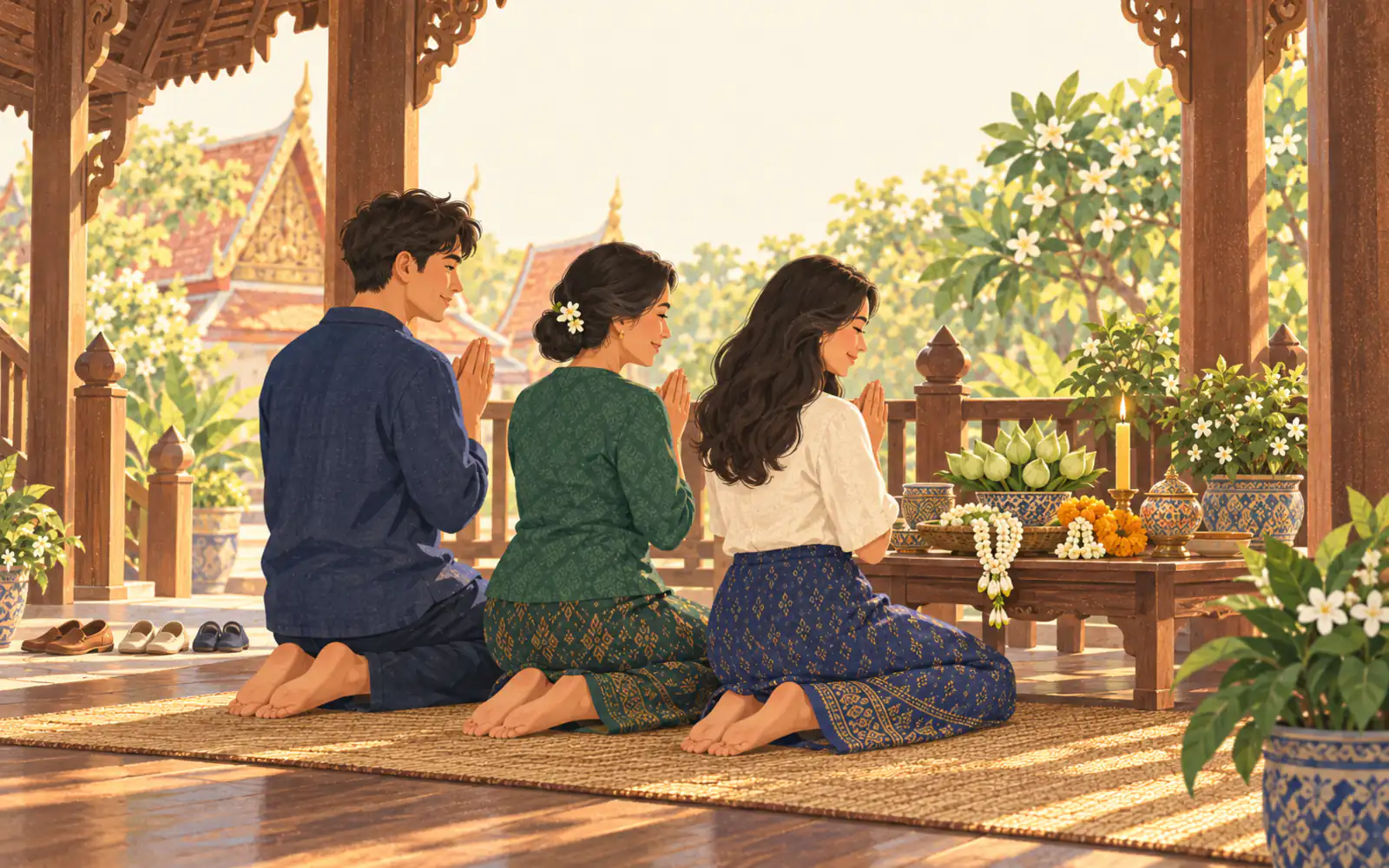
Sooner or later, a message lands in the family chat: a cousin is going to buat, to ordain. Or it’s your brother. Or, maybe, it’s you, and your mum has started asking in a very casual way that is not casual at all. Here’s what ordination means to a Thai family, what happens on the day, and how to be part of it, whether you’re there or watching from abroad.
What does it mean when a Thai son ordains?
To buat phra is to be ordained as a Buddhist monk. In Thailand it is usually not a lifelong decision: Wikipedia’s overview notes that temporary ordination is the norm among Thai Buddhists, and men often return to lay life afterwards.
The Thailand Foundation calls ordination a significant merit-making occasion for the whole family, and a way for a son to show gratitude to his parents for raising him. Mothers come up a lot. Ordination is often described, for example in the Thai Wikipedia article on it, as something a son does at least once so that his mother can share in the merit, a way of repaying the “milk debt” for the milk that fed him. Making merit, tham bun, is the thread running through the whole day (we cover the everyday version in our guide to tak bat, giving alms).
Traditionally, the Thailand Foundation says, a man is expected to ordain when he turns 20, which is also the minimum age for full ordination.
Why is he called a nak?
Because of a serpent who wanted to be a monk. The Thailand Foundation tells the story: a naga prince wished to be ordained but couldn’t, being a serpent, and the Buddha allowed future ordinands to be called naga in honour of his devotion. So for a few days your cousin is the nak, and everyone calls him that.
What happens at a Thai ordination?
The details vary by region and temple, but the Thailand Foundation describes the usual steps:
- Head shaving. Usually on the eve of the ordination, the parents shave the nak’s head and eyebrows as a blessing. It’s emotional, and also the moment everyone gets their phone out.
- White clothes. The nak is dressed all in white before the ceremony.
- Tham khwan nak. In many families, a mor khwan, a specialist in these rites, performs a ceremony for the nak’s khwan, the part of a person linked to morale and well-being. The family and guests are invited in.
- The procession, hae nak. The next day, the nak is taken to the temple in a procession, hae nak. What it looks like depends a lot on the region.
- The ordination in the ubosot. Inside the ordination hall, the monks ordain him. The candidate answers set questions in Pali (Dhammathai.org lists them), so he’ll have rehearsed his lines.
That last part is the bit nobody films well, and the bit he’ll remember.
ต้องถอดรองเท้าไหม
torng thort rorng thao mai
ต้องถอดรองเท้าไหมครับ
torng thort rorng thao mai khrap
ต้องถอดรองเท้าไหมคะ
torng thort rorng thao mai kha
Do I need to take my shoes off?
Literally: “must take-off shoes (question)”
Ask before any building at the wat. The answer is almost always yes.
Draft: waiting for a native speaker’s review.
How long do Thai men stay monks?
Traditionally, for the three months of the rains retreat, Phansa, often called Buddhist Lent. The Thailand Foundation’s Lent guide describes young men ordaining a few days before it begins and leaving shortly after it ends, earning merit for themselves and their families. Our Buddhist holy days 2027 page has next year’s start and end of Phansa.
Today it’s often much shorter. The Thailand Foundation says one week to one month is common, and ordinations happen at any time of year. Work, visas and school terms all get a say.
What about younger boys and novices?
Before 20, a boy can ordain as a novice, a samanera (often shortened to nen). Novices keep ten precepts rather than the full monastic code, Dhammathai.org explains. Wikipedia’s overview notes that novices are typically sponsored by their parents and become eligible for full ordination at 20.
There’s also a very short version linked to death. Thai Wikipedia’s article on novice ordination describes buat na fai, ordination “before the fire”, as a novice ordination often done to dedicate merit to the person who has died. It usually takes place on the day of the cremation, and the novice usually disrobes once the rites are over. Who ordains is a family decision. If you’re facing a funeral, our Thai funeral guide covers the rest.
Can a luk khrueng or foreign-born son ordain?
Being half Thai, or born abroad, isn’t in the rules. What the rules ask is in the questions put to every candidate for full ordination, which Dhammathai.org lists. Among them: is he a man, is he at least 20, is he free of debt, is he not bound to royal service, and has his mother and father given permission. That last one is usually the easy bit in a Thai family.
Wikipedia’s overview of Thai Buddhism notes that Thailand has a monastery built for international monks, Wat Pah Nanachat, so monks from other countries are not new. Practical details, like how long he must stay, what he needs to learn first and whether a Thai ID helps, are up to the temple: ask the abbot your family knows, and ask early.
Can women be ordained in Thailand?
Monastic rules differ here, and we’ll keep this factual. Women in Thailand can become mae chi. Wikipedia describes them as renunciants who usually shave their heads, wear white and keep eight or ten precepts, and notes that they don’t have the same legal recognition as monks.
Full ordination for women, as bhikkhuni, is often described as not officially accepted by Thailand’s two main monastic orders. Some Thai women have been ordained abroad: according to Wikipedia, Dhammananda Bhikkhuni received full ordination in Sri Lanka in 2003 and is abbess of Songdhammakalyani Monastery in Nakhon Pathom province.
For mothers, sisters and grandmothers, the ordination day itself is very much theirs: the merit, the head shaving, the procession, the meal.
What do guests do and wear?
- Dress for the temple. Cover shoulders and knees, and take your shoes off before halls with a Buddha image. Our Thai temple etiquette guide explains how to wai and bow to a monk, including your newly ordained cousin.
- Ask about colour. Families sometimes have a dress code for the day. Just ask.
- Join in where invited. The tham khwan rite, the procession and the meal all welcome family. Follow what others do.
- Money. If you want to give, ask a relative what’s usual. Our guide to Thai money envelopes explains how envelopes generally work.
If you’re watching from abroad, ask someone to video-call you in, or to send the procession afterwards. Being there on a phone screen still counts.
เดินทางปลอดภัยนะ
dern thaang plort phai na
เดินทางปลอดภัยนะครับ
dern thaang plort phai na khrap
เดินทางปลอดภัยนะคะ
dern thaang plort phai na kha
Have a safe trip.
Literally: “travel safe okay”
For a longer trip: a bus to the provinces, a flight back to Sweden.
Draft: waiting for a native speaker’s review.
Customs vary, and what we couldn’t confirm
Ordinations differ a lot by region, temple and family, and Thai-Chinese and non-Buddhist families may have their own ways. A few things we couldn’t confirm from strong sources, so we’ve left them out of the guide:
- That a son should ordain before marriage. You’ll hear it often, but we didn’t find a reliable source that sets it as a rule.
- Details of the procession, like circling the ordination hall or throwing coins. These vary by region and we didn’t find a source we trust.
- Whether Thai temples abroad hold ordinations, and how. Some may; ask your local temple directly.
- How the legal status of women’s ordination in Thailand stands today, and the history behind it (including a 1928 measure): sources we read give conflicting accounts.
What your family does wins.
Practise before the big family days
Reply Thai’s Big family days lessons cover the temples, birthdays and gatherings where everyone wants to talk to you, so the polite lines are ready before the procession starts.
Reply Thai for iPhoneComing soonThai words on this page are a draft until a native speaker has reviewed them.
Questions people ask
Why do Thai men become monks?
Ordination is a big merit-making occasion for the whole family and a way for a son to thank his parents for raising him. It is often described as letting his mother share in the merit and repaying her care. Many Thai men ordain for a short time and then return to lay life.
How long do Thai men stay monks?
Traditionally for the three months of the rains retreat, Phansa (Buddhist Lent). Today many ordain for one week to one month, at any time of year. Some ordain as novices very briefly around a funeral, often just for the cremation day.
What is a nak in a Thai ordination?
Nak means naga, a mythical serpent, and is the name for the man about to be ordained. His parents traditionally shave his head and eyebrows, he dresses in white, and a procession, hae nak, takes him to the temple.
Can a half-Thai or foreign-born son be ordained in Thailand?
The questions put to every candidate ask whether he is a man, at least 20, free of debt and permitted by his mother and father. Before 20 he can ordain as a novice. Thailand also has monasteries for international monks. Ask the temple your family uses about its own requirements.
Can women be ordained in Thailand?
Women can become mae chi, often described as renunciants who shave their heads, wear white and keep eight or ten precepts. Thailand's two main monastic orders are described as not officially accepting fully ordained women (bhikkhuni). Some Thai women have been ordained as bhikkhuni abroad, such as Dhammananda Bhikkhuni in Sri Lanka in 2003.
What should I wear to a Thai ordination?
The temple rules apply: cover your shoulders and knees, and take your shoes off before entering a hall with a Buddha image. Our temple etiquette guide has the details. Ask the family if there is a colour or dress code for the day.
Sources
All links read on .
- Thailand Foundation: Buat Nak, Rituals before Monkhood (2 July 2021)
- Thailand Foundation: Buddhist Lent, a Season of Spiritual Well-being and Improvement (17 July 2024)
- Thailand Foundation: Buddhism in Thailand (30 August 2021)
- Dhammathai.org: ordination of a single nak, the questions put to the candidate (Thai; checked 14 Oct 2026)
- Dhammathai.org: novice ordination and the ten precepts (Thai; checked 14 Oct 2026)
- Thai Wikipedia: Upasombot, full ordination (Thai; background, checked 14 Oct 2026)
- Thai Wikipedia: Banphacha, novice ordination (Thai; background, checked 14 Oct 2026)
- Wikipedia: Buddhism in Thailand (background; checked 14 Oct 2026)
- Wikipedia: Mae chi (background; checked 14 Oct 2026)
- Wikipedia: Bhikkhuni (background; checked 14 Oct 2026)
- Wikipedia: Dhammananda Bhikkhuni (background; checked 14 Oct 2026)
How we write and check our guidesReport a mistake
Letters from the in-between
One email when there’s something worth reading: new guides, stories from other luk khrueng, and a phrase for your next family call. No spam, ever.