When Yai dies and you are far away: grieving from abroad
Last checked . Rules change; confirm with the family and the temple.
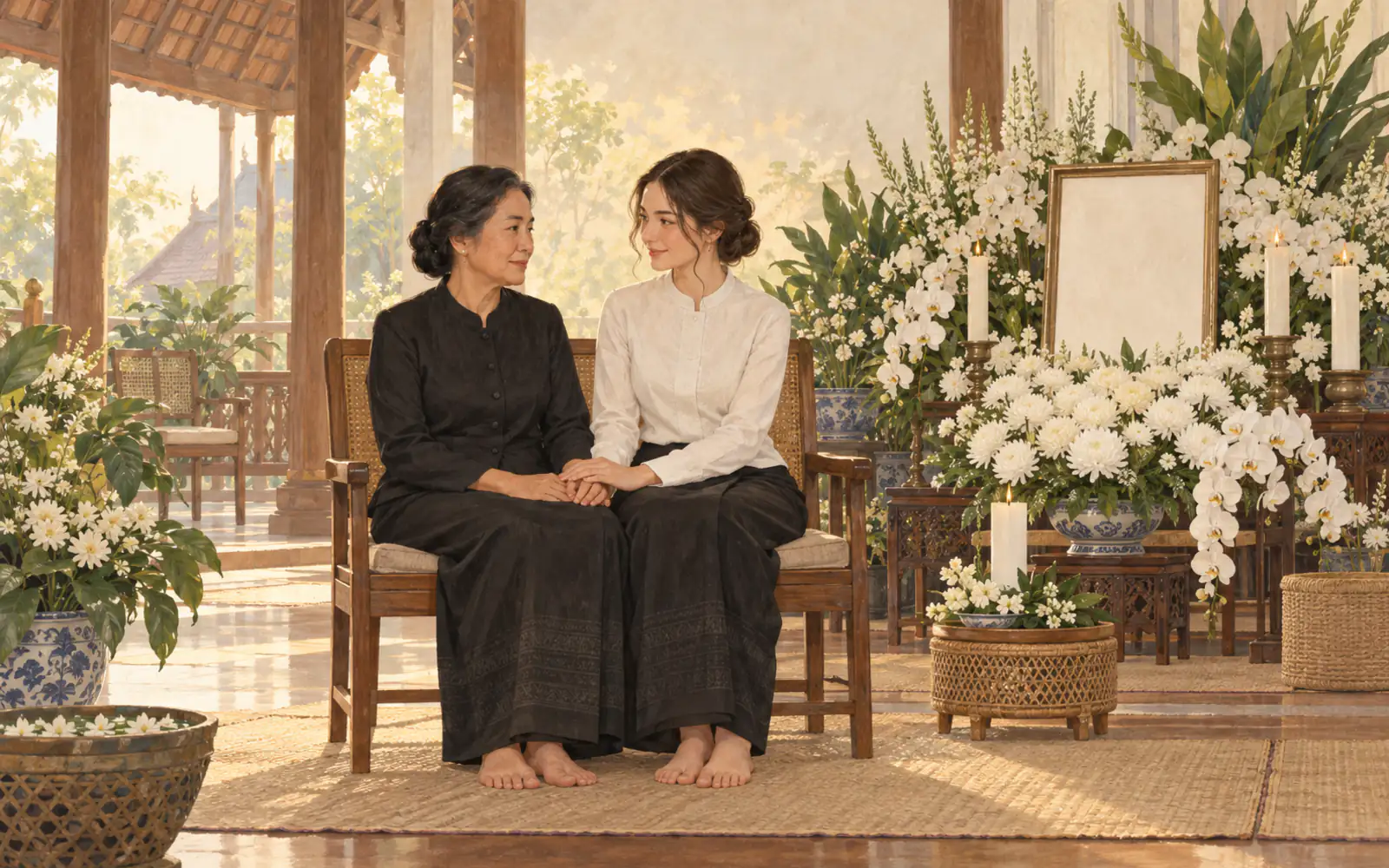
General information, not medical or professional advice. Customs vary by region and family, and what your family does wins. If grief is overwhelming, please talk to someone: there are helplines further down this page.
The call comes, often at a strange hour because of the time difference. Yai, or Ta, or Pu, or Ya has died. And you are far away.
There is no right way to feel about this. Shock, numbness, guilt, relief after a long illness, all of it can arrive at once. This page is here to make the next few days a little less lonely.
What happens in the first days?
In Thai Buddhist families, the first days usually bring a water-pouring rite, then evenings of monks chanting, then a cremation, and later merit-making. Our Thai funeral etiquette guide explains each step, what to wear and what to say. You don’t need to read it now.
What matters for you, far away, is the timing. The Thailand Foundation says the chanting typically lasts 1, 3, 5 or 7 days, and can continue for up to 100 days before the cremation. Some families wait 100 days or a year to cremate. Then the family makes merit again at 7, 50 and 100 days after the death.
So if you can’t be there this week, it is not your only chance.
Should I fly home for the funeral?
There is no right answer. Money, work, children, health, visas, a partner who needs you: all of it is real. Some people fly the same night. Some go for the cremation weeks later. Some go for the 100-day merit-making. Some can’t go at all.
Before you decide, it can help to ask one relative a few gentle questions:
- When will the cremation be? Sometimes it is days away, sometimes months.
- Is there a day the family would most like you there?
- Is there anything you can do from where you are?
If you do fly, our guide to which passport to enter Thailand on may take one worry off the list.
If you can’t go, that is not a failure of love. Your grandparent knew who you were to them. Distance doesn’t undo that.
How can I take part from abroad?
In whatever way feels right to you and works for your family.
- Call or message. A short message to your parent or the relatives closest to Yai means a lot. You don’t need the perfect words.
- Ask about the ceremonies. Some families keep relatives abroad in the loop by phone or video. Others prefer to keep phones away during the chanting. Let them decide, and don’t take a “no” personally.
- Make merit where you live. If there’s a Thai temple near you, you can ask whether you can make merit there in your grandparent’s name. Our guide to tak bat and merit-making explains what merit-making is.
- Mark the later days. The 7, 50 and 100-day merit-making are moments you can mark from home, or join by phone if the family offers.
- Ask about money quietly. If you want to help with costs, ask a relative whether and how to send something. The funeral guide covers why there’s no fixed amount.
Some people also set a photo out at home with flowers, or light a candle. If that helps you, it’s yours to do.
What can I still say to Yai?
Many people keep talking to a grandparent after they’ve died: out loud, at a temple, in a message nobody will read. If the words you most want to say are the simplest ones, here is one.
รักยายนะ
rak yaai na
รักยายนะครับ
rak yaai na khrap
รักยายนะคะ
rak yaai na kha
Love you, Yai.
Literally: “love grandma (okay)”
Thai elders don’t always say it out loud, but they love hearing it from a grandchild. นะ makes it soft.
Draft: waiting for a native speaker’s review.
How do I tell my children?
Children may have known Yai mostly through a screen. Their grief can still be real, and it can look different from yours.
- Use plain, honest words. The Child Mind Institute advises never using euphemisms, because children take words literally and something like “went to sleep” can frighten them. The NHS says direct, honest and open communication helps more than hiding the truth.
- Let them see you’re sad. The Child Mind Institute says seeing your sadness reassures children that feeling upset is okay.
- Include them. The NHS suggests talking as a family about how a child can take part in marking the death. That might be lighting a candle, looking at photos, or coming to the temple with you.
- Expect questions later. The NHS notes children may come back to it at different times and in different ways. Play and a memory box (photos, drawings, something Yai gave them) can help.
“I wish I’d spoken more Thai with her”
This one can hurt the most. The calls where you nodded along. The stories you only half understood. The thing you never managed to say.
Please be gentle with yourself. How much Thai you speak was shaped by where you grew up, who spoke it at home, school, time and a hundred things a child doesn’t choose. It was never a measure of how much you loved her, or how much she loved you. Grandparents and grandchildren have always found ways around missing words: food, hands, the same jokes, sitting together.
Grieving across two cultures can feel lonely too. Friends where you live may not know what a 100-day merit-making is. Relatives in Thailand may grieve in ways that feel unfamiliar. Both are allowed to be true.
If one day you want to learn more Thai in her memory, that door stays open. There is no deadline on it.
When should I look for support?
Grief has no timetable. But if you can’t sleep, can’t function, or feel hopeless, please reach out, to a doctor, someone you trust, or a helpline.
- UK: Cruse Bereavement Support’s helpline is free from UK landlines and mobiles on 0808 808 1677 (Monday, Wednesday, Thursday and Friday 9:30am to 5pm, Tuesday 1pm to 8pm, as of 14 October 2026). It can only take calls from the UK.
- UK, any time: Samaritans answer 116 123, free, day or night, 365 days a year.
- Thailand: the Department of Mental Health lists 1323 as a free, 24-hour mental health hotline.
- Elsewhere: your doctor, or your local bereavement or crisis service.
If you are in danger right now, call your local emergency number.
How do Thai families keep remembering?
Remembering doesn’t stop after the 100 days.
- Songkran. UNESCO describes Songkran as a time when families pay their respects to older adults, ancestors and Buddha images, and calls pouring water a significant act of reverence. Our Songkran guide covers the water blessing for elders.
- Qingming, or Cheng Meng. Ethnic Chinese families in Thailand are among those who mark Qingming, a time for visiting ancestors’ graves and making offerings. Wikipedia notes that people who live far away and can’t travel to the graves may make an offering from a distance. There’s more in our page on Thai-Chinese families.
And later, not now, there may be practical things: a parent in Thailand who is now alone, or questions about family land. When you’re ready, our guides on caring for ageing parents in Thailand and inheriting land in Thailand are there.
What we couldn’t confirm
- Joining ceremonies online. We found no reputable source on how Thai temples or families include relatives by video. It varies, so ask.
- Home altars. We found no source describing a standard home altar for a grandparent who has died abroad. Families do different things; follow yours.
- Merit-making at temples abroad. We couldn’t confirm what individual Thai temples outside Thailand offer. Contact the temple near you.
- Calling 1323 from abroad. We couldn’t confirm whether the Thai hotline can be reached from outside Thailand.
Thai words on this page are a draft until a native speaker has reviewed them.
Questions people ask
My grandparent died in Thailand and I can't fly in time. What can I do?
Thai Buddhist families often hold chanting for several days, sometimes cremate later, and make merit again at 7, 50 and 100 days after the death. Those are later chances to take part, in person or by calling on the day. You can also send a message, ask whether someone can keep you updated, or make merit near you.
Should I fly to Thailand for my grandmother's funeral?
There is no right answer. Ask your family when the cremation is, since it can be days or months away, and decide what is possible for you. Being unable to go is not a failure of love.
How do I tell my child that their Thai grandma died?
Be honest and use plain words. The Child Mind Institute advises against euphemisms like 'went to sleep', and the NHS says direct, open communication helps more than hiding the truth. Expect questions to come back over time.
Where can I get bereavement support?
In the UK, Cruse's free helpline is 0808 808 1677 and Samaritans answer 116 123 day or night. In Thailand, the Department of Mental Health lists 1323 as a free 24-hour mental health hotline.
I wish I'd spoken more Thai with my grandma. Is that normal?
It is a very human feeling, and you are allowed to feel it. The love between you never depended on perfect Thai, and it is never too late to keep learning in their memory if you want to.
Sources
All links read on . Details change; confirm with the family and the temple before you act.
- Thailand Foundation: Thai funerals, an overview guide (21 August 2024)
- Wikipedia: Thai funeral (background, checked 14 Oct 2026)
- NHS: Children and bereavement (page last reviewed 9 January 2023, checked 14 Oct 2026)
- Child Mind Institute: Helping children deal with grief (updated 27 July 2026)
- Cruse Bereavement Support: Helpline (checked 14 Oct 2026)
- Samaritans: Contact a Samaritan (checked 14 Oct 2026)
- Department of Mental Health, Thailand: home page, 1323 hotline (Thai, checked 14 Oct 2026)
- UNESCO: Songkran in Thailand, traditional Thai New Year festival (inscribed 2023, checked 14 Oct 2026)
- Wikipedia: Qingming Festival (background, checked 14 Oct 2026)