Thai wedding traditions: a guide for families and partners
Someone in the family is getting married (แต่งงาน, taeng ngaan). Maybe it’s your cousin. Maybe it’s you, and your partner’s Thai family is about to become your family too.
Either way, a Thai wedding day can feel like a play where everyone else has read the script. Here is the script, step by step, with the caveat every Thai auntie would add: every family does it a little differently.
What happens at a traditional Thai wedding?
Most Thai Buddhist weddings follow a recognisable order. The Thailand Foundation notes that the engagement and the wedding used to be held on separate days, but today they are usually done on the same day. A common running order looks like this:
- Morning merit-making with monks.
- The khan maak procession: the groom’s side carries trays of gifts to the bride’s home.
- The gate game on the way in.
- Presenting the betrothal gifts and sin sod, counted in front of both families.
- The water-pouring blessing, with elders pouring water over the couple’s hands.
- The reception, usually in the evening.
Each region has its own traditions, the Thailand Foundation says. In the North, for example, binding holy threads around the couple’s wrists can stand in for the conch-shell water pouring. The Northeast has its own blessing ceremony, and Muslim and Baba (Chinese-Thai) families in the South have their own rites. So treat the list above as a map, not a rulebook.
Why are there monks at a Thai wedding?
The morning usually begins with making merit, ทำบุญ (tham bun). The Thailand Foundation says couples usually invite nine monks, whose blessing is believed to keep sorrow away and support a long, healthy marriage.
The couple offers food to the monks together, often holding one ladle. The Thai Wikipedia article on Thai weddings links this to the wish to stay together in future lives. There’s also a playful belief, reported by the Thailand Foundation, that whoever’s hand sits higher on the ladle will have the upper hand in the marriage. Expect a few aunties to check.
After the meal the monks chant, and they bless water that is used later in the day. If you’re a guest at this part, treat it like a visit to the temple. Our Thai temple etiquette guide covers the details, from shoes to how to bow.
What is the khan maak procession?
Khan maak are the ceremonial trays the groom’s side carries to the bride’s home. According to the Thailand Foundation, they hold the sin sod, the engagement ring, betel nuts, incense, candles, grains and other auspicious items. The Thai Wikipedia article adds that the money and gold are covered with cloth on the way.
The procession is loud and happy, with singing, dancing and long drums. If you’re on the groom’s side, you’ll probably be handed a tray and told where to stand. Smile and carry it carefully. That’s the whole job.
What is the door game at a Thai wedding?
When the procession arrives, it can’t just walk in. The bride’s female relatives and friends block the way with belts or chains. The Thailand Foundation calls these the pratoo ngoen (silver gate) and pratoo tong (golden gate).
To pass each gate, the groom or someone senior on his side hands over a small envelope. The gatekeepers tease, set silly challenges and insist the envelope is far too thin, and the price tends to go up gate by gate. The Thai Wikipedia article notes that there can be two or three gates, and that whether to have gates, and how many, is agreed with the bride’s side in advance. It’s a game, and the laughter is the point.
What does sin sod mean?
Sin sod (also spelled sin sot or sinsod) is usually translated as “bride price”. It is given at the betrothal to the parents or guardian of the person being married. It sits next to the betrothal gift itself, such as the engagement ring, which the Thai Wikipedia article says is traditionally the bride’s.
Thai law mentions it too. In an unofficial English translation, Section 1437 of the Thai Civil and Commercial Code describes sinsod as “property given by the betrothing party to the parents, the adoptive parent or the guardian of the betrothed party in return for the betrothed party agreeing to marry”. That’s a translation, not legal advice: the Thai text is the one that counts, and how it applies to any one family is a question for a Thai lawyer.
At the ceremony, the sin sod is presented on the trays and counted in front of witnesses from both families, the Thai Wikipedia article says. The Thailand Foundation describes the bride’s mother carrying it on her shoulder, pretending it is very heavy. It’s a small, sweet bit of theatre.
A few things worth knowing, especially if you are the partner marrying in:
- It’s usually agreed between the families beforehand. Traditionally a respected go-between visits the bride’s parents and the families talk terms politely and indirectly, according to the Thai Wikipedia article.
- It is often symbolic now. The Thailand Foundation says the sin sod is more like a symbolic act for most families today, and the bride’s parents may give it back to the couple after the wedding to help them start their life together.
- It varies by family and region. Each family settles its own customs, and what one family does may surprise another. We couldn’t find a reliable, dated source for typical amounts, so we won’t print one.
- It’s a family conversation, not a public one. Talk it through with your partner first, then let them and the ผู้ใหญ่ (phuu yai), the elders, lead. Asking gently what it means in this family goes a long way.
Sin sod is not the guests’ business, and it is not the same thing as the envelope guests give at the reception.
What is the water-pouring blessing?
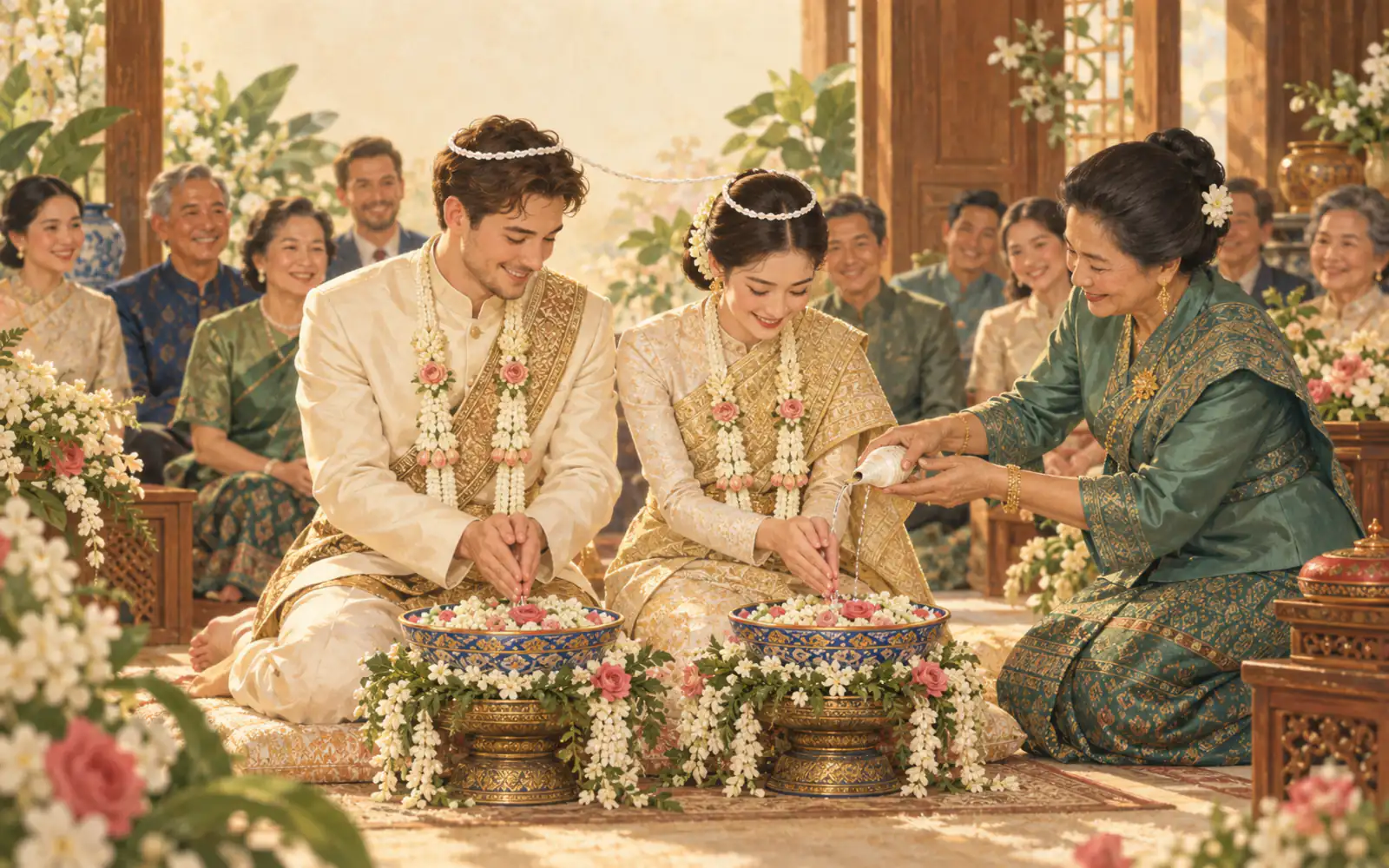
This is the heart of the day for many families, and the Thailand Foundation spells it rod nam sang. The couple kneel side by side on a low platform with their hands held out. The Thailand Foundation says they wear “holy garlands”. The Thai Wikipedia article describes a pair of joined ceremonial loops, often called mongkol faet, one for each of the couple, with the ends of the cord wound around the bowl of blessed water (for evening pourings, a version without the connecting cord is common).
Then the elders come forward one by one, starting with the parents or senior relatives (the Thai Wikipedia article’s order), and pour blessed water from a conch shell over the couple’s hands while saying a wish for them. Guests follow. The Thailand Foundation says guests often receive a small keepsake in return.
If you’re invited to pour: a small pour is enough, say your wish quietly, and a wai to the couple afterwards is a kind finish.
What happens at the Thai wedding reception?
The evening reception is for the wider circle of family, friends and colleagues. The Thailand Foundation describes it as close to a Western reception: a suit and a white gown, cutting the cake, and a toastmaster who leads the room in a loud “Chai Yo!” three times. Just follow the MC.
The couple often go from table to table to thank guests (the Thai Wikipedia article mentions this), and the Thailand Foundation says most guests give cash in an envelope, mostly to help cover the wedding costs. How much to put in it has its own page: how much to give at a Thai wedding.
This is also where you meet everyone. A lot of aunties, a lot of names. Our guide to Thai family words helps you work out who is who, and hello in Thai covers the first greeting. After hello, this is the line you’ll use most:
ยินดีที่ได้รู้จัก
yin dii thii dai ruu jak
ยินดีที่ได้รู้จักครับ
yin dii thii dai ruu jak khrap
ยินดีที่ได้รู้จักค่ะ
yin dii thii dai ruu jak kha
Nice to meet you.
Literally: “glad that get know”
The line for someone new. With your partner’s family it says you’re happy to be here.
Draft: waiting for a native speaker’s review.
How much does a Thai wedding cost?
Honestly, it varies too much for one number, and we couldn’t find a reliable, dated survey to quote. What we can say is what drives the cost:
- The venue and guest list. Where the reception is held and how many people come make the biggest difference.
- The ceremony itself. Offerings for the monks, the khan maak trays, gifts for the bride’s parents and elders, and small rewards for the tray bearers and go-betweens, all mentioned in the Thai Wikipedia article.
- Sin sod and the betrothal gold. These depend entirely on the two families, and sin sod is often returned to the couple.
- The envelopes. Guests’ envelopes often help cover the costs, the Thailand Foundation says.
If you’re planning one, the best budget advice comes from the families involved, not from a figure on the internet.
Haven’t met the family yet? Start with meeting your Thai partner’s family, which stops right before the engagement talk.
What should a partner or guest actually do?
Follow, smile and ask. Someone will always tell you where to sit and when to stand, and asking a cousin “what happens next?” is completely normal. Nobody expects a partner from abroad, or a luk khrueng who grew up far away, to know every step. Showing up warmly is what the family remembers.
Reply Thai, coming soon to iPhone, has a “My partner’s family” moment with short lessons for meeting the parents and the big day, so the first hello comes out easily.
Reply Thai for iPhoneComing soonThai words on this page are a draft until a native speaker has reviewed them.
Questions people ask
What happens at a traditional Thai wedding?
Many Thai weddings follow a similar order: a morning merit-making where the couple offers food to monks, the groom's khan maak procession to the bride's home, the gate game, the presentation of the betrothal gifts and sin sod, and the water-pouring blessing where elders pour water over the couple's hands. An evening reception often follows. Every region and family does it a little differently.
What does sin sod mean?
Sin sod (also spelled sin sot or sinsod) is usually translated as the bride price: property given at the betrothal to the parents, adoptive parent or guardian of the person being married. Thai law mentions it in Section 1437 of the Civil and Commercial Code. The Thailand Foundation says it is more like a symbolic act for most families, and the bride's parents may give it back to the couple after the wedding.
How much does a Thai wedding cost?
There is no typical figure we could confirm. Cost depends on the venue, the number of guests, the region and what the two families agree, including whether there is a sin sod and whether it is returned. Guests' envelopes often help cover the reception, the Thailand Foundation says.
What is the door game at a Thai wedding?
When the groom's procession reaches the bride's home, her relatives and friends block the way with belts or chains, called the silver gate and the golden gate. The groom's side pays a small envelope to pass each one, with plenty of teasing. The Thai Wikipedia article on Thai weddings notes that whether there will be gates, and how many, is agreed with the bride's side in advance.
Who pours water at a Thai wedding?
Elders and guests. The couple kneels with their hands held out, and elders, starting with the parents or senior relatives, pour blessed water from a conch shell over their hands while saying a wish for the couple.
Sources
All links read on .
How we write and check our guidesReport a mistake
Letters from the in-between
One email when there’s something worth reading: new guides, stories from other luk khrueng, and a phrase for your next family call. No spam, ever.