Meeting your Thai partner's family: a gentle guide
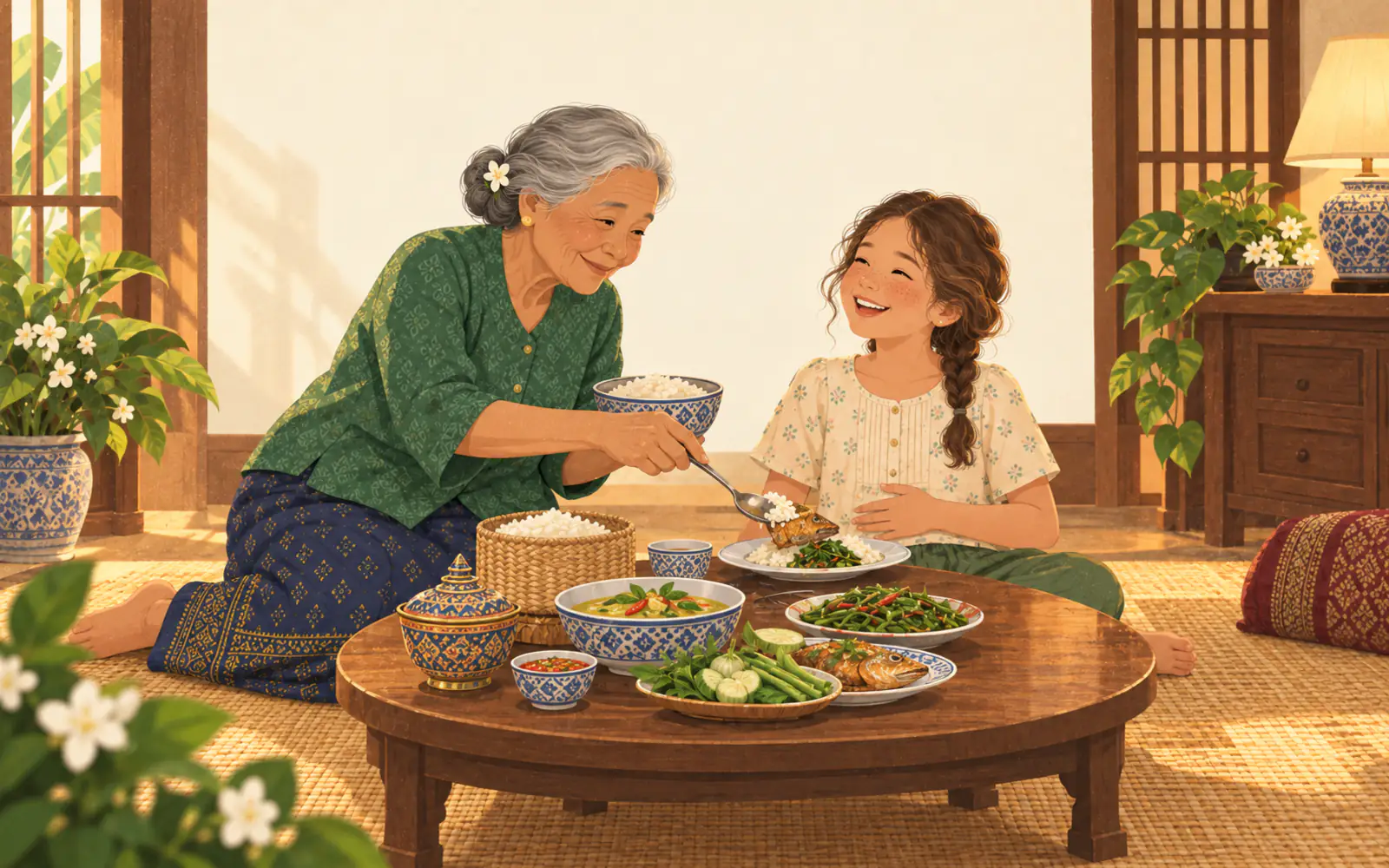
Meeting your partner’s family for the first time is nerve-racking in any language. With a Thai family there’s an extra layer: a greeting with your hands, a table that keeps refilling, and questions you may not be ready for. The good news is that warmth and a bit of preparation cover almost all of it. Here’s what helps, whether you’re the new partner or the luk khrueng bringing someone home.
How do you greet your Thai partner’s parents?
With a polite hello and a wai: palms together at chest height, a small bow of the head. In Thailand the person who is junior in age or status offers the wai first, and the senior person returns it, Mahidol University’s guide to Thailand explains. Meeting your partner’s parents, that’s usually you. If an elder wais you, wai back.
Pair it with the hello, plus ครับ or ค่ะ (our guide to ka and khrap explains which one is yours). Then the line for someone new:
ยินดีที่ได้รู้จัก
yin dii thii dai ruu jak
ยินดีที่ได้รู้จักครับ
yin dii thii dai ruu jak khrap
ยินดีที่ได้รู้จักค่ะ
yin dii thii dai ruu jak kha
Nice to meet you.
Literally: “glad that get know”
The line for someone new. With your partner’s family it says you’re happy to be here.
Draft: waiting for a native speaker’s review.
When you’re invited into a Thai home, let your hosts introduce you to the other guests. Those introductions are how people work out who is senior to whom, so you’ll know who to greet first.
What should you call your partner’s mum and dad?
Thai families call each other by kinship words rather than first names, and which word fits depends on the family, the region and how close you are. Ask your partner before you arrive what you should use, and practise it once or twice out loud. Our guide to Thai family words explains who is called what, from parents to aunties and older cousins.
What happens at the dinner table?
You’ll be fed. In Thai culture, asking whether someone has eaten is a way of showing care, The Nation explains, and often stands in for “how are you?”. Expect to hear gin khaao rue yang, “have you eaten?”, early on: more on that in our guide to have you eaten yet in Thai.
In many Thai families a meal is rice with several dishes shared by everyone, and many people eat with a spoon and fork, using the fork to push food onto the spoon. Ask your partner how their family does it. A few habits that land well:
- Say yes to food. Take a little of each dish rather than a lot of one.
- Praise the cook. Specifically, and to their face.
- Offer to help. Clearing plates or carrying dishes is a kind first move, even if you’re waved back to your seat.
มีอะไรให้ช่วยไหม
mii a-rai hai chuai mai
มีอะไรให้ช่วยไหมครับ
mii a-rai hai chuai mai khrap
มีอะไรให้ช่วยไหมคะ
mii a-rai hai chuai mai kha
Anything I can help with?
Literally: “have what let help question”
The everyday offer in any Thai kitchen. Add ป้า at the end to make it hers.
Draft: waiting for a native speaker’s review.
What about shoes, feet and heads?
Shoes come off at the door of a Thai home, the Thailand Foundation says, however humble or grand the house. Feet are considered the lowest part of the body, so don’t point your feet, especially the soles, at people, and don’t rest them on a table. The head is the highest, so avoid touching anyone’s head, and that includes ruffling the hair of your partner’s little nieces and nephews.
On clothes, neat and modest is the safe choice for a first visit. If a temple visit is part of the day, dress for it: Wat Pho in Bangkok, for example, asks visitors to dress politely and does not allow women in shorts above the knee.
Can you hold hands in front of the family?
Go gently. Many families prefer affection kept low-key in front of elders, and families differ a lot here, so follow your partner’s lead. A hand on the arm may be fine in one living room and a lot in another.
What should you bring?
Ask your partner whether the family expects a gift, and what they’d enjoy. Our guide to gifts for a Thai family covers what to bring, how to hand it over and what to avoid.
When are you getting married? When are the babies coming?
If the question comes, it usually comes with a smile, and it doesn’t need a real answer. A light, warm reply ends the topic without closing the door.
ยังไม่รีบ
yang mai riip
ยังไม่รีบครับ
yang mai riip khrap
ยังไม่รีบค่ะ
yang mai riip kha
I’m in no rush.
Literally: “still not hurry”
For “when’s the wedding?”. Said with a smile, it ends the topic without closing the door.
Draft: waiting for a native speaker’s review.
ยังไม่มี
yang mai mii
ยังไม่มีครับ
yang mai mii khrap
ยังไม่มีค่ะ
yang mai mii kha
Not yet.
Literally: “still not have”
The same ยังไม่ as ยังไม่กิน (“haven’t eaten yet”). “Yet” leaves the door open, which relatives like.
Draft: waiting for a native speaker’s review.
If you’d rather not discuss it at all, agree with your partner beforehand who steers the conversation somewhere else. The partner who speaks Thai can usually do it most gracefully.
What about money and family obligations?
Gratitude to parents, ga-tan-yuu (often spelled katanyu), runs deep in many Thai families. A Thai study of gratitude in an ageing society frames it as children repaying their mother’s kindness. How that shows up day to day, including whether adult children help their parents financially, differs from family to family. It’s a conversation for you and your partner, in private, not something to guess at over dinner.
If marriage is on the horizon, you may hear about sin sod, part of a traditional Thai wedding. Our guide to Thai wedding traditions explains it, and it’s another conversation for you and your partner first.
Does it change if the family is in Thailand or abroad?
Families abroad keep some customs and mix in others, so ask your partner which ones their family kept: the wai, the shoes at the door, the full table. In Thailand, expect more relatives at once, and maybe a trip to meet grandparents in another province. Thai-Western couples are a small group in Thailand: a study of the 2010 census found they made up less than 1% of married couples, and most lived in Bangkok. So if you’re the first foreign partner in the family, expect some curious questions, and take them as a way in.
If you’re the luk khrueng bringing a partner home
You’re the bridge, in both directions. Brief your partner beforehand: who’s who, what to call them, which aunt will ask about weddings. Then brief your family on your partner: what they eat, how much Thai they have. Translate generously, including the feelings behind the words.
And if your own Thai feels rusty in front of your parents and a new partner at once, be kind to yourself. Every polite hello you manage counts, and your family is likely to be proud you’re trying. In Reply Thai’s My partner’s family moment you can practise the first-meeting lines before the big day, for yourself or with your partner.
Customs vary
Every family does this differently, and what your family does wins. Thai families from different regions, Thai-Chinese families and Muslim families in the south all have their own customs; at a southern Muslim wedding, for example, the Thailand Foundation describes the groom’s mother proposing on his behalf. We couldn’t confirm a reliable official source on home dress codes, on how much affection is fine in front of parents, or on how Thai family meals are served, so ask your partner: they know their family best.
Reply Thai for iPhoneComing soonThai words on this page are a draft until a native speaker has reviewed them.
Questions people ask
Who wais first when you meet your Thai partner's parents?
The person who is younger or junior offers the wai first and the senior person returns it, Mahidol University's guide to Thailand explains. Meeting your partner's parents, that usually means you wai first, with a polite hello.
What should I call my Thai partner's mom and dad?
Ask your partner what the family uses. Thai families call each other by kinship words, and what fits depends on the family. Our guide to Thai family words explains who is called what.
Do I have to eat everything I'm offered at a Thai family meal?
No one expects you to finish everything. In Thai culture, food is a way of showing care, and asking whether you've eaten often stands in for "how are you?". Trying a little of each dish and thanking the cook goes a long way.
Is it OK to hold hands or kiss in front of a Thai family?
Families differ a lot here, and we couldn't confirm a reliable source on what's fine in front of parents. Many families prefer affection kept low-key in front of elders, so follow your partner's lead.
How do I answer when a Thai family asks when we're getting married?
Smile and keep it light. Yang mai riip, "I'm in no rush", ends the topic without closing the door, and yang mai mii, "not yet", works for the kids question.
Sources
All links read on .
- Faculty of Medicine Siriraj Hospital, Mahidol University: Thailand Information (30 December 2016)
- Thailand Foundation: Feet low, head high, a guide to Thai etiquette (16 February 2024)
- Thailand Foundation: Thai Wedding, by Thanachporn Varapongsittikul (24 April 2023)
- The Nation (Thailand): How Thai culture uses food to connect and greet, by Tammy Tameryn Somhar (7 June 2025)
- PickupThai: When do Thais wai? Who should I and should I not wai? (page checked 14 Oct 2026)
- Intarat, S. et al.: Development of a Causal Model of Influence on Gratitude (katanyu) of Thais in an Aging Society, Journal of Multidisciplinary in Social Sciences 15(2) (published 9 May 2023)
- Phuengsamran, D. et al. (2023). Demographic Context of Thai-Western Partnerships in Thailand. Journal of Population and Social Studies 31, 802–813 (28 July 2023)
- Wat Pho (Wat Phra Chetuphon), Bangkok: planning your visit, dress code (Thai, page checked 14 Oct 2026)
- Wikipedia: Wai (gesture) (background, page checked 14 Oct 2026)
- Wikipedia: Culture of Thailand, etiquette section (background, page checked 14 Oct 2026)
- Wikipedia: Thai cuisine, serving section (background, page checked 14 Oct 2026)
How we write and check our guidesReport a mistake
Letters from the in-between
One email when there’s something worth reading: new guides, stories from other luk khrueng, and a phrase for your next family call. No spam, ever.