Thailand on UNESCO's living-heritage list, sourced
There’s a particular feeling when something from your Thai side shows up on a world stage: the soup Yai makes, the festival you flew home for, the massage your aunt swears by. UNESCO keeps a list of the world’s living traditions, and six of them are Thai. Here is each one, with the year it was added, what it is, and where families actually meet it.
Which Thai traditions are on UNESCO’s living-heritage list?
UNESCO’s Thailand page lists six elements on the Representative List of the Intangible Cultural Heritage of Humanity:
| Year | Element |
|---|---|
| 2018 | Khon, masked dance drama |
| 2019 | Nuad Thai, traditional Thai massage |
| 2021 | Nora, dance drama in southern Thailand |
| 2023 | Songkran, the traditional Thai New Year |
| 2024 | Tom yum kung |
| 2024 | Kebaya (shared with Brunei, Indonesia, Malaysia and Singapore) |
“Intangible” means it isn’t a building: it’s a practice that only survives because people keep doing it. That’s the part that makes it ours. Nothing new was added for Thailand in 2025, as of UNESCO’s page on 14 October 2026.
What is Khon, and where do families see it?
Khon (2018) is Thailand’s masked dance drama. UNESCO describes it as a mix of music, singing, literature, dance, ritual and handicraft, with graceful movement and glittering costumes. The stories follow Rama, his journey through the forest, his army of monkeys and his battles with the army of Thosakan, king of the giants. It was once passed on in royal and princely courts and in dance masters’ households; today, UNESCO says, it is taught mostly in schools and universities, with clubs working to reach young people. So if you’ve met Khon, it may well have been at a school show or a cousin’s performance rather than a grand theatre.
What is Nuad Thai?
Nuad Thai (2019) is traditional Thai massage. UNESCO describes it as a hands-on, non-medicinal therapy that works along energy lines called sen, using hands, elbows, knees and feet, sometimes with hot herbal compresses. UNESCO traces its roots to self-care in the peasant society of the past, when every village had its massage healers for muscle aches from working in the fields. If you grew up being asked to walk on a parent’s back, or watched an auntie find the exact knot in someone’s shoulder, you’ve seen a homely cousin of this tradition.
What is Nora?
Nora (2021) is a dance drama from southern Thailand, more than five hundred years old according to UNESCO. It’s acrobatic and lively, with improvised singing in the local dialect, a lead dancer’s fast, elaborate movements of legs, arms and fingers, and music led by a southern oboe with drums, gongs and cymbals. Performers wear crowns, beads, bird-like wings, swan tails and long metallic fingernails. You’ll find it at temple fairs and community events, and it’s taught by masters at home, in community groups and in schools. If your family is from the south, ask whether anyone remembers a Nora night.
How did Songkran become UNESCO heritage?
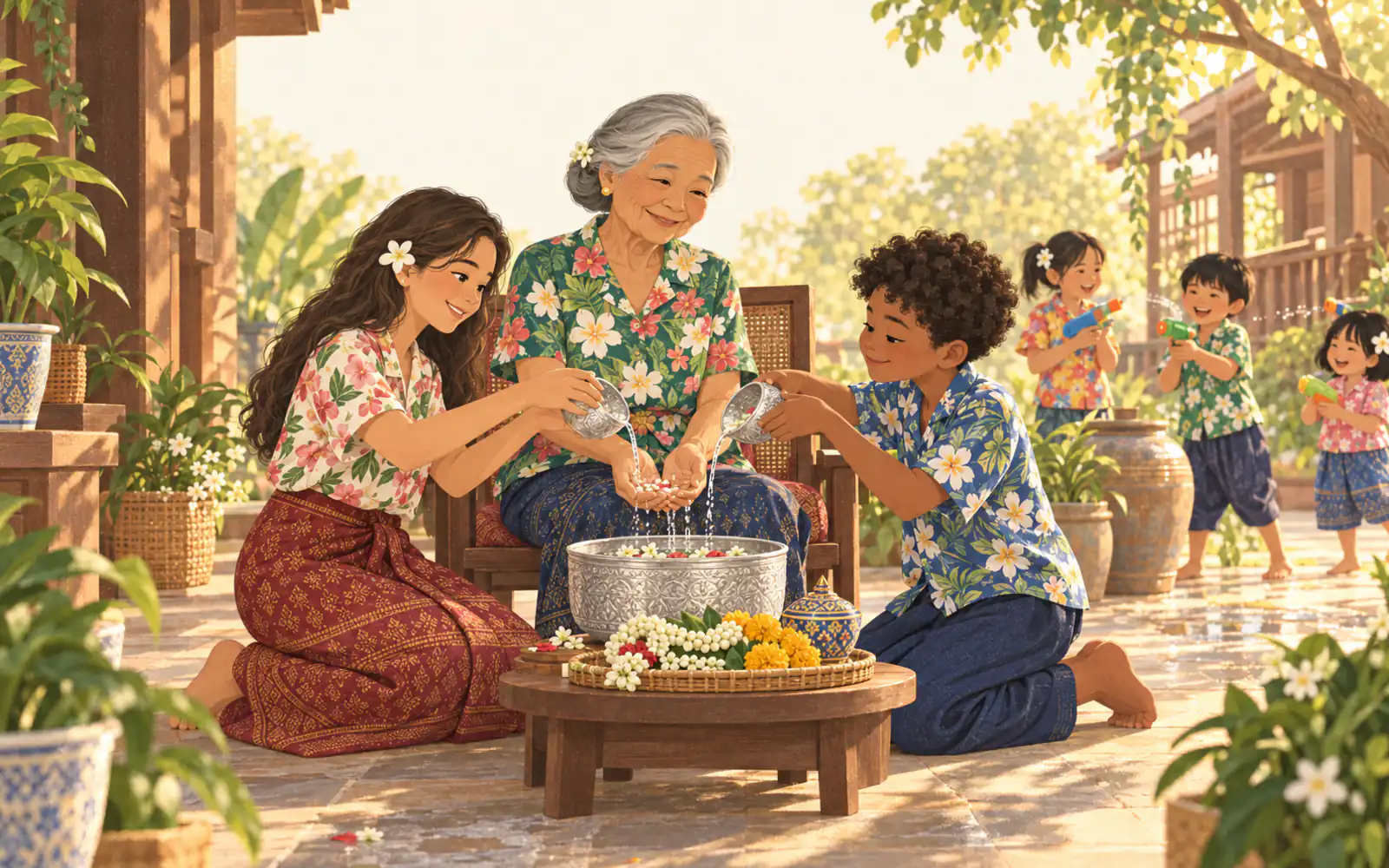
Songkran (2023) is the traditional Thai New Year in mid-April. UNESCO calls pouring water its central act, standing for cleansing, reverence and good fortune, and lists paying respect to elders and ancestors, bathing Buddha images and reuniting with family among its practices. Nation Thailand describes the moment many of us know best: anointing the hands of parents, grandparents and seniors with scented water to ask for their blessing for the new year. Our Songkran 2027 guide has the dates and the whole family routine.
สุขสันต์วันสงกรานต์
suk-san wan song-graan
สุขสันต์วันสงกรานต์ครับ
suk-san wan song-graan khrap
สุขสันต์วันสงกรานต์ค่ะ
suk-san wan song-graan kha
Happy Songkran.
Literally: “happy day Songkran”
The greeting for 13–15 April. With grandparents, add ครับ/ค่ะ and a wai.
Draft: waiting for a native speaker’s review.
Is tom yum really on the UNESCO list?
Yes. Tom yum kung (2024), the prawn soup, is on the list. UNESCO traces it to Buddhist riverside communities in the Central Plains, who ate the plentiful river prawns and drew on their knowledge of medicinal plants; the prawns are boiled with herbs including lemongrass, kaffir lime leaves, galangal and shallots. The Tourism Authority of Thailand praises its balance of hot, sour, salty and sweet. Best of all, UNESCO says the know-how is passed on orally within families and at social gatherings, including the knowledge of which herbs and ingredients to choose. Which is a formal way of saying kitchen know-how like Yai’s is part of the story. Our guide to cooking the Thai food you grew up with covers tom yum, and Thai food by region puts the Central Plains in context.
ไม่มีใครทำอร่อยเท่ายาย
mai mii khrai tham a-roi thao yaai
Nobody cooks like you, Yai.
Literally: “not have who make delicious equal grandma”
The big compliment. Works for mum too: ไม่มีใครทำอร่อยเท่าแม่.
Draft: waiting for a native speaker’s review.
Why is the kebaya on Thailand’s list?
The kebaya (2024) is a shared listing from five countries: Brunei Darussalam, Indonesia, Malaysia, Singapore and Thailand. UNESCO describes a front-opening, often embroidered top fastened with brooches or buttons and worn with a sarong, and calls it a shared element that “transcends ethnicity, religion and borders”. TAT notes its significance for communities in southern Thailand. It’s a nice reminder that heritage doesn’t have to belong to one country to be yours; many luk khrueng know that feeling well (see what luk khrueng means).
What about Muay Thai and other nominations?
Muay Thai is not on the list, as of UNESCO’s Thailand page on 14 October 2026. That page lists a Muay Thai nomination file as pending, along with Loy Krathong and the phakhaoma, the multi-purpose Thai cloth. It also lists Chud Thai, the Thai national costume, as an ongoing nomination for 2026. None of these is inscribed yet, and UNESCO doesn’t give a date for a decision. Muay Thai is still very much a living tradition: start with our Muay Thai beginner’s guide or the older art of Muay Boran.
How many UNESCO World Heritage sites does Thailand have?
Separate from the living-heritage list, UNESCO’s World Heritage List covers places. Thailand has nine, six cultural and three natural, according to the Tourism Authority of Thailand (27 July 2026). The newest is Wat Phra Mahathat Woramahawihan in Nakhon Si Thammarat, inscribed at the World Heritage Committee’s 48th session in Busan in July 2026; TAT describes it as a major Buddhist centre since the 8th century. The others include the historic cities of Sukhothai and Ayutthaya, Ban Chiang, the Khao Yai and Kaeng Krachan forests, Si Thep and Phu Phrabat.
What we couldn’t confirm
- World Heritage details. UNESCO’s own World Heritage pages were not reachable for us, so the count of nine comes from TAT, with Wikipedia’s list as background for the names.
- Other things Thailand gave the world. We wanted to tell the story of the Thai drink Krating Daeng and Red Bull, but couldn’t open a strong press source to check the details, so we’ve left it out for now.
- Customs vary. How your family does Songkran, or how sour Yai’s tom yum is, depends on region and household. What your family does wins.
Say it with pride
None of this is a test. You don’t need to know Khon to be Thai, or to have been to Nakhon Si Thammarat. But if you want one sentence for the next time Yai beams at you, this is it:
ภูมิใจที่พูดไทยได้
phuum jai thii phuut thai dai
ภูมิใจที่พูดไทยได้ครับ
phuum jai thii phuut thai dai khrap
ภูมิใจที่พูดไทยได้ค่ะ
phuum jai thii phuut thai dai kha
I’m proud I can speak Thai.
Literally: “proud that speak Thai can”
Warm and true. Family hears it as love for them, not as showing off.
Draft: waiting for a native speaker’s review.
Reply Thai has a whole “Thai and proud” moment built around lines like this, so you can say it to family and mean it. For more of what shaped us, see what we grew up with.
Reply Thai for iPhoneComing soonThai words on this page are a draft until a native speaker has reviewed them.
Questions people ask
Which Thai traditions are on UNESCO's intangible heritage list?
Six: Khon masked dance drama (2018), Nuad Thai traditional massage (2019), Nora dance drama from southern Thailand (2021), Songkran (2023), tom yum kung (2024) and the kebaya (2024), which Thailand shares with Brunei, Indonesia, Malaysia and Singapore. All six are on the Representative List.
Is tom yum a UNESCO heritage?
Yes. UNESCO inscribed Tomyum Kung, the prawn version, on its Representative List of the Intangible Cultural Heritage of Humanity in 2024. UNESCO says the cooking knowledge is passed on orally within families and at social gatherings.
Is Muay Thai on the UNESCO heritage list?
Not as of 14 October 2026. UNESCO's Thailand page lists Muay Thai among nomination files still waiting to be treated, alongside Loy Krathong and the phakhaoma cloth. It is not an inscribed element.
How many UNESCO World Heritage sites does Thailand have?
Nine: six cultural and three natural, according to the Tourism Authority of Thailand. The newest is Wat Phra Mahathat Woramahawihan in Nakhon Si Thammarat, inscribed at the World Heritage Committee's 48th session in Busan in July 2026.
What is the difference between World Heritage and intangible cultural heritage?
World Heritage sites are places, like Ayutthaya or Sukhothai. Intangible cultural heritage is living practice: dances, festivals, healing arts, food and craft, like Songkran and tom yum kung, kept alive by the people who do them.
Sources
All links read on .
- UNESCO Intangible Cultural Heritage: Thailand, elements on the lists and nominations in progress (page checked 14 Oct 2026)
- UNESCO Intangible Cultural Heritage: Khon, masked dance drama in Thailand, inscribed 2018 (page checked 14 Oct 2026)
- UNESCO Intangible Cultural Heritage: Nuad Thai, traditional Thai massage, inscribed 2019 (page checked 14 Oct 2026)
- UNESCO Intangible Cultural Heritage: Nora, dance drama in southern Thailand, inscribed 2021 (page checked 14 Oct 2026)
- UNESCO Intangible Cultural Heritage: Songkran in Thailand, traditional Thai New Year festival, inscribed 2023 (page checked 14 Oct 2026)
- UNESCO Intangible Cultural Heritage: Tomyum Kung, inscribed 2024 (page checked 14 Oct 2026)
- UNESCO Intangible Cultural Heritage: Kebaya, knowledge, skills, traditions and practices, inscribed 2024 (page checked 14 Oct 2026)
- Nation Thailand: Songkran, the journey from ancient water festival to UNESCO cultural heritage (6 December 2023)
- Tourism Authority of Thailand: UNESCO recognition for Tomyum Kung and Kebaya enhances Thailand's cultural prestige (11 December 2024)
- Tourism Authority of Thailand: TAT celebrates Wat Phra Mahathat UNESCO World Heritage inscription with year-round campaign (27 July 2026)
- Wikipedia: List of World Heritage Sites in Thailand (background; page checked 14 Oct 2026)
How we write and check our guidesReport a mistake
Letters from the in-between
One email when there’s something worth reading: new guides, stories from other luk khrueng, and a phrase for your next family call. No spam, ever.