Massaman vs red vs yellow curry: Thai curries explained
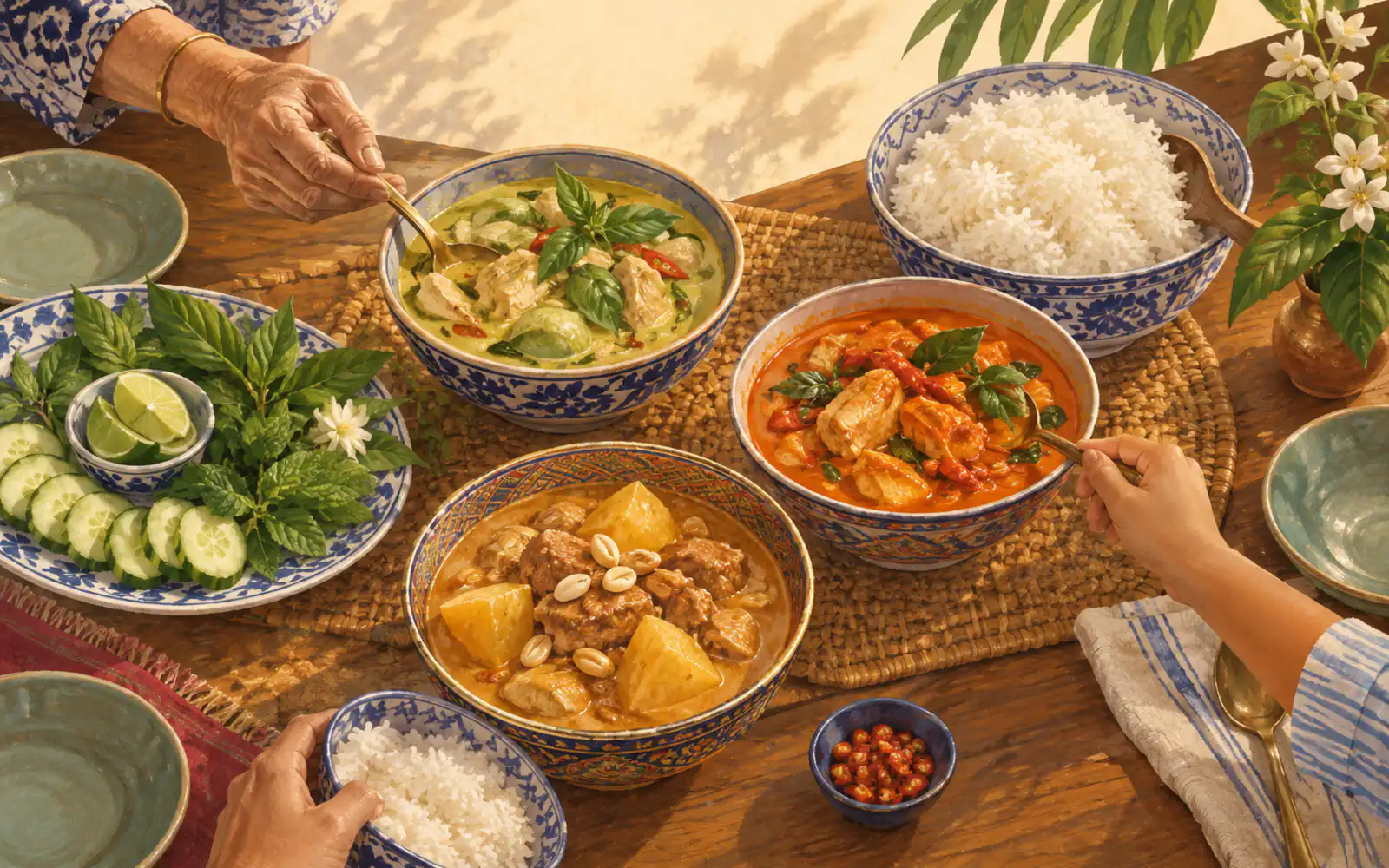
You ordered “red curry” at a restaurant abroad and it was lovely, and it was not the curry your mum makes. That’s normal. Thai curry isn’t one dish in five colours. Each one starts from its own paste, and every family has its own idea of how that paste should taste.
Here’s the short version of how they differ, and the longer version of why.
What is the difference between massaman, red and yellow curry?
The difference is in the paste, and in the spices that go into it.
- Red curry (kaeng phet, literally “spicy curry”) is built on dried red chillies, pounded with garlic, shallots, galangal, lemongrass and shrimp paste. It’s the all-rounder: herbal, salty, with real heat.
- Yellow curry (kaeng kari) is the Indian-influenced one. Turmeric gives the colour, and cumin, coriander and fenugreek give the warmth. It has less chilli, so it’s generally milder, and it very often comes with potatoes.
- Massaman adds spices that came from South Asia and the Malay Archipelago, such as cumin, cinnamon, mace and bay leaf, alongside coriander seed and the usual Thai aromatics. The MICHELIN Guide describes its heat as “a gentle piquancy tempered by coconut milk”, with sweet, sour, salty and spicy all in balance. Potatoes and onions go in the pot.
So if you want heat, red. If you want gentle and golden, yellow. If you want cinnamon and slow-cooked comfort, massaman.
How do the six main Thai curries compare?
A rough guide. Heat depends on the cook more than the colour, so treat the middle column as “usually”, not a promise.
| Curry | What drives the paste | Coconut? | Usually |
|---|---|---|---|
| Green (kaeng khiao wan) | Fresh green chillies, with Thai basil and Thai eggplant in the pot | Yes | Hotter than red |
| Red (kaeng phet) | Dried red chillies, galangal, lemongrass, shrimp paste | Yes | Medium |
| Yellow (kaeng kari) | Turmeric, cumin, coriander, fenugreek; less chilli | Varies by cook | Mild |
| Massaman | Dried chillies plus cumin, cinnamon, mace, bay leaf | Yes | Mild |
| Panang (phanaeng) | Dried chillies, makrut lime; thick and creamy | Yes, cream | Mild |
| Jungle (kaeng pa) | Paste plus whatever grows nearby | Usually not | Very hot |
Why does massaman taste so different?
Because it travelled further. The MICHELIN Guide’s 2026 piece on the dish says its name comes from musulman, a now-archaic English term for Muslims, and that ingredients like cumin, mace, bay leaf, onions and potatoes point to the trade routes of the Indian Ocean. Where exactly it was first cooked is still open: some scholars point to the Andaman Coast, others to the elite kitchens of Ayutthaya. By the turn of the 19th century it was well known in the royal household and appears in a poem from the court of King Rama II.
That history explains the taste: a Thai curry paste and a spice-route pantry in the same pot. Today it is usually made with beef or chicken, and only rarely with pork, according to the same article.
One detail we like from the same article: massaman is “far from the most common curry” at Thai curry-and-rice shops, even though it’s a favourite with visitors. If your family hardly ever makes it, you’re in good company.
Is green curry hotter than red curry?
Often, though it varies by cook. Green curry’s colour comes from fresh green chillies, and it tends to be more pungent than the milder red curries. Its Thai name means “green sweet curry”, but the sweet describes the soft green colour, not the flavour, so don’t expect a mild one.
If you’re cooking for kids, or for a partner still building up their chilli tolerance, this is the phrase you’ll need at any stall:
เผ็ดน้อย
phet noi
เผ็ดน้อยครับ
phet noi khrap
เผ็ดน้อยค่ะ
phet noi kha
Not too spicy, please.
Literally: “spicy little”
Stall heat is real heat. เผ็ดน้อย asks for less; ไม่เผ็ด means no chilli at all.
Draft: waiting for a native speaker’s review.
What makes panang different?
Panang (phanaeng) is the thick one. The paste is cooked in coconut cream until the oil separates, so the sauce is thick and coats the meat instead of filling the bowl. Makrut lime leaves bring the fragrance. Wikipedia calls it milder and richer than red or green curry. The MICHELIN Guide calls it a rich, coconut-based curry influenced by Indian and Malay cooking. Where the name comes from is a theory, not a fact: some link it to Penang, others to the Malay word for “grilled”.
Is there a Thai curry without coconut milk?
Several. The first Thai dictionary, from 1873, defined kaeng simply as a watery dish eaten with rice, built on shrimp paste, shallots, chillies and garlic. No coconut. Jungle curry (kaeng pa) is the classic example: a highly spicy, watery curry of paste, water and whatever grows nearby (traditionally without coconut, though some versions add it). The sour kaeng som is another. The MICHELIN Guide lists the southern version among its spicy must-try dishes, calls it “potently hot”, and notes it is also known as gaeng leung, yellow curry. (Yes, that’s a second “yellow curry”. Ask which one your family means.)
The regional picture is in our guide to Thai food by region.
Should you make the paste or buy a jar?
Honestly: both are fine, for different days.
Homemade is a mortar, a pestle and an afternoon. The MICHELIN Guide’s panang recipe makes its paste from scratch and says fresh paste gives “a more fragrant aroma and vibrant flavor”. If your family pounds its own, the sound of that mortar is probably part of your childhood.
A jar or a packet is how plenty of home cooks get dinner on the table on a Tuesday. Nobody needs to feel bad about it. Cook the paste in coconut cream until it smells fragrant and the oil starts to separate, then season at the end with fish sauce and palm sugar until it tastes the way you remember. That last step is where the family flavour lives, whatever paste you started with.
Shopping abroad? Our guide to finding Thai ingredients covers galangal, makrut lime and the honest substitutes.
Which curry does your family make?
Ask. It’s one of the best questions you can put to Yai, because the answer usually comes with a story: which market she bought the paste at, whether her mother pounded her own, why there are potatoes in it (or why there absolutely aren’t).
Then offer to help. The first curry you learn from family is the one you’ll cook for the rest of your life:
มีอะไรให้ช่วยไหม
mii a-rai hai chuai mai
มีอะไรให้ช่วยไหมครับ
mii a-rai hai chuai mai khrap
มีอะไรให้ช่วยไหมคะ
mii a-rai hai chuai mai kha
Anything I can help with?
Literally: “have what let help question”
The everyday offer in any Thai kitchen. Add ป้า at the end to make it hers.
Draft: waiting for a native speaker’s review.
If she lives far away, a video call works: prop the phone by the stove and let her talk you through it. Our video call with Yai phrases help, and for the dishes beyond curry, see cook the Thai food you grew up with.
And when the pot is done, tell the cook:
ไม่มีใครทำอร่อยเท่ายาย
mai mii khrai tham a-roi thao yaai
Nobody cooks like you, Yai.
Literally: “not have who make delicious equal grandma”
The big compliment. Works for mum too: ไม่มีใครทำอร่อยเท่าแม่.
Draft: waiting for a native speaker’s review.
Practise the family dinner
The Family meals moment in Reply Thai has the replies you’ll want around a curry pot: offering to help, asking for more, “not too spicy”, and the compliment every cook is waiting for.
Thai words on this page are a draft until a native speaker has reviewed them.
Questions people ask
What is the difference between massaman and red curry?
Red curry paste is built on dried red chillies with garlic, shallots, galangal, lemongrass and shrimp paste, so it is more herbal. Massaman adds warm spices that came from South Asia and the Malay Archipelago, such as cumin, cinnamon, mace and bay leaf, and the MICHELIN Guide describes its chilli heat as mild, a gentle piquancy tempered by coconut milk.
Is massaman curry the same as yellow curry?
No. Both are mild and often come with potatoes, but yellow curry (kaeng kari) is coloured and flavoured by turmeric and Indian-style spices like cumin and coriander, while massaman leans on cinnamon, mace and bay leaf, and balances sweet, sour, salty and gently spicy.
Which Thai curry is the mildest?
Massaman, yellow and panang are generally the milder ones, and green and jungle curry tend to be hotter. But heat depends on how much and which chilli goes into the paste, so the same curry can be gentle in one kitchen and fierce in the next.
Does green curry mean it is sweet?
Not really. Its Thai name, kaeng khiao wan, means “green sweet curry”, but the “sweet” describes the soft shade of green. Fresh green chillies give it its colour, and it tends to be more pungent than red curry.
Do all Thai curries have coconut milk?
No. The 1873 Thai dictionary defined kaeng as a watery dish eaten with rice, and coconut milk was not part of that. Jungle curry (kaeng pa) and sour curry (kaeng som) are usually made without it.
Sources
All links read on .
- MICHELIN Guide Thailand: Iconic dishes, what is massaman curry? (Andrew Fowler, 22 January 2026)
- MICHELIN Guide Thailand: How to make Thai beef panang curry like a MICHELIN restaurant (21 August 2026)
- MICHELIN Guide Thailand: The spicier the better, 6 spicy Thai dishes you must try (28 June 2019)
- Wikipedia: Thai curry (background, read 14 October 2026)
- Wikipedia: Massaman curry (background, read 14 October 2026)
- Wikipedia: Green curry (background, read 14 October 2026)
- Wikipedia: Red curry (background, read 14 October 2026)
- Wikipedia: Yellow curry (background, read 14 October 2026)
- Wikipedia: Phanaeng (background, read 14 October 2026)
- Wikipedia: Kaeng pa (jungle curry, background, read 14 October 2026)
How we write and check our guidesReport a mistake
Letters from the in-between
One email when there’s something worth reading: new guides, stories from other luk khrueng, and a phrase for your next family call. No spam, ever.