Cook the Thai food you grew up with: 6 family dishes
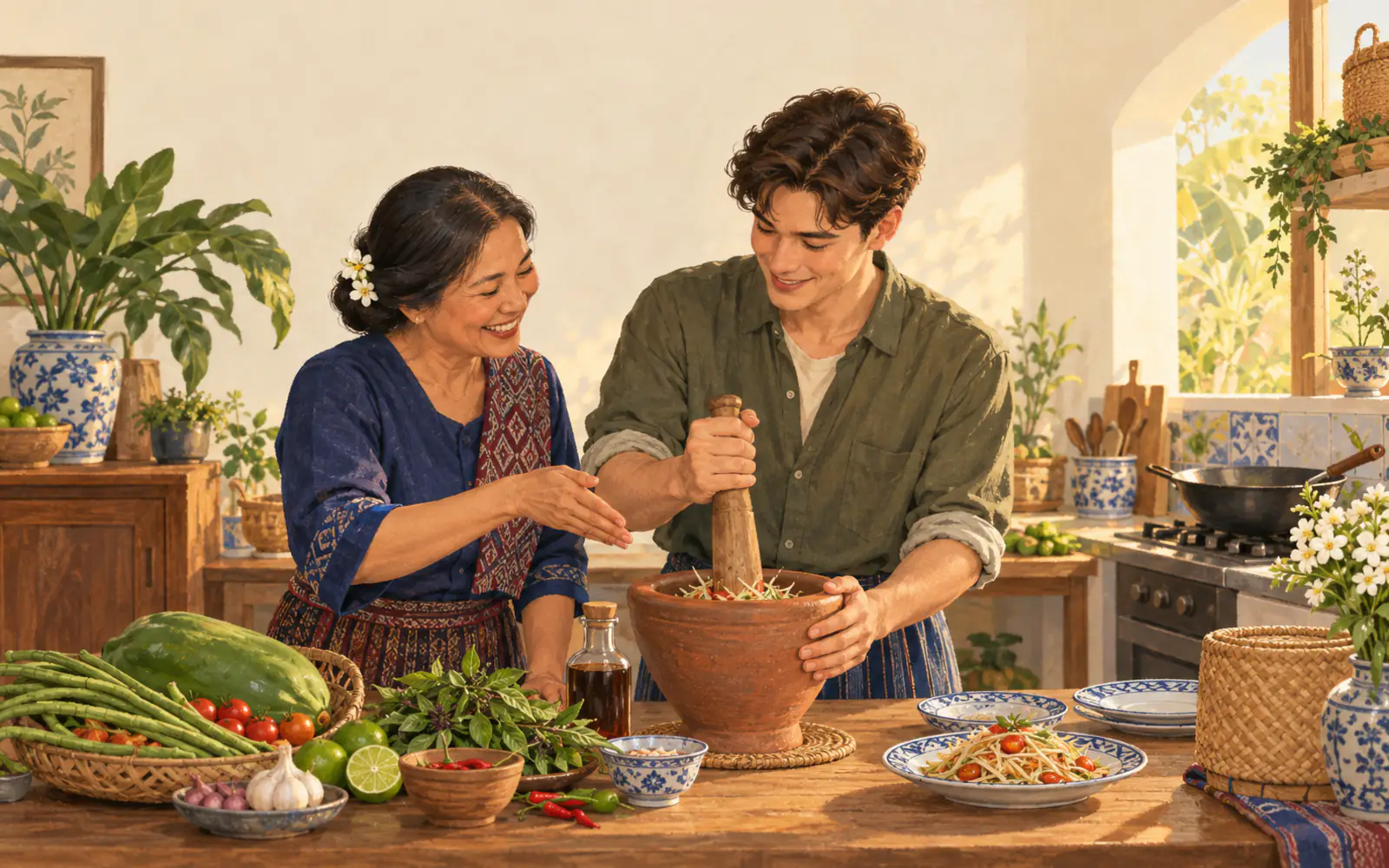
You can follow a recipe to the gram and it still won’t taste like home. Something is missing, and it usually isn’t an ingredient. It’s the order things go in, how hot the pan is, or the thing your mum does without thinking that never made it into any cookbook.
This guide covers six dishes that come up again and again in Thai families abroad. For each one: what it is, the technique that matters most, what families argue about, and how to get your own family’s version before it lives only in someone’s hands. It isn’t a recipe collection. We point to good sources for the measurements and keep the page for the parts recipes leave out.
What makes Thai home cooking taste like home?
Mostly balance and timing. The Tourism Authority of Thailand describes tom yum kung as famed for its “harmonious blend of hot, sour, salty, and sweet flavours”, and that balance runs through most Thai home cooking. Families get there by tasting as they go, not by measuring, which is why your mum’s answer to “how much fish sauce?” is so often “enough”.
How do you get tom yum right?
Tom yum is the hot and sour soup, and tom yum kung is the prawn version that UNESCO added to its heritage list in December 2024. Thailand’s government news office describes it as a dish of farming communities, “especially those along rivers and canals”.
The technique that matters: the herbs go in early, the sour goes in late. Lemongrass, galangal, makrut lime leaves and chillies are sliced, roughly pounded and simmered so the broth takes their flavour. Fish sauce and lime juice go in at the end, once the meat is cooked, because heat destroys their flavour. If your tom yum tastes dull, that’s the first thing to check.
What families argue about: clear or creamy. Nam sai is the clear broth. Nam khon is creamier, usually with prawns, with evaporated milk or non-dairy creamer stirred in at the end. Wikipedia dates the creamy style to the 1980s, which makes it younger than some of the people who insist it’s the only real one. And the herbs: plenty of families leave the lemongrass and galangal in the bowl as a flavour, not a food. Don’t eat them; many aren’t edible, and nobody will judge you if you push them to the side.
If tom yum is too sharp for the kids, ask for it the way a lot of family kitchens already do:
เผ็ดน้อย
phet noi
เผ็ดน้อยครับ
phet noi khrap
เผ็ดน้อยค่ะ
phet noi kha
Not too spicy, please.
Literally: “spicy little”
Stall heat is real heat. เผ็ดน้อย asks for less; ไม่เผ็ด means no chilli at all.
Draft: waiting for a native speaker’s review.
Pad kra pao: holy basil or Thai basil?
Pad kra pao is a fast stir-fry of meat or seafood with holy basil, garlic and chilli, served over rice, often with a fried egg on top. Wikipedia calls it one of the most popular dishes in Thailand and says it only became widely popular after 1957, which surprises people who assumed it was ancient.
The technique that matters: a very hot pan and speed. Garlic and chilli go in first (some cooks pound them together), then the meat, the sauce, and the basil right at the end so it wilts rather than stews. The egg is fried hard and fast in plenty of oil, so the edges go crisp and lacy while the yolk stays soft.
What families argue about:
- The basil. Kaphrao is holy basil, and it’s the dish’s name. Thai basil (horapha) is a different herb with its own dishes. Thailand has red and white holy basil; the red one is more pungent. Abroad you may only find Thai basil. Use it, enjoy it, and expect someone at the table to point out that it isn’t kra pao.
- The vegetables. Long beans or baby corn in kra pao is a live debate. Wikipedia notes vegetables crept in over time, partly to make the meat go further. Your family has an opinion; ask what it is.
- The egg. Technically optional. Try telling that to your family.
If finding holy basil is the hard part, our guide to Thai ingredients abroad covers where to look and what to swap.
Khao man gai: why is the rice the hard part?
Khao man gai is chicken on rice, with a sauce and a bowl of clear broth on the side. It’s Thailand’s version of Hainanese chicken rice; the Tourism Authority of Thailand traces it to Hainanese chicken rice and calls the sauce the Thai twist. If your family is Thai-Chinese, this may be the most “home” dish on the list; our Chinese New Year in Thai-Chinese families page has more on those roots.
The technique that matters: the rice. The Thai name means roughly “chicken oily rice”, and that’s the clue: the rice should taste of chicken, not just sit under it. How your family gets there (which fat, which stock, how much garlic and ginger) is exactly the question to ask. Plain rice with chicken on top is a nice lunch, but it isn’t khao man gai.
The sauce: usually fermented yellow soybean paste with ginger, garlic, chilli, thick soy sauce and vinegar. TAT describes it as “a spicy, fermented soybean sauce with ginger and garlic”. Families tune it hard: more ginger, more chilli, a bit more sweet. This is the part to ask about, because it’s the part your family will have changed.
What families argue about: skin on or off, and whether the broth comes with daikon (Wikipedia says it often does).
Som tam: Thai style or Lao style?
Som tam is green papaya salad, pounded in a mortar so the papaya bruises and drinks the dressing. The MICHELIN Guide describes it as “lovingly pounded in a traditional mortar and pestle”, and the word tam itself refers to the pounding.
The technique that matters: pound, don’t smash. Garlic and chilli first, then the papaya and the rest, turned with a spoon as you go so it’s seasoned all through. A blender or a bowl and fork won’t give you the same texture.
What families argue about: which som tam. Green papaya salad is generally believed to have been created by Lao people, and it spread through the rest of Thailand from Isan, the northeast. Central Thai versions tend to be sweeter, often with peanuts and dried shrimp. Lao and Isan versions may add fermented fish (pla ra) or brined crab. If your mum is from Isan, her som tam is the original. If she’s from Bangkok, hers is the original too. Don’t get involved. For more on how regions shape what’s on the table, see Thai food by region.
Massaman: why does it taste of cinnamon?
Massaman is one of the milder, warmer Thai curries, with potatoes and onions and usually beef or chicken in coconut milk. The MICHELIN Guide says its name comes from musulman, a now-archaic English term for Muslims. Cinnamon is part of its flavour, and ingredients such as cumin, mace and bay leaf point to the trade routes of the Indian Ocean. Where exactly it started is still debated: some scholars point to the Andaman Coast, others to the kitchens of Ayutthaya. Pork is rare in massaman.
The technique that matters: fry the paste in coconut cream until it’s fragrant and the fat separates, before anything else goes in. Then a long, slow simmer, so the meat goes tender and the potatoes soak up the sauce.
What families argue about: jar paste or homemade. Plenty of good cooks use a jar. Ask Yai whether she ever pounded her own; it’s a good story either way. How massaman compares with red, green and yellow curry is in Thai curries explained.
Mango sticky rice: what makes it so good?
Glutinous rice, soaked and steamed, mixed with sweetened, salted coconut milk, served with ripe mango and more coconut milk on top. Sometimes there are crispy yellow mung beans. In Thailand it’s eaten mostly in peak mango season, April and May, which for many families lines up with a Songkran trip.
The technique that matters: the coconut milk is heated with sugar and salt but not boiled, then mixed into the cooked rice and left to sit so it soaks in. The salt is the secret; without it, it’s just sweet.
What families argue about: which mango (it has to be properly ripe), and whether it’s really a dessert or a reasonable lunch. More sweets your family might make are in Thai desserts.
How do you get your family’s version before it’s lost?
Recipes online can get you close. Only your family can get you home. A few ways that work:
Cook next to her. The best way to learn is to stand in the kitchen and be useful. Start with this:
มีอะไรให้ช่วยไหม
mii a-rai hai chuai mai
มีอะไรให้ช่วยไหมครับ
mii a-rai hai chuai mai khrap
มีอะไรให้ช่วยไหมคะ
mii a-rai hai chuai mai kha
Anything I can help with?
Literally: “have what let help question”
The everyday offer in any Thai kitchen. Add ป้า at the end to make it hers.
Draft: waiting for a native speaker’s review.
Film it on a video call. If your mum or Yai is far away, prop the phone on the counter and let her talk you through it while you cook. Ask her to show you how much, not tell you. Save the video. One day it will matter more than any recipe. Our video call with Yai page has the Thai for the call itself.
Taste together and say so. When it comes out right (or right enough), the cook deserves to hear it:
ไม่มีใครทำอร่อยเท่ายาย
mai mii khrai tham a-roi thao yaai
Nobody cooks like you, Yai.
Literally: “not have who make delicious equal grandma”
The big compliment. Works for mum too: ไม่มีใครทำอร่อยเท่าแม่.
Draft: waiting for a native speaker’s review.
Accept the third helping, gently. When you’re the one being fed:
ขอนิดเดียวพอ
khor nit diao phor
ขอนิดเดียวพอครับ
khor nit diao phor khrap
ขอนิดเดียวพอค่ะ
khor nit diao phor kha
Just a little, please.
Literally: “ask-for tiny-bit enough”
The middle way: you accept her offer, but only a spoonful. Elders love this one.
Draft: waiting for a native speaker’s review.
Write it down in her words. Not “500 g”, but “a handful, until it smells like this”. That’s the recipe your kids will want.
Where can you find good recipes to start from?
For measurements, a cook who explains the why helps more than a long ingredient list. One place to start is Pailin’s Kitchen on YouTube; search it for the dish you want. The Wikipedia articles on tom yum, pad kra pao, khao man gai, som tam, massaman and mango sticky rice are good background reading on where each one comes from. Then cook it once by the recipe, once with your mum on the phone, and keep the second version.
Practise the family meal, not just the dish
The Family meals moment in Reply Thai is the other half of cooking Thai: the phrases for helping in the kitchen, praising the cook, saying “just a little” and asking for more, practised as replies so they come out easily at the table. It pairs with have you eaten yet?, the greeting that starts most Thai meals.
Thai words on this page are a draft until a native speaker has reviewed them.
Questions people ask
Should pad kra pao use holy basil or Thai basil?
Holy basil. Kaphrao is holy basil, and it gives the dish its name. Thai basil (horapha) is a different herb with its own dishes. If you can only find Thai basil, the result is still good food, just not quite kra pao.
What is the difference between clear and creamy tom yum?
Tom yum nam sai is the clear broth. Tom yum nam khon is the creamy style, usually with prawns, where evaporated milk or non-dairy creamer is stirred in at the end. Wikipedia dates the creamy style to the 1980s.
Is tom yum on the UNESCO heritage list?
Yes. Tom Yum Kung, the prawn version, was inscribed on UNESCO’s Representative List of the Intangible Cultural Heritage of Humanity in December 2024, according to Thailand’s Public Relations Department and the Tourism Authority of Thailand.
What is the sauce served with khao man gai?
Khao man gai, Thailand’s version of Hainanese chicken rice, comes with a sauce usually built on fermented yellow soybean paste with ginger, garlic and chilli. The Tourism Authority of Thailand calls that spicy fermented soybean sauce the Thai twist on the dish.
Is som tam Thai or Lao?
Both, in a way. Green papaya salad is generally believed to have been created by Lao people, and it spread through the rest of Thailand from Isan, the northeast. Central Thai versions tend to be sweeter, often with peanuts and dried shrimp; Lao and Isan styles may add fermented fish (pla ra) or brined crab.
Sources
All links read on .
- Tourism Authority of Thailand (TAT Newsroom): UNESCO recognition for Tomyum Kung and Kebaya (11 December 2024)
- Thailand Public Relations Department: Tom Yum Kung inscribed as UNESCO’s Intangible Cultural Heritage of Humanity (6 December 2024)
- TAT Newsroom: Silk Road on a Thai plate, Chinese heritage in Thai food (16 February 2026)
- MICHELIN Guide Thailand: The spicier the better, 6 spicy Thai dishes you must try (28 June 2019)
- Wikipedia: Tom yum (clear and creamy styles, when to add lime and fish sauce), read 2026-10-14
- Wikipedia: Phat kaphrao (holy basil stir-fry, history, add-ins), read 2026-10-14
- Wikipedia: Ocimum tenuiflorum (holy basil, red and white kaphrao, not horapha), read 2026-10-14
- MICHELIN Guide Thailand: Iconic dishes, what is massaman curry? (Andrew Fowler, 22 January 2026)
- Wikipedia: Hainanese chicken rice (khao man kai in Thailand, sauce, broth), read 2026-10-14
- Wikipedia: Green papaya salad (pounding, Lao and Isan roots, Central Thai style), read 2026-10-14
- Wikipedia: Massaman curry (name, origin theories, spices), read 2026-10-14
- Wikipedia: Mango sticky rice (method in outline, season), read 2026-10-14
- Pailin’s Kitchen (YouTube channel), read 2026-10-14
How we write and check our guidesReport a mistake
Letters from the in-between
One email when there’s something worth reading: new guides, stories from other luk khrueng, and a phrase for your next family call. No spam, ever.